







Question: Hello, I need help with this problem, please. Any help is appreciated. Thank you! Liang Company began operations in Year 1. During its first two
Hello, I need help with this problem, please. Any help is appreciated. Thank you!
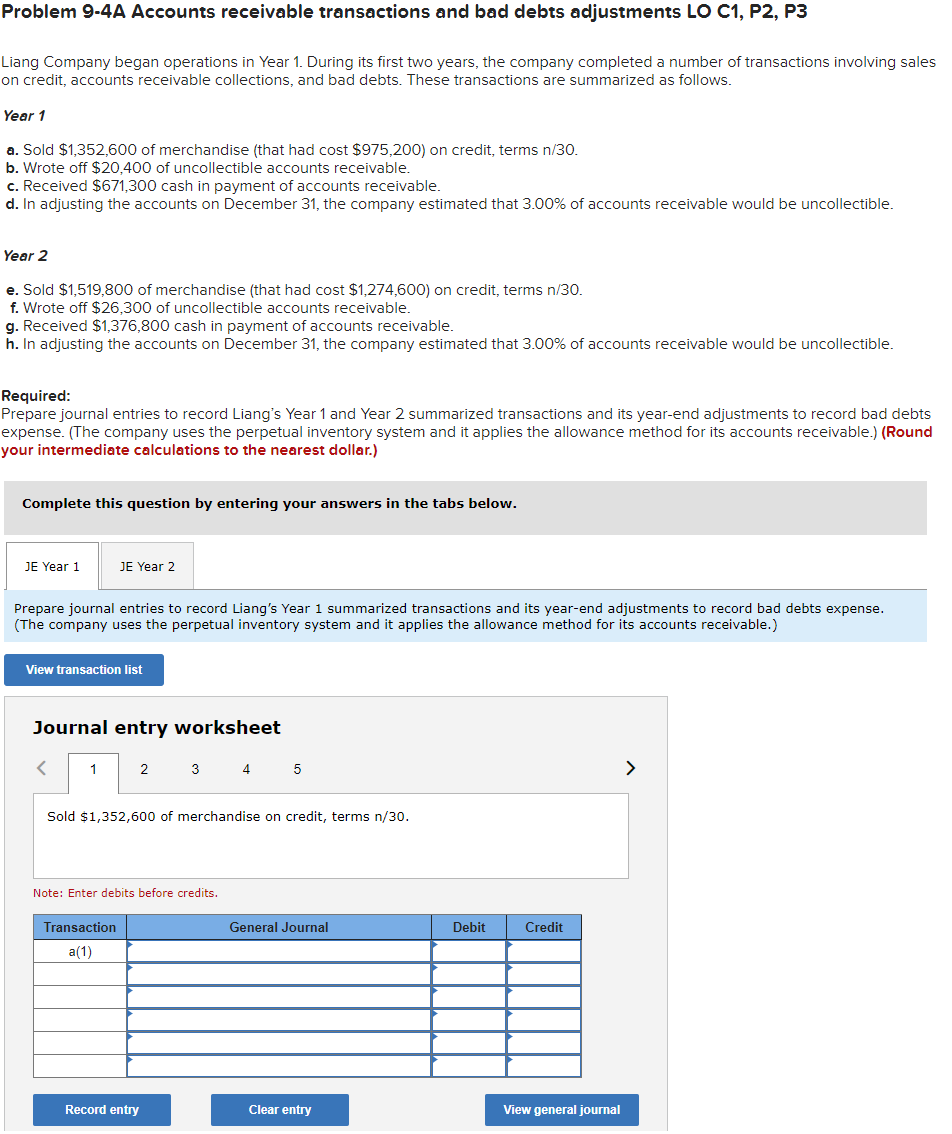
Liang Company began operations in Year 1. During its first two years, the company completed a number of transactions involving sales on credit, accounts receivable collections, and bad debts. These transactions are summarized as follows. Year 1 a. Sold $1,352,600 of merchandise (that had cost $975,200 ) on credit, terms n/30. b. Wrote off $20,400 of uncollectible accounts receivable. c. Received $671,300 cash in payment of accounts receivable. d. In adjusting the accounts on December 31 , the company estimated that 3.00% of accounts receivable would be uncollectible. Year 2 e. Sold $1,519,800 of merchandise (that had cost $1,274,600 ) on credit, terms n/30. f. Wrote off $26,300 of uncollectible accounts receivable. g. Received $1,376,800 cash in payment of accounts receivable. h. In adjusting the accounts on December 31 , the company estimated that 3.00% of accounts receivable would be uncollectible. Required: Prepare journal entries to record Liang's Year 1 and Year 2 summarized transactions and its year-end adjustments to record bad debts expense. (The company uses the perpetual inventory system and it applies the allowance method for its accounts receivable.) (Round your intermediate calculations to the nearest dollar.) Complete this question by entering your answers in the tabs below. Prepare journal entries to record Liang's Year 1 summarized transactions and its year-end adjustments to record bad debts expense. (The company uses the perpetual inventory system and it applies the allowance method for its accounts receivable.) Journal entry worksheet Note: Enter debits betore credits
Step by Step Solution
There are 3 Steps involved in it

Get step-by-step solutions from verified subject matter experts
 Study Help