







Question: Hello, I need some help understanding this worksheet. It is about Economics and Ethics. The first attached picture is an overview to help answer the
Hello, I need some help understanding this worksheet. It is about Economics and Ethics. The first attached picture is an overview to help answer the question, the third picture is the part I need help with. NO NEED TO ANSWER QUESTIONS 16-19. Thank you
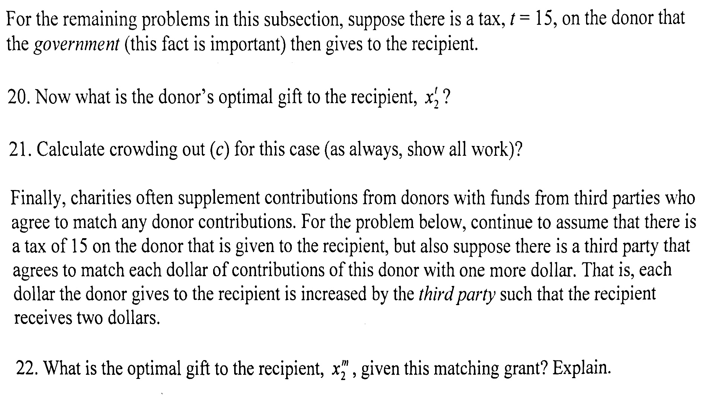
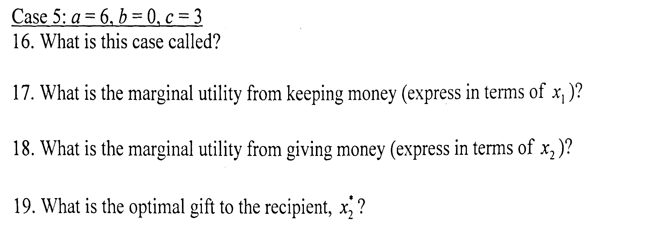
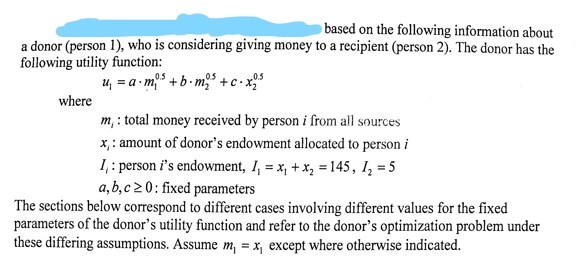
For the remaining problems in this subsection, suppose there is a tax, r = 15, on the donor that the government (this fact is important) then gives to the recipient. 20. Now what is the donor's optimal gift to the recipient, x; '2' 21. Calculate crowding not {C} for this case (as always, show all work)? Finally, charities oen supplement contributions from donors with funds from third parties who agree to match any donor contributions. For the problem below, continue to assume that there is a tax of 15 on the donor that is given to the recipient, but also suppose there is a third party that agrees to match each dollar of contributions of this donor with one more dollar. That is, each dollar the donor gives to the recipient is increased by the thirdparox such that the recipient receives two dollars. 22. What is the optimal gift to the recipient, x: , given this matching grant? Explain. Case 5:a=6 b=0 c=3 1-5. What is this case called? 17. What is the marginal utilityr from keeping money (express in terms of x, )? 13. What is the marginal utility from giving money [express in terms of it2 )? 19. What is the optimal gift to the recipient, x; ? based on the following information about a donor (person 1), who is considering giving money to a recipient (person 2). The donor has the following utility function: 1 =am, +b m,'+c . x, where m, : total money received by person i from all sources x : amount of donor's endowment allocated to person i 1, : person i's endowment, I = x, + x, = 145, 1, = 5 a, b, c 2 0: fixed parameters The sections below correspond to different cases involving different values for the fixed parameters of the donor's utility function and refer to the donor's optimization problem under these differing assumptions. Assume m, = x except where otherwise indicated
Step by Step Solution
There are 3 Steps involved in it

Get step-by-step solutions from verified subject matter experts
 Study Help