







Question: Hello, I only need help for d) e), Please answer d) e)! Thank you! 5. Barry can work 3120 hours in a (non-leap) year. He
 Hello,
I only need help for d) e), Please answer d) e)!
Thank you!
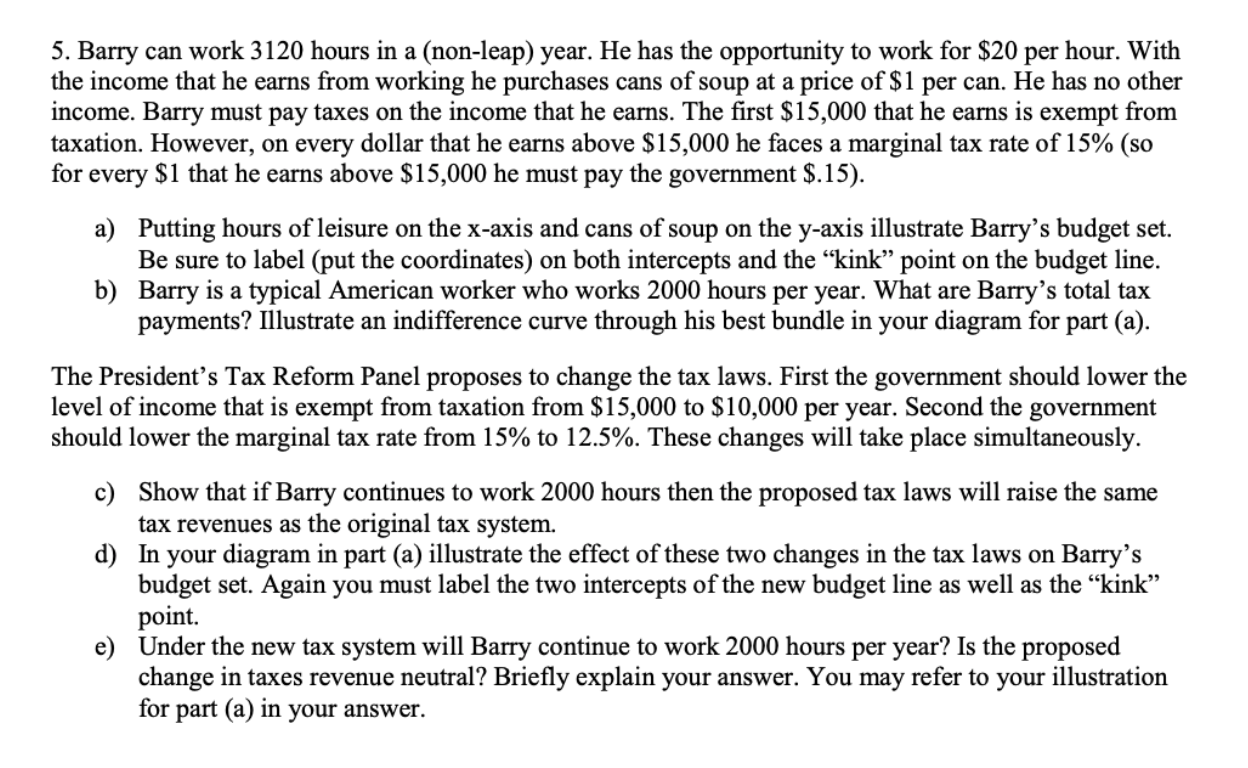
5. Barry can work 3120 hours in a (non-leap) year. He has the opportunity to work for $20 per hour. With the income that he earns from working he purchases cans of soup at a price of $1 per can. He has no other income. Barry must pay taxes on the income that he earns. The first $15,000 that he earns is exempt from taxation. However, on every dollar that he earns above $15,000 he faces a marginal tax rate of 15% (so for every $1 that he earns above $15,000 he must pay the government $.15). a) Putting hours of leisure on the x-axis and cans of soup on the y-axis illustrate Barry's budget set. Be sure to label (put the coordinates) on both intercepts and the kink point on the budget line. b) Barry is a typical American worker who works 2000 hours per year. What are Barry's total tax payments? Illustrate an indifference curve through his best bundle in your diagram for part (a). The President's Tax Reform Panel proposes to change the tax laws. First the government should lower the level of income that is exempt from taxation from $15,000 to $10,000 per year. Second the government should lower the marginal tax rate from 15% to 12.5%. These changes will take place simultaneously. c) Show that if Barry continues to work 2000 hours then the proposed tax laws will raise the same tax revenues as the original tax system. d) In your diagram in part (a) illustrate the effect of these two changes in the tax laws on Barry's budget set. Again you must label the two intercepts of the new budget line as well as the kink point. e) Under the new tax system will Barry continue to work 2000 hours per year? Is the proposed change in taxes revenue neutral? Briefly explain your answer. You may refer to your illustration for part (a) in your answer. 5. Barry can work 3120 hours in a (non-leap) year. He has the opportunity to work for $20 per hour. With the income that he earns from working he purchases cans of soup at a price of $1 per can. He has no other income. Barry must pay taxes on the income that he earns. The first $15,000 that he earns is exempt from taxation. However, on every dollar that he earns above $15,000 he faces a marginal tax rate of 15% (so for every $1 that he earns above $15,000 he must pay the government $.15). a) Putting hours of leisure on the x-axis and cans of soup on the y-axis illustrate Barry's budget set. Be sure to label (put the coordinates) on both intercepts and the kink point on the budget line. b) Barry is a typical American worker who works 2000 hours per year. What are Barry's total tax payments? Illustrate an indifference curve through his best bundle in your diagram for part (a). The President's Tax Reform Panel proposes to change the tax laws. First the government should lower the level of income that is exempt from taxation from $15,000 to $10,000 per year. Second the government should lower the marginal tax rate from 15% to 12.5%. These changes will take place simultaneously. c) Show that if Barry continues to work 2000 hours then the proposed tax laws will raise the same tax revenues as the original tax system. d) In your diagram in part (a) illustrate the effect of these two changes in the tax laws on Barry's budget set. Again you must label the two intercepts of the new budget line as well as the kink point. e) Under the new tax system will Barry continue to work 2000 hours per year? Is the proposed change in taxes revenue neutral? Briefly explain your answer. You may refer to your illustration for part (a) in your
Step by Step Solution
There are 3 Steps involved in it

Get step-by-step solutions from verified subject matter experts
 Study Help