







Question: Hello, may I get help with the questions and graph, please? I have already filled out the data below. I have attached the procedure as
Hello, may I get help with the questions and graph, please? I have already filled out the data below. I have attached the procedure as well...This is A Radioactive Decay Assignment
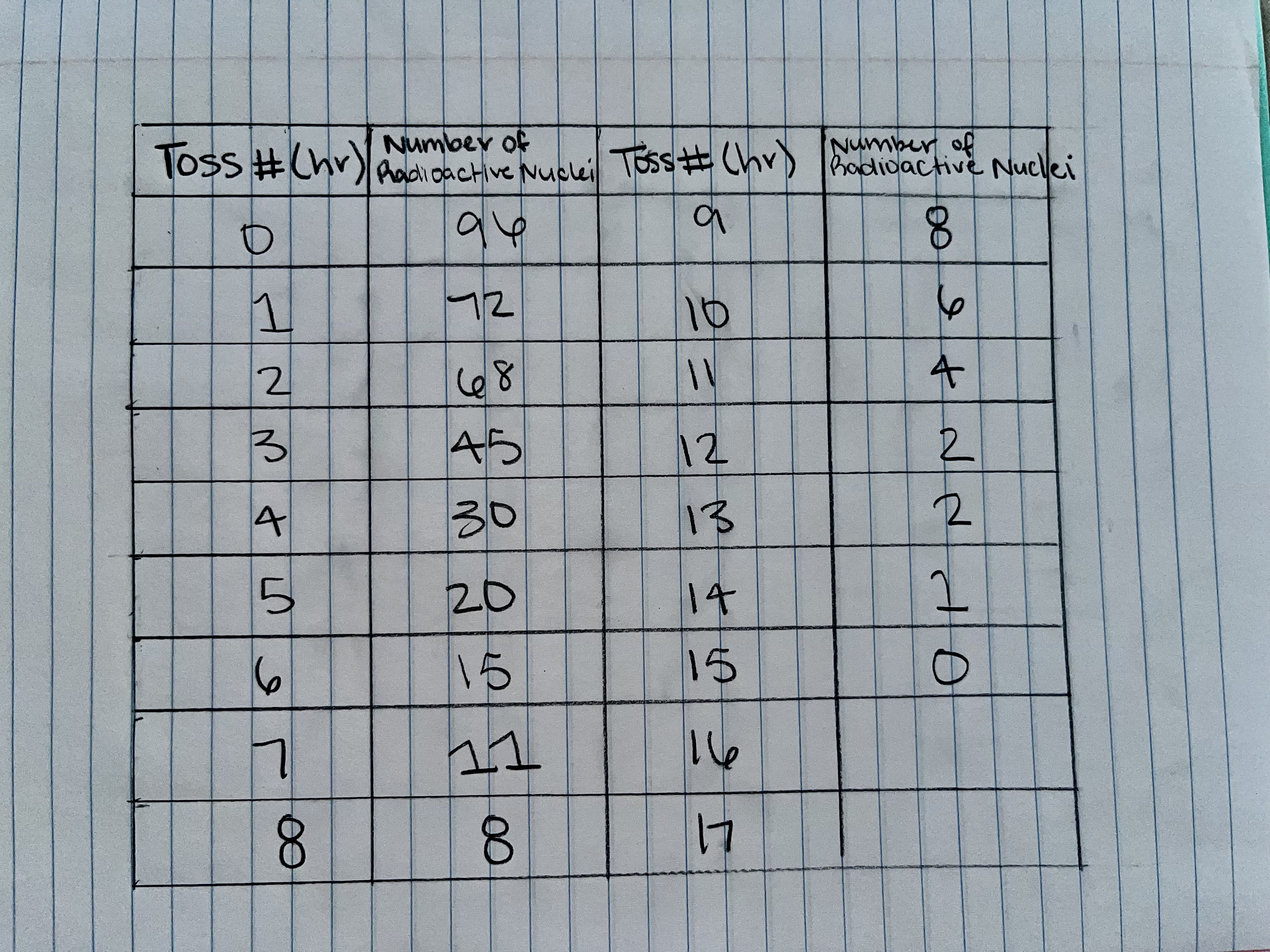
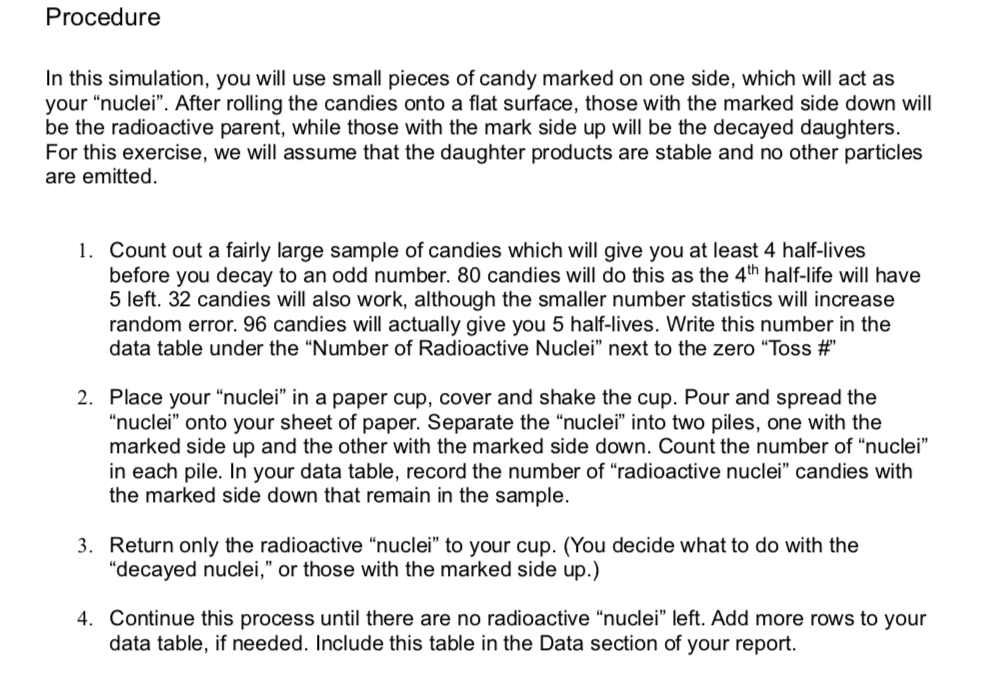
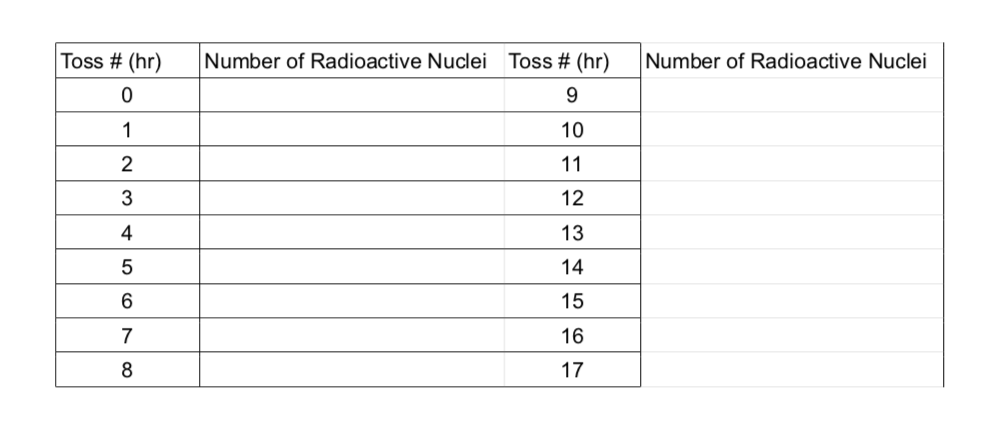
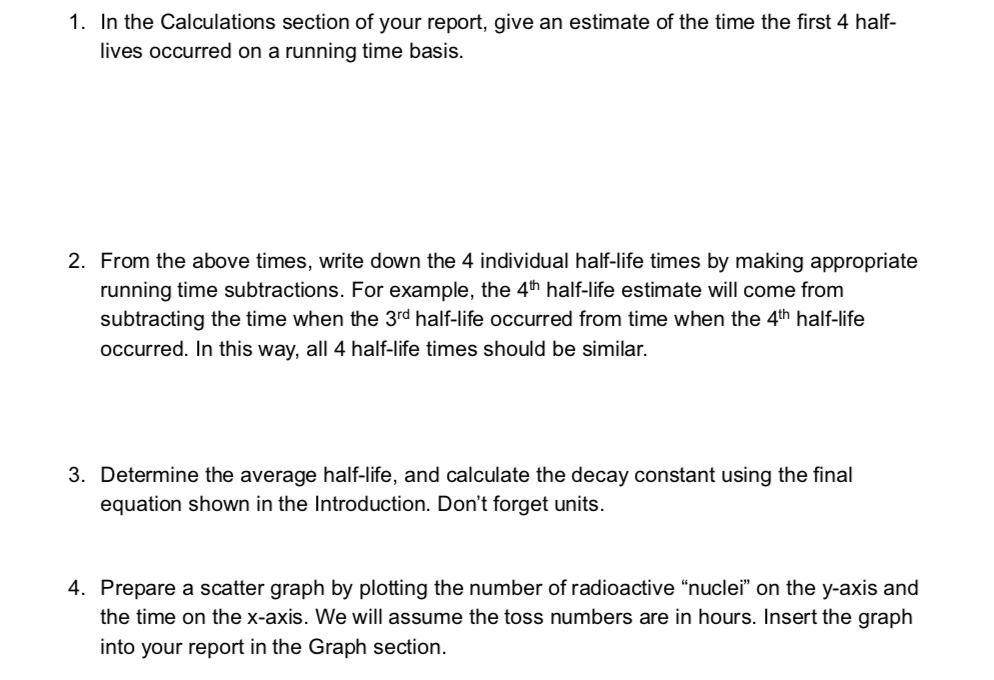
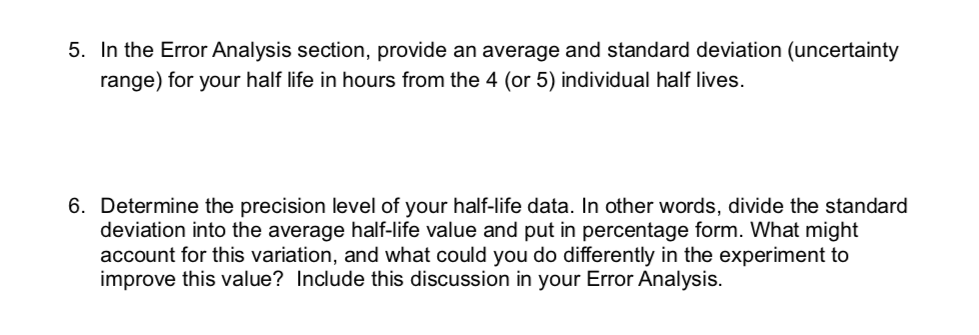
Toss # (hr) Number of Radioactive Nuclei/ Toss # (hr)) Number of Radioactive Nuclei -72 10 6 60 8 11 45 12 30 13 20 14 15 15 11 8 17Procedure In this simulation. you will use small pieces of candy marked on one side. which will act as your "nuclei". After rolling the candies onto a flat surface. those with the marked side down will be the radioactive parent. while those with the mark side up will be the decayed daughters. For this exercise. we will assume that the daughter products are stable and no other particles are emitted. 1. Count out a fairly large sample of candies which will give you at least 4 half-lives before you decay to an odd number. 80 candies will do this as the 4'\" half-life will have 5 left. 32 candies will also work. although the smaller number statistics will increase random error. 96 candies will actually give you 5 half-lives. Write this number in the data table under the "Number of Radioactive Nuclei" next to the zero \"Toss #" Place your "nuclei" in a paper cup, cover and shake the cup. Four and spread the \"nuclei" onto your sheet of paper. Separate the "nuclei" into two piles. one with the marked side up and the other with the marked side down. Count the number of "nuclei" in each pile. In your data table. record the number of "radioactive nuclei" candies with the marked side down that remain in the sample. . Return only the radioactive "nuclei" to your cup. (You decide what to do with the "decayed nuclei." or those with the marked side up.) Continue this process until there are no radioactive "nuclei" left. Add more rows to your data table. if needed. Include this table in the Data section of your report. Toss # (hr) Number of Radioactive Nuclei Toss # (hr) Number of Radioactive Nuclei D M \"403011:- \" _ n - n -_ 1. In the Calculations section of your report, give an estimate of the time the rst 4 half- lives occurred on a running time basis. 2. From the above times, write down the 4 individual half-life times by making appropriate running time subtractions. For example, the 4'\" half-life estimate will come from subtracting the time when the 3rd half-life occurred from time when the 4'\" half-life occurred. In this way, all 4 half-life times should be similar. 3. Determine the average half-life, and calculate the decay constant using the nal equation shown in the Introduction. Don't forget units. 4. Prepare a scatter graph by plotting the number of radioactive "nuclei" on the y-axis and the time on the x-axis. We will assume the toss numbers are in hours. Insert the graph into your report in the Graph section. 5. In the Error Analysis sedion, provide an average and standard deviation (uncertainty range) for your half life in hours from the 4 (or 5) individual half lives. 6. Determine the precision level of your half-life data. In other words, divide the standard deviation into the average half-life value and put in percentage form. What might account for this variation, and what could you do differently in the experiment to improve this value? Include this discussion in your Error Analysis
Step by Step Solution
There are 3 Steps involved in it

Get step-by-step solutions from verified subject matter experts
 Study Help