







Question: Hello please help me to answer this. Thank you! Please don't submit plagia,,rized answer. Thanks 28. LO.2, LO.3 (Alternative cost management strategies; writing) In 1993,
Hello please help me to answer this. Thank you! Please don't submit plagia,,rized answer. Thanks
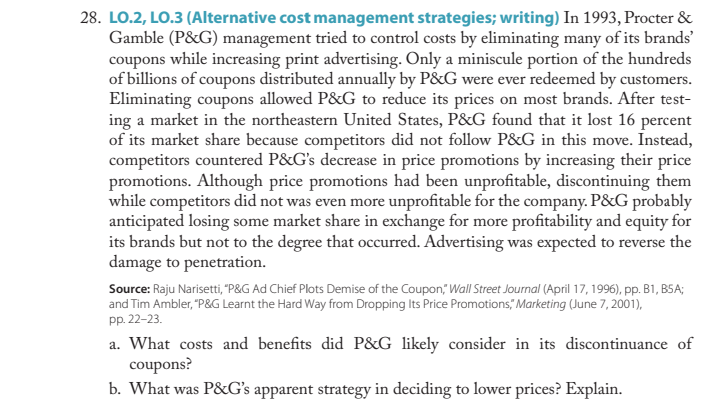
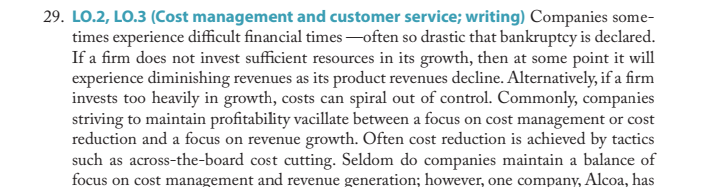
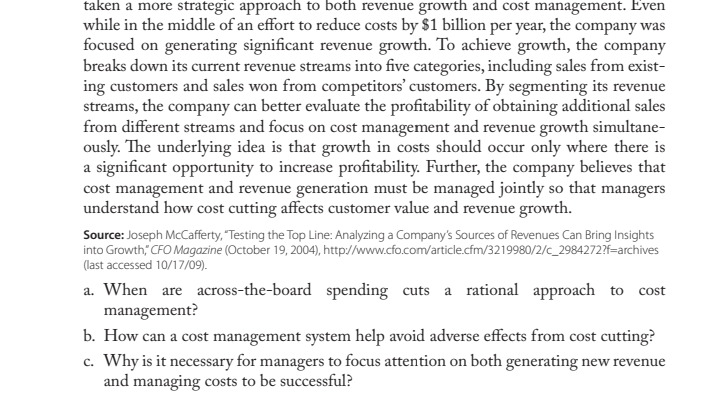
28. LO.2, LO.3 (Alternative cost management strategies; writing) In 1993, Procter & Gamble (P&G) management tried to control costs by eliminating many of its brands' coupons while increasing print advertising. Only a miniscule portion of the hundreds of billions of coupons distributed annually by P&G were ever redeemed by customers. Eliminating coupons allowed P&G to reduce its prices on most brands. After test- ing a market in the northeastern United States, P&G found that it lost 16 percent of its market share because competitors did not follow P&G in this move. Instead, competitors countered P&G's decrease in price promotions by increasing their price promotions. Although price promotions had been unprofitable, discontinuing them while competitors did not was even more unprofitable for the company. P&G probably anticipated losing some market share in exchange for more profitability and equity for its brands but not to the degree that occurred. Advertising was expected to reverse the damage to penetration. Source: Raju Narisetti, "P&G Ad Chief Plots Demise of the Coupon," Wall Street Journal (April 17, 1996), pp. B1, B5A; and Tim Ambler, "P&G Learnt the Hard Way from Dropping Its Price Promotions," Marketing (June 7, 2001), pp. 22-23. a. What costs and benefits did P&G likely consider in its discontinuance of coupons? b. What was P&G's apparent strategy in deciding to lower prices? Explain.29. LO.2, LO.3 (Cost management and customer service; writing) Companies some- times experience difficult financial times -often so drastic that bankruptcy is declared. If a firm does not invest sufficient resources in its growth, then at some point it will experience diminishing revenues as its product revenues decline. Alternatively, if a firm invests too heavily in growth, costs can spiral out of control. Commonly, companies striving to maintain profitability vacillate between a focus on cost management or cost reduction and a focus on revenue growth. Often cost reduction is achieved by tactics such as across-the-board cost cutting. Seldom do companies maintain a balance of focus on cost management and revenue generation; however, one company, Alcoa, hastaken a more strategic approach to both revenue growth and cost management. Even while in the middle of an effort to reduce costs by $1 billion per year, the company was focused on generating significant revenue growth. To achieve growth, the company breaks down its current revenue streams into five categories, including sales from exist- ing customers and sales won from competitors' customers. By segmenting its revenue streams, the company can better evaluate the profitability of obtaining additional sales from different streams and focus on cost management and revenue growth simultane- ously. The underlying idea is that growth in costs should occur only where there is a significant opportunity to increase profitability. Further, the company believes that cost management and revenue generation must be managed jointly so that managers understand how cost cutting affects customer value and revenue growth. Source: Joseph McCafferty, "Testing the Top Line: Analyzing a Company's Sources of Revenues Can Bring Insights into Growth,"CFO Magazine (October 19, 2004), http://www.cfo.com/article.cfm/3219980/2/c_2984272?f=archives (last accessed 10/17/09). a. When are across-the-board spending cuts a rational approach to cost management? b. How can a cost management system help avoid adverse effects from cost cutting? c. Why is it necessary for managers to focus attention on both generating new revenue and managing costs to be successful
Step by Step Solution
There are 3 Steps involved in it

Get step-by-step solutions from verified subject matter experts
 Study Help