







Question: Hello requesting assistance with this case study, I am Manager, Finance and Accounts. Please see attached Introduction The Dutch Railway system processes 1.3 million passengers
Hello requesting assistance with this case study, I am Manager, Finance and Accounts. Please see attached
Introduction
The Dutch Railway system processes 1.3 million passengers and more than a million
tons of cargo daily with high reliability and safety and a low CO2 profile. In the
coming 10 years, the daily number of trains will need to grow 30% to enable train
operators to deliver on the growing demand for Passenger and Cargo traffic. This
is a major challenge for the Dutch Railway infrastructure manager, ProRail Traffic
Control.
An obvious choice would be to change and grow the rail infrastructure
within the Netherlands. But growing the infrastructure would require a multi-billion
Euro investment and may take too much time and space in urban areas. So to meet
this growing demand, ProRail Traffic Control needs to invest in technologies that
make it possible to automate and digitize large parts of the now manual traffic
control process. This way the transportation capacity can be increased with the
current infrastructure. This case study will focus on the strategic workforce
challenges for the 700 Train Traffic Controllers and 150 operational planners
whose jobs will change tremendously because of this.
Where we stand now
In the past decades, the level of automation at ProRail Traffic Control has increased.
At the moment, the train schedule runs automatically if it fits into the pre-planned
train schedule. However, the core of technology like signalling and safety
systems has not had a fundamental upgrade in decades.
When the trains run as scheduled, the system requires minimal intervention by
operators. But in case of a disruption, a lot of manual actions are required of the
operators. This means all workstations are manned for handling disruption and result in
extremes in highs and lows in stress on the operators.
Planning for the future
To achieve the projected capacity growth for the Traffic Control business unit,
management and experts from the technical staff developed a 10-year vision on the
required changes together with IT and the scheduling department. As the means
of digitizing the traffic control process is central to this vision, it was dubbed Digital
Vision.
Digital Vision noted the following:
1. Business continuity: All workstations must be manned by a certified employee
at all times, so 24/7.
2. Re-schooling: European governments and national train management
companies decided to unify the technology of train safety management
to a European standard (ERTMS). This will require a re-schooling of large
numbers of people.
3. Turnover: Due to f i n a n c i a l co n s t r a i n t s , t h e nu m b e r of em p l o y e e s
r e q u i r e , f o r t h e di g i t i z a t i o n pr o c e s s e s , wi l l be r e d u c e d by 10 % .
However, it is anticipated that 30% of the workforce will be lost to retirement
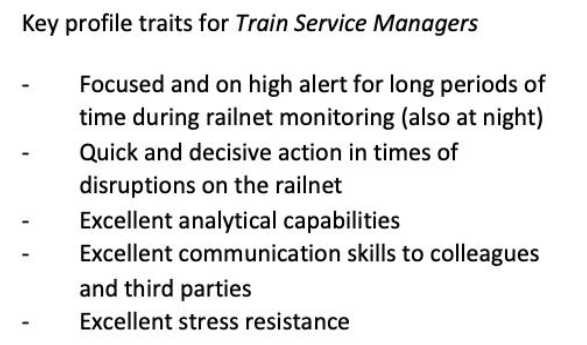
over the next 5 to 10 years. Recruitment must take into consideration the
specific competencies required for Train Service Managers as noted in the figure
below. Operations Department comprises of the technical staff such as traffic
controllers, railway and train service managers, Railway monitoring officers,
operation staff, engineers and others.
Capacity growth without rising costs. The major driver for the Digital
Vision was enabling the required capacity growth without rising costs. For the
last 5 years ProRail has only been able to breakeven and in order to fund the
Digital Vision has acquired a loan of 500 million Euro.
5. Trade Dispute: The union representing the Train Operators and Traffic
Controllers demand an increase in vacation days from 11 standard working days
(Monday to Friday) to 15 working days and an increase in salary by 8%. The last
increase was in 2019 of 5%.
Assignment requirements:
The Netherlands is ranked the sixth in the world in terms of the quality of
railroad infrastructure. However, in order to prepare for the future, the
currently existing infrastructure needs a 30% increase in capacity and tremendous
changes in the current workforce.
ProRail Traffic Control has put together a team to assist in drafting a strategic
workforce plan that will help it achieve its objectives. The team is required to
discuss the role of HR in terms of
1. recruitment and selection for operation and technical staff,
2. Communication to staff on pending changes and other relevant information re
ProRail Traffic Control Digital Vision Project.
3. Training and development and compensation and benefits administration
4. Preserving the brand of Dutch Railway Infrastructure- ProRail Traffic
Control Digital Vision to maintain its local and global standing.
Each group member should assume one (1) of the following roles of the Executive Team:
Manager, Human Resources
Manager, Operations
Manager, Finance and Accounts
Manager, Legal Services
Manager, Communiction nd PR
Key profile traits for Train Service Managers Focused and on high alert for long periods of time during railnet monitoring (also at night) Quick and decisive action in times of disruptions on the railnet Excellent analytical capabilities Excellent communication skills to colleagues and third parties Excellent stress resistance
Step by Step Solution
There are 3 Steps involved in it

Get step-by-step solutions from verified subject matter experts
 Study Help