







Question: Help answer the questions attached 1. 'Statistically we expect that good decisions will lead to favourable outcomes more often than will either poor decisions, or
Help answer the questions attached
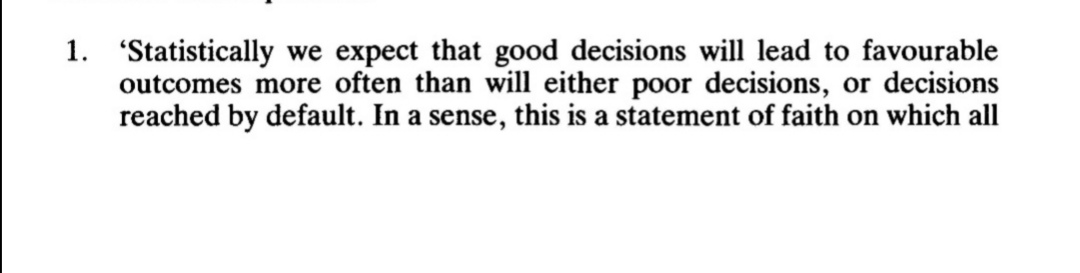
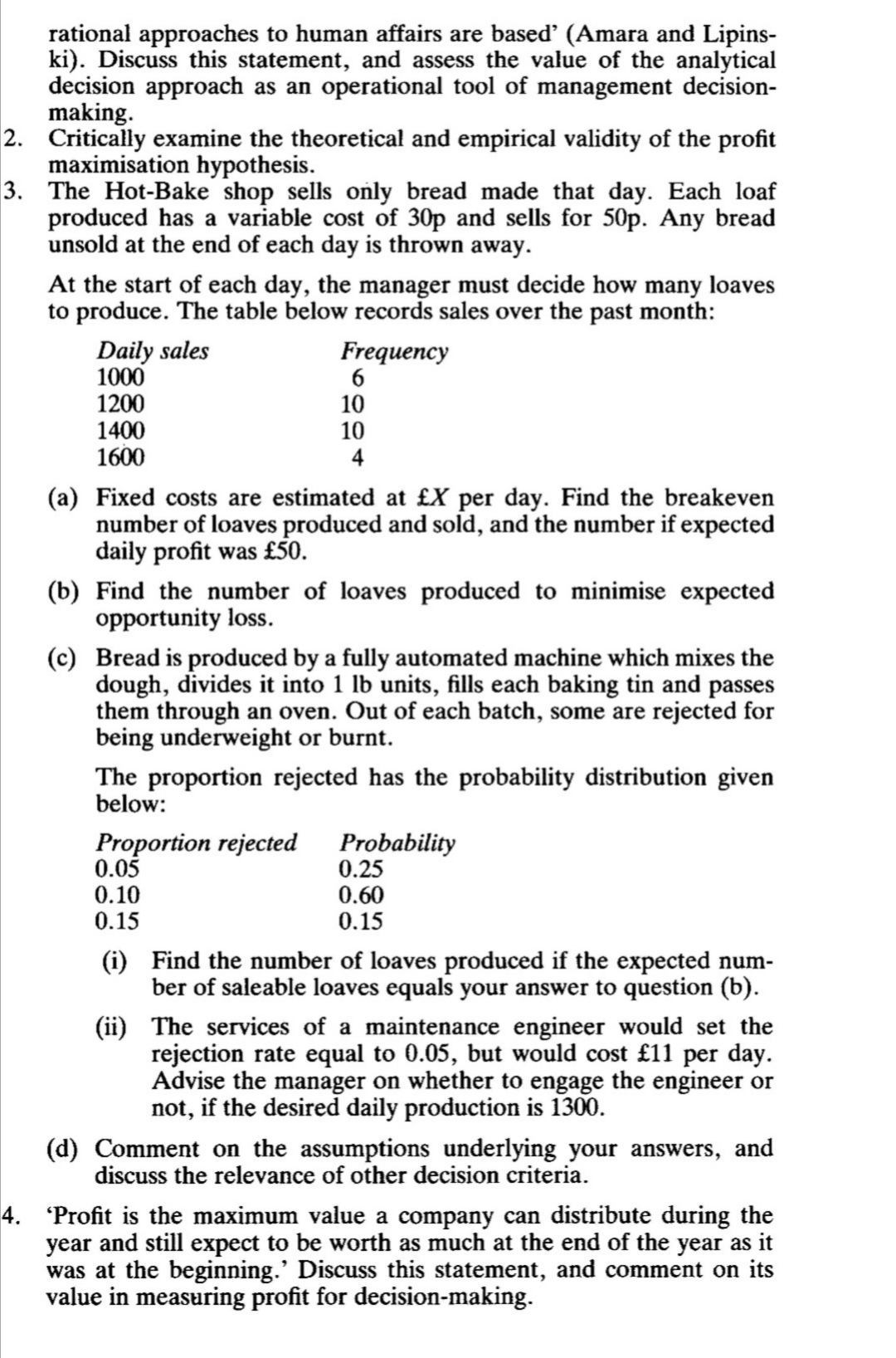
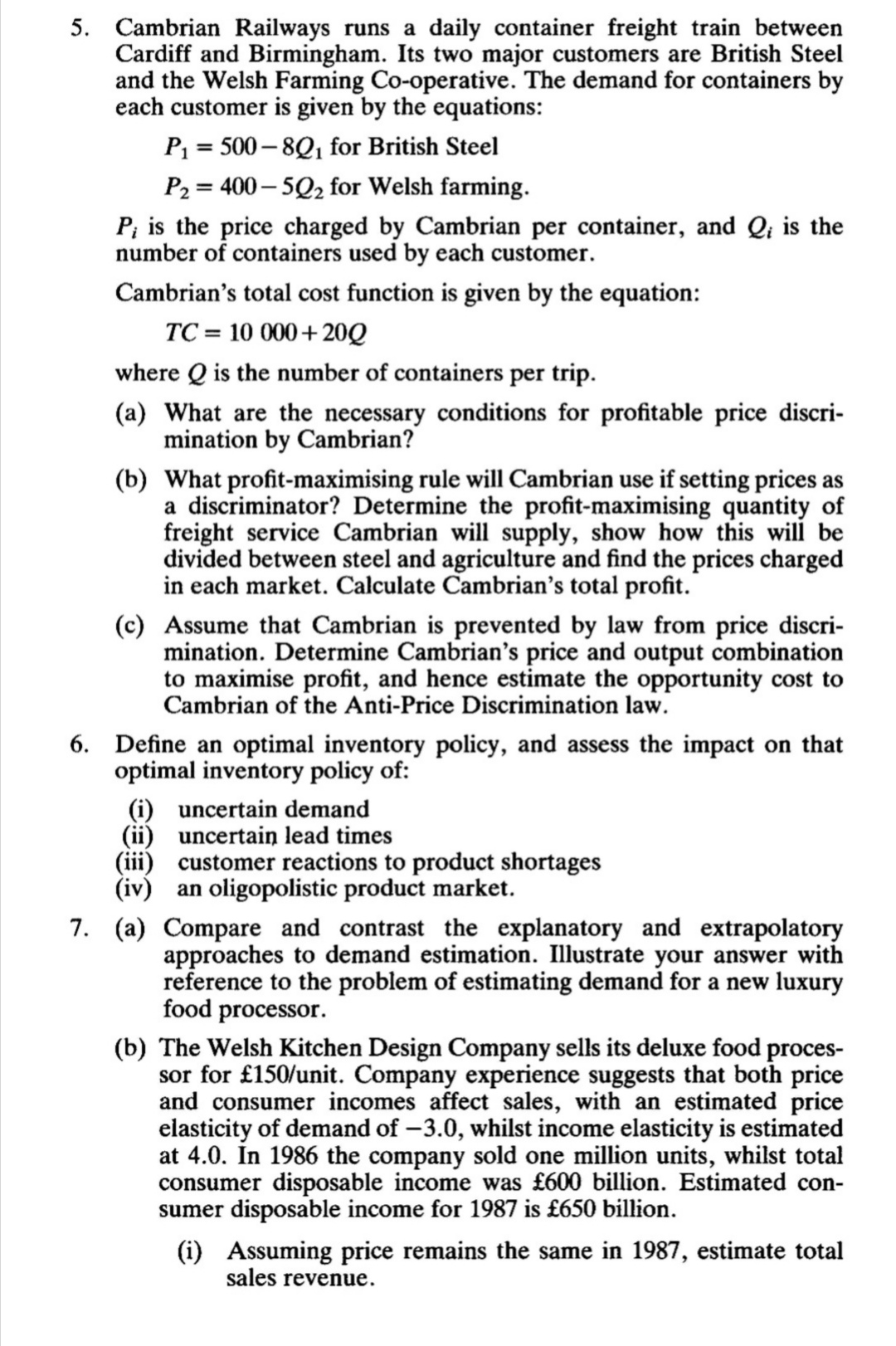
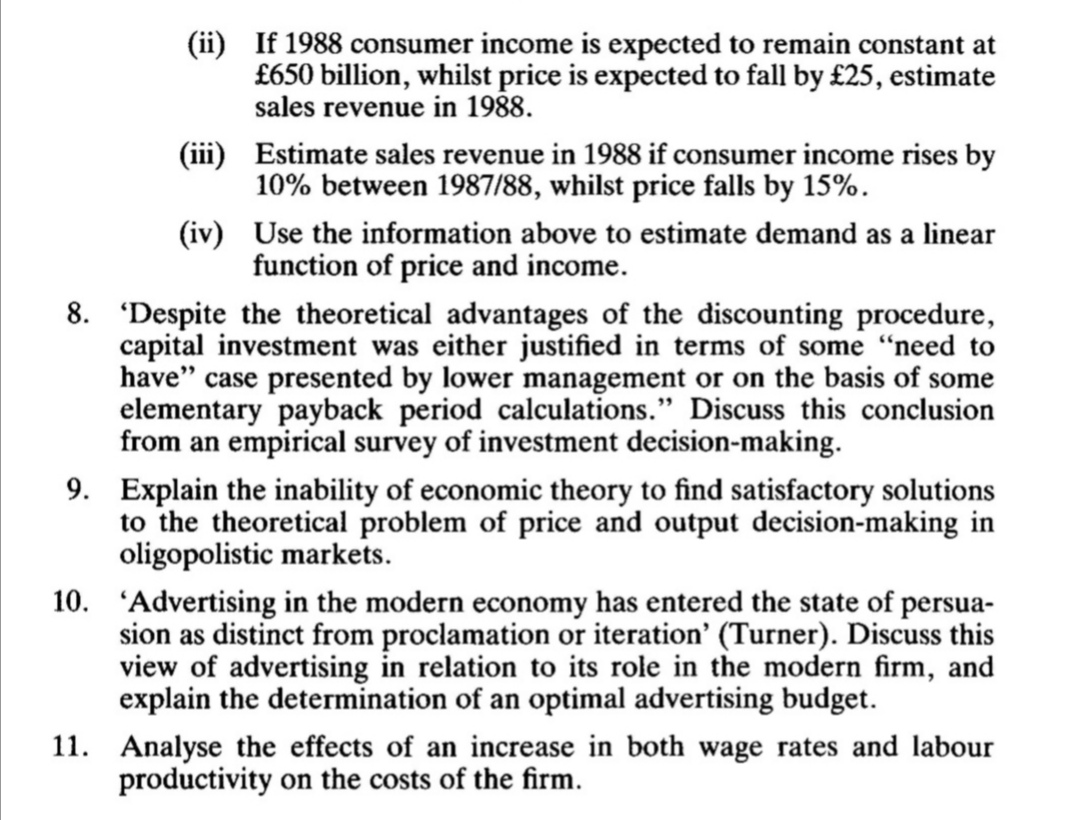
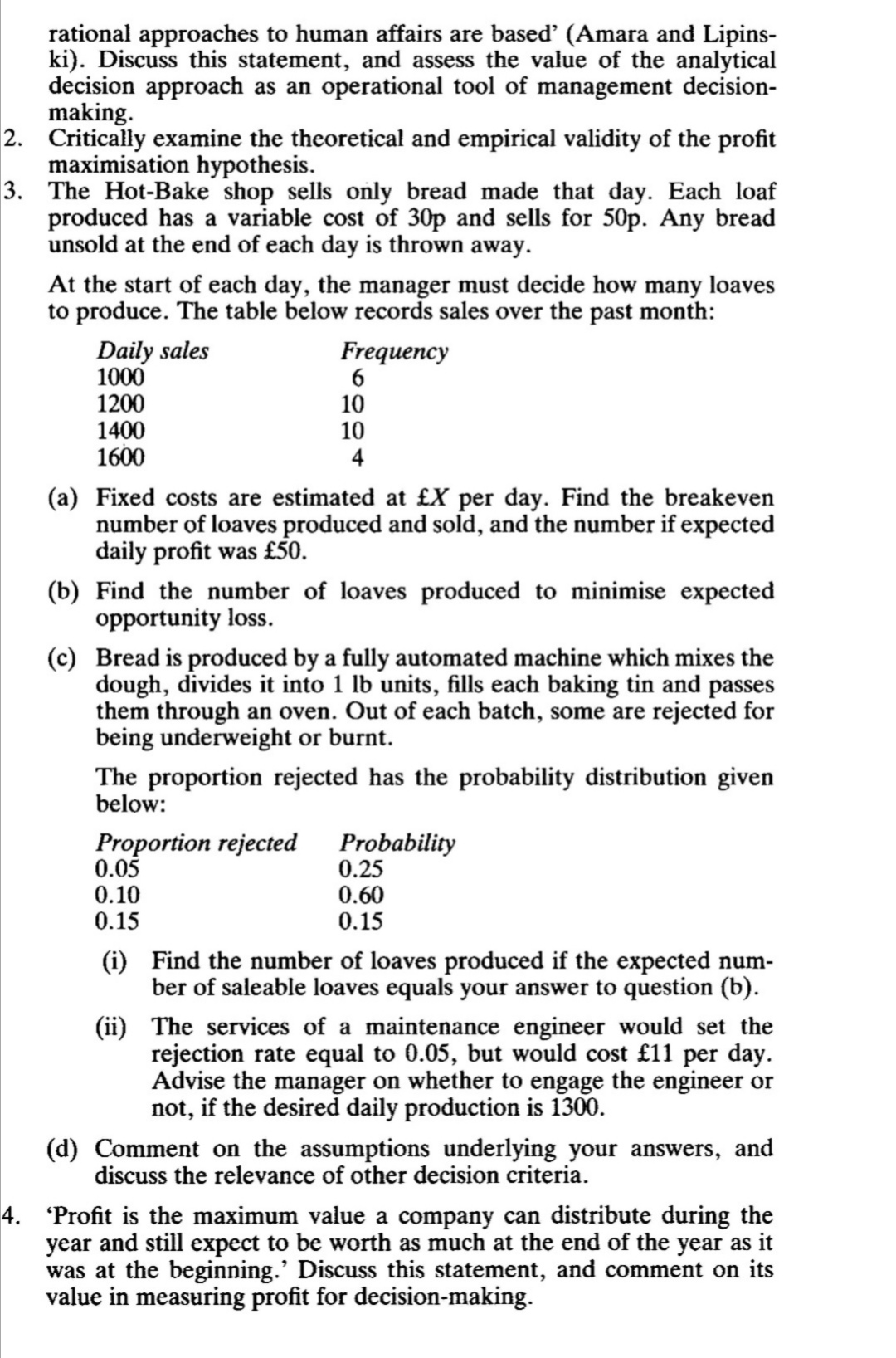
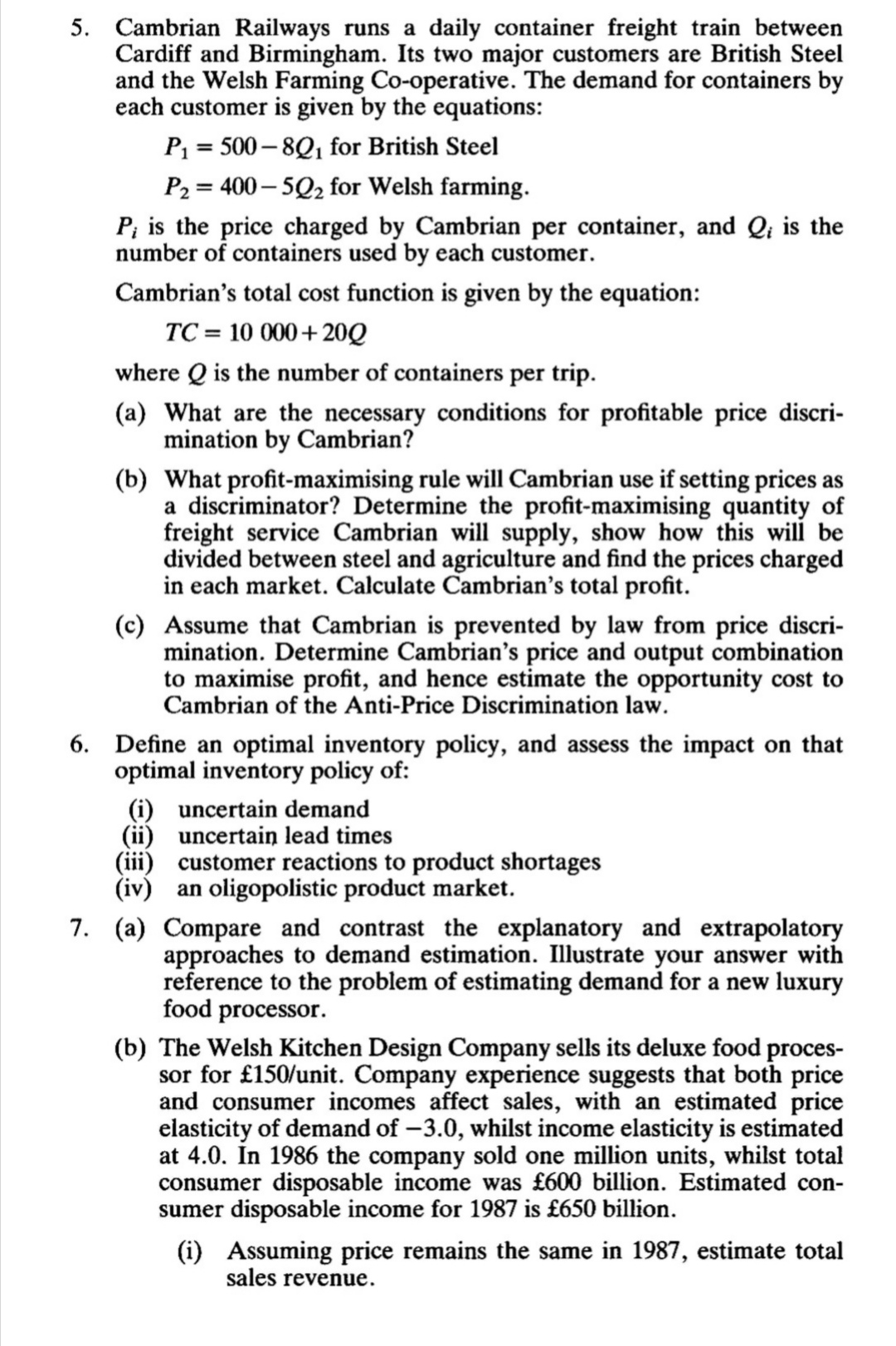
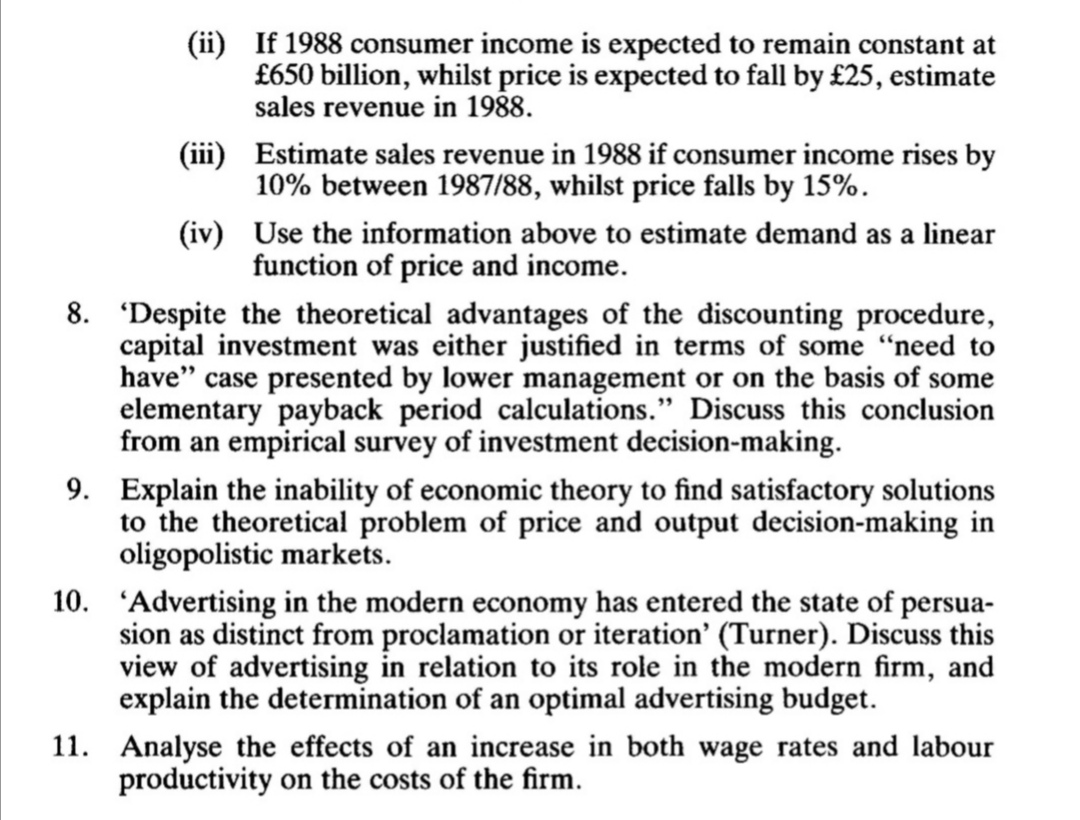
1. 'Statistically we expect that good decisions will lead to favourable outcomes more often than will either poor decisions, or decisions reached by default. In a sense, this is a statement of faith on which all 4. rational approaches to human affairs are based' (Amara and Lipins- ki). Discuss this statement, and assess the value of the analytical decision approach as an operational tool of management decision- making. Critically examine the theoretical and empirical validity of the prot maximisation hypothesis. The Hot-Bake shop sells only bread made that day. Each loaf produced has a variable cost of 30p and sells for 50p. Any bread unsold at the end of each day is thrown away. At the start of each day, the manager must decide how many loaves to produce. The table below records sales over the past month: Daily sales Frequency 1000 6 1200 10 1400 10 1600 4 (a) Fixed costs are estimated at X per day. Find the breakeven number of loaves produced and sold, and the number if expected daily prot was 50. (b) Find the number of loaves produced to minimise espected opportunity loss. (c) Bread is produced by a fully automated machine which mixes the dough, divides it into 1 lb units, lls each baking tin and passes them through an oven. Out of each batch, some are rejected for being underweight or burnt. The proportion rejected has the probability distribution given below: Proportion rejected Probability 0.05 0.25 0.10 0.60 0.15 0.15 (i) Find the number of loaves produced if the expected num ber of saleable loaves equals your answer to question (b). (ii) The services of a maintenance engineer would set the rejection rate equal to 0.05, but would cost 11 per day. Advise the manager on whether to engage the engineer or not, if the desired daily production is 1300. ((1) Comment on the assumptions underlying your answers, and discuss the relevance of other decision criteria. 'Prot is the maximum value a company can distribute during the year and still expect to be worth as much at the end of the year as it was at the beginning.' Discuss this statement, and comment on its value in measuring prot for decision-making. 5. Cambrian Railways runs a daily container freight train between Cardiff and Birmingham. Its two major customers are British Steel and the Welsh Farming Co-operative. The demand for containers by each customer is given by the equations: P1 = 500 8Q, for British Steel P2 = 400 5Q2 for Welsh farming. P, is the price charged by Cambrian per container, and Q. is the number of containers used by each customer. Cambrian's total cost function is given by the equation: TC = 10 000+ 209 where Q is the number of containers per trip. (a) What are the necessary conditions for protable price discri- mination by Cambrian? (b) What prot-maximising rule will Cambrian use if setting prices as a discriminator? Determine the prot-maximising quantity of freight service Cambrian will supply, show how this will be divided between steel and agriculture and nd the prices charged in each market. Calculate Cambrian's total prot. (c) Assume that Cambrian is prevented by law from price discri- mination. Determine Cambrian's price and output combination to maximise prot, and hence estimate the opportunity cost to Cambrian of the Anti-Price Discrimination law. 6. Dene an optimal inventory policy, and assess the impact on that optimal inventory policy of: (i) uncertain demand (ii) uncertain lead times (iii) customer reactions to product shortages (iv) an oligopolistic product market. 7. (a) Compare and contrast the explanatory and extrapolatory approaches to demand estimation. Illustrate your answer with reference to the problem of estimating demand for a new luxury food processor. (b) The Welsh Kitchen Design Company sells its deluxe food proces- sor for 15Wunit. Company experience suggests that both price and consumer incomes affect sales, with an estimated price elasticity of demand of -3.0, whilst income elasticity is estimated at 4.0. In 1986 the company sold one million units, whilst total consumer disposable income was 6\") billion. Estimated con- sumer disposable income for 1987 is 650 billion. (i) Assuming price remains the same in 1987, estimate total sales revenue. 10. 11. (ii) If 1988 consumer income is expected to remain constant at 650 billion, whilst price is expected to fall by 25, estimate sales revenue in 1988. (iii) Estimate sales revenue in 1988 if consumer income rises by 10% between 1987/88, whilst price falls by 15%. (iv) Use the information above to estimate demand as a linear function of price and income. 'Despite the theoretical advantages of the discounting procedure, capital investment was either justied in terms of some \"need to have" case presented by lower management or on the basis of some elementary payback period calculations.\" Discuss this conclusion from an empirical survey of investment decision-making. Explain the inability of economic theory to nd satisfactory solutions to the theoretical problem of price and output decision-making in oligopolistic markets. 'Advertising in the modern economy has entered the state of persua- sion as distinct from proclamation or iteration' (Turner). Discuss this view of advertising in relation to its role in the modern rm, and explain the determination of an optimal advertising budget. Analyse the effects of an increase in both wage rates and iabour productivity on the costs of the rm
Step by Step Solution
There are 3 Steps involved in it

Get step-by-step solutions from verified subject matter experts
 Study Help