







Question: ...Help ASAP 4.4 Best polynomial approximation Given jointly distributed random variables a and y, a best &th order polynomial approximation BPA, (w/x] to E [ylx],
...Help ASAP
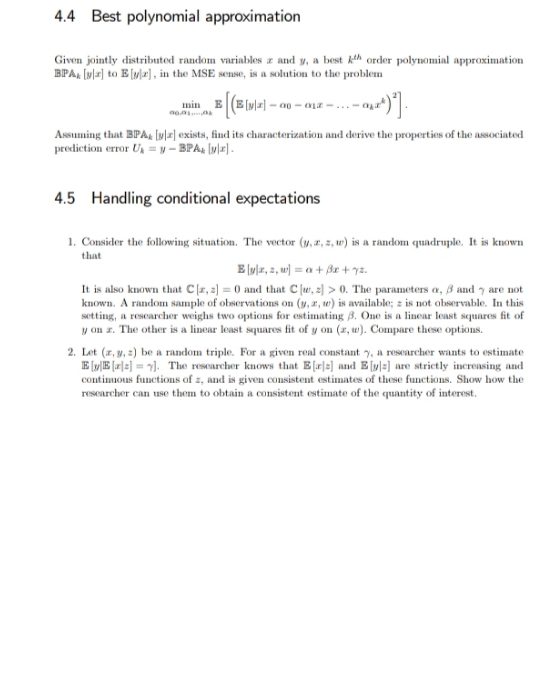
4.4 Best polynomial approximation Given jointly distributed random variables a and y, a best &th order polynomial approximation BPA, (w/x] to E [ylx], in the MSE sense, is a solution to the problem min Assuming that BPA: [y|x] exists, find its characterization and derive the properties of the associated prediction error Us = y - BPA, [v/x] . 4.5 Handling conditional expectations 1. Consider the following situation. The vector (v. 2, z, w) is a random quadruple. It is known that It is also known that C[z, =] = 0 and that C[w, =] > 0. The parameters or, A and , are not known. A random sample of observations on (1, 2, w) is available; = is not observable. In this setting, a researcher weighs two options for estimating A. One is a linear least squares fit of y on z. The other is a linear least squares fit of y on (z, w). Compare these options. 2. Let (z, v. =) be a random triple. For a given real constant y, a researcher wants to estimate E [vb [x=] = y]. The researcher knows that B [el=] and E [y|=] are strictly increasing and continuous functions of z, and is given consistent estimates of these functions. Show how the researcher can use them to obtain a consistent estimate of the quantity of interest
Step by Step Solution
There are 3 Steps involved in it

Get step-by-step solutions from verified subject matter experts
 Study Help