







Question: help Continuing with the exercise, Suppose you have a file that is 4 MB (where M=1,000,000). All of of your packets and only your packets
help
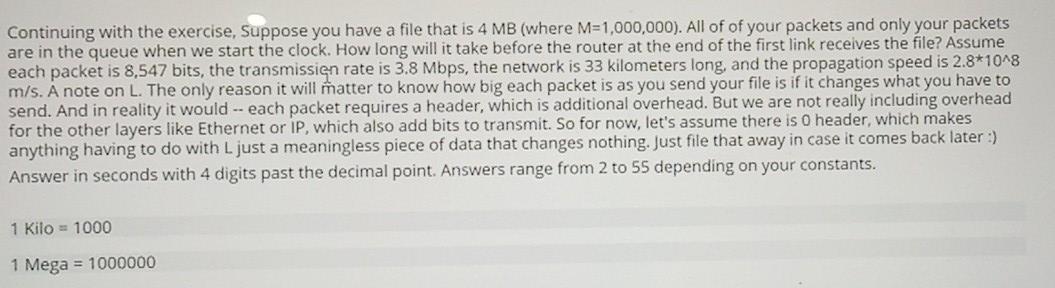
Continuing with the exercise, Suppose you have a file that is 4 MB (where M=1,000,000). All of of your packets and only your packets are in the queue when we start the clock. How long will it take before the router at the end of the first link receives the file? Assume each packet is 8,547 bits, the transmissien rate is 3.8 Mbps, the network is 33 kilometers long, and the propagation speed is 2.8*10^8 m/s. A note on L. The only reason it will matter to know how big each packet is as you send your file is if it changes what you have to send. And in reality it would -- each packet requires a header, which is additional overhead. But we are not really including overhead for the other layers like Ethernet or IP, which also add bits to transmit. So for now, let's assume there is O header, which makes anything having to do with L just a meaningless piece of data that changes nothing. Just file that away in case it comes back later :) Answer in seconds with 4 digits past the decimal point. Answers range from 2 to 55 depending on your constants. 1 Kilo = 1000 1 Mega = 1000000
Step by Step Solution
There are 3 Steps involved in it

Get step-by-step solutions from verified subject matter experts
 Study Help