Question: HELP EXAMPLE OF HOW IT SHOULD BE DONE! Please HELP ART LESSON PLAN TESSELLATION PRINT PROJECT On The Lesson Plan Topic, Objective, Grade Level, TEKS,
HELP
EXAMPLE OF HOW IT SHOULD BE DONE! Please HELP
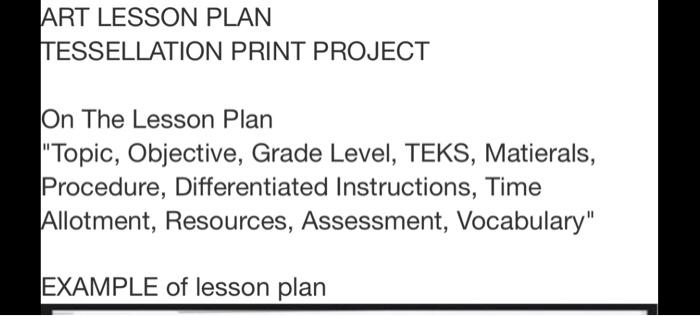
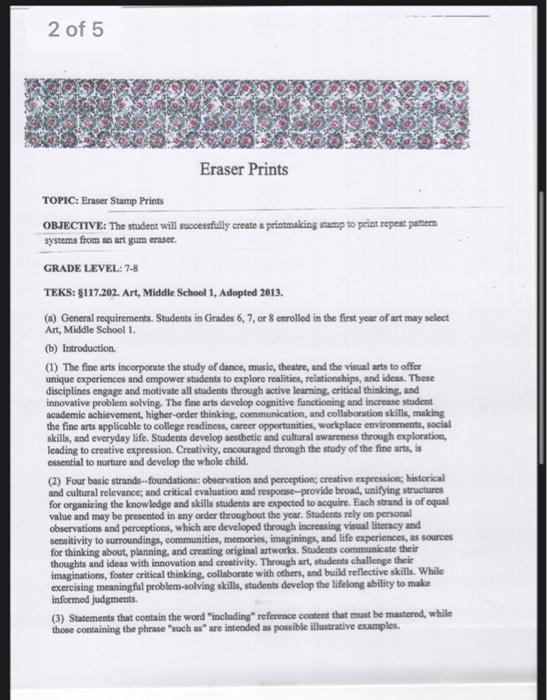
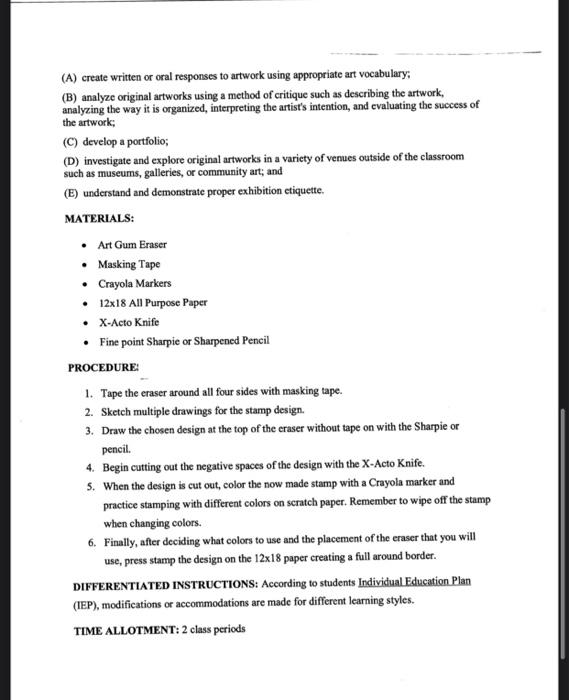
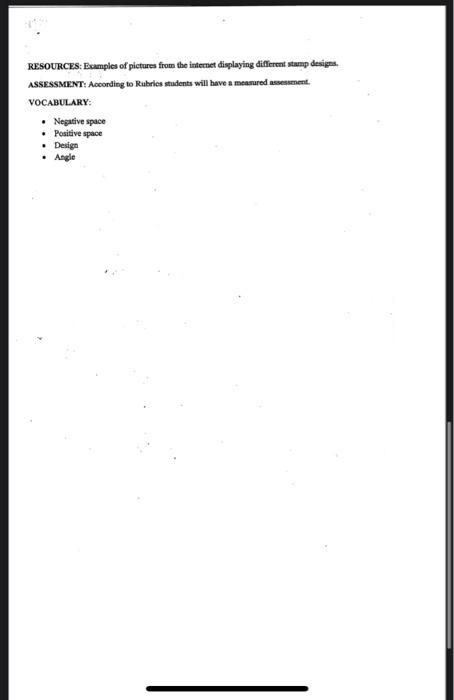
ART LESSON PLAN TESSELLATION PRINT PROJECT On The Lesson Plan "Topic, Objective, Grade Level, TEKS, Matierals, Procedure, Differentiated Instructions, Time Allotment, Resources, Assessment, Vocabulary" EXAMPLE of lesson plan 2 of 5 Eraser Prints TOPIC: Eraser Stamp Prints OBJECTIVE: The student will successfully create a printmaking stamp to print repeat pattern systems from an art gum eraser. GRADE LEVEL: 7-8 TEKS: $117.202. Art, Middle School 1. Adopted 2013. @ General requirements. Students in Grades 6, 7, or 8 enrolled in the first yeur of art may select Art, Middle School 1. (b) Introduction (1) The fine arts incorporate the study of dance, music, theatre, and the visual arts to offer unique experiences and empower students to explore realities, relationships, and ideas. These disciplines engage and motivate all students through active learning, critical thinking, and innovative problem solving. The fine arts develop cognitive functioning and increase student academic achievement, higher-order thinking, communication, and collaboration skills, making the fine arts applicable to college readiness, career opportunities, workplace environments, social skills, and everyday life. Students develop aesthetic and cultural awareness through exploration, leading to creative expression. Creativity, encouraged through the study of the fine arts, is essential to nurture and develop the whole child. (2) Four basic strande--foundations observation and perception; creative expression; historical and cultural relevance, and critical evaluation and response--provide broad, unifying structures for organizing the knowledge and skills students are expected to acquire. Each strand is of equal value and may be presented in any order throughout the year. Students rely on personal observations and perceptions, which are developed through increasing visual literacy and sensitivity to surroundings, communities, memories, imaginings, and life experiences, as sources for thinking about, planning, and creating original artworks. Students communicate their thoughts and ideas with innovation and creativity. Through art, students challenge their imaginations, foster critical thinking, collaborate with others, and build reflective skills. While exercising meaningful problem-solving skills, students develop the lifelong ability to make informed judgments. (3) Statements that contain the word "including" reference content that must be mastered, while those containing the phrase "such as" are intended as possible illustrative examples. (A) create written or oral responses to artwork using appropriate art vocabulary (B) analyze original artworks using a method of critique such as describing the artwork, analyzing the way it is organized, interpreting the artist's intention, and evaluating the success of the artwork: (C) develop a portfolio (D) investigate and explore original artworks in a variety of venues outside of the classroom such as museums, galleries, or community art; and (E) understand and demonstrate proper exhibition etiquette. MATERIALS: Art Gum Eraser Masking Tape Crayola Markers 12x18 All Purpose Paper X-Acto Knife Fine point Sharpie or Sharpened Pencil PROCEDURE 1. Tape the eraser around all four sides with masking tape. 2. Sketch multiple drawings for the stamp design. 3. Draw the chosen design at the top of the eraser without tape on with the Sharpie or pencil. 4. Begin cutting out the negative spaces of the design with the X-Acto Knife. 5. When the design is cut out, color the now made stamp with a Crayola marker and practice stamping with different colors on scratch paper. Remember to wipe off the stamp when changing colors. 6. Finally, after deciding what colors to use and the placement of the eraser that you will use, press stamp the design on the 12x18 paper creating a full around border DIFFERENTIATED INSTRUCTIONS: According to students Individual Education Plan (IEP), modifications or accommodations are made for different learning styles. TIME ALLOTMENT: 2 class periods RESOURCES: Examples of pictures from the internet displaying different stump designs ASSESSMENT: According to Rubrios students will have a mesured assessment. VOCABULARY: Negative space Positive space Design Angle ART LESSON PLAN TESSELLATION PRINT PROJECT On The Lesson Plan "Topic, Objective, Grade Level, TEKS, Matierals, Procedure, Differentiated Instructions, Time Allotment, Resources, Assessment, Vocabulary" EXAMPLE of lesson plan 2 of 5 Eraser Prints TOPIC: Eraser Stamp Prints OBJECTIVE: The student will successfully create a printmaking stamp to print repeat pattern systems from an art gum eraser. GRADE LEVEL: 7-8 TEKS: $117.202. Art, Middle School 1. Adopted 2013. @ General requirements. Students in Grades 6, 7, or 8 enrolled in the first yeur of art may select Art, Middle School 1. (b) Introduction (1) The fine arts incorporate the study of dance, music, theatre, and the visual arts to offer unique experiences and empower students to explore realities, relationships, and ideas. These disciplines engage and motivate all students through active learning, critical thinking, and innovative problem solving. The fine arts develop cognitive functioning and increase student academic achievement, higher-order thinking, communication, and collaboration skills, making the fine arts applicable to college readiness, career opportunities, workplace environments, social skills, and everyday life. Students develop aesthetic and cultural awareness through exploration, leading to creative expression. Creativity, encouraged through the study of the fine arts, is essential to nurture and develop the whole child. (2) Four basic strande--foundations observation and perception; creative expression; historical and cultural relevance, and critical evaluation and response--provide broad, unifying structures for organizing the knowledge and skills students are expected to acquire. Each strand is of equal value and may be presented in any order throughout the year. Students rely on personal observations and perceptions, which are developed through increasing visual literacy and sensitivity to surroundings, communities, memories, imaginings, and life experiences, as sources for thinking about, planning, and creating original artworks. Students communicate their thoughts and ideas with innovation and creativity. Through art, students challenge their imaginations, foster critical thinking, collaborate with others, and build reflective skills. While exercising meaningful problem-solving skills, students develop the lifelong ability to make informed judgments. (3) Statements that contain the word "including" reference content that must be mastered, while those containing the phrase "such as" are intended as possible illustrative examples. (A) create written or oral responses to artwork using appropriate art vocabulary (B) analyze original artworks using a method of critique such as describing the artwork, analyzing the way it is organized, interpreting the artist's intention, and evaluating the success of the artwork: (C) develop a portfolio (D) investigate and explore original artworks in a variety of venues outside of the classroom such as museums, galleries, or community art; and (E) understand and demonstrate proper exhibition etiquette. MATERIALS: Art Gum Eraser Masking Tape Crayola Markers 12x18 All Purpose Paper X-Acto Knife Fine point Sharpie or Sharpened Pencil PROCEDURE 1. Tape the eraser around all four sides with masking tape. 2. Sketch multiple drawings for the stamp design. 3. Draw the chosen design at the top of the eraser without tape on with the Sharpie or pencil. 4. Begin cutting out the negative spaces of the design with the X-Acto Knife. 5. When the design is cut out, color the now made stamp with a Crayola marker and practice stamping with different colors on scratch paper. Remember to wipe off the stamp when changing colors. 6. Finally, after deciding what colors to use and the placement of the eraser that you will use, press stamp the design on the 12x18 paper creating a full around border DIFFERENTIATED INSTRUCTIONS: According to students Individual Education Plan (IEP), modifications or accommodations are made for different learning styles. TIME ALLOTMENT: 2 class periods RESOURCES: Examples of pictures from the internet displaying different stump designs ASSESSMENT: According to Rubrios students will have a mesured assessment. VOCABULARY: Negative space Positive space Design Angle









 Study Help