







Question: help have? On average, how many neutrons does it have? How many electrons are present in its valonce orbital? 3. Muttiple choice: A calcium ion
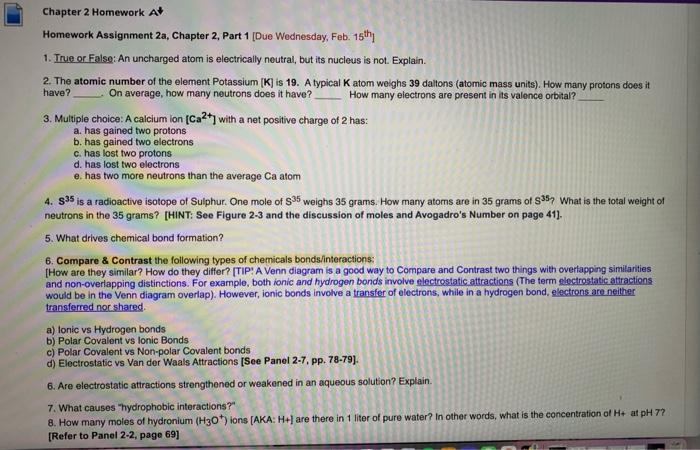
have? On average, how many neutrons does it have? How many electrons are present in its valonce orbital? 3. Muttiple choice: A calcium ion [Ca2+] with a net positive charge of 2 has: a. has gained two protons b. has gained two electrons c. has lost two protons d. has lost two electrons e. has two more neutrons than the average Ca atom 4. S35 is a radioactive isotope of Sulphur. One mole of S35 weighs 35 grams. How many atoms are in 35 grams of S35 ? What is the total weight of neutrons in the 35 grams? [HINT: See Figure 2-3 and the discussion of moles and Avogadro's Number on page 41]. 5. What drives chemical bond formation? 6. Compare \& Contrast the following types of chemicals bonds/interactions: [How are they similar? How do they differ? ITIP: A Venn diagram is a good way to Compare and Contrast two things with overfapping similanities and non-overlapping distinctions. For example, both ionic and hydrogen bonds involve electrostatic attractions (The term electrostatic attractions would be in the Venn diagram overlap). However, ionic bonds involve a transfer of electrons, while in a hydrogen bond, electrons are neither transferred noc shared. a) Ionic vs Hydrogen bonds b) Polar Covalent vs lonic Bonds c) Polar Covalent vs Non-polar Covalent bonds d) Electrostatic vs Van der Waals Attractions [See Panel 2-7, pp. 78-79]. 6. Are electrostatic attractions strengthened or weakened in an aqueous solution? Explain. 7. What causes "hydrophobic interactions
Step by Step Solution
There are 3 Steps involved in it

Get step-by-step solutions from verified subject matter experts
 Study Help