







Question: help help help all parts Consider the same two economies and the same production technology of the previous exercise, but assume now that TFP=TFPH0.6, so
help help help
all parts
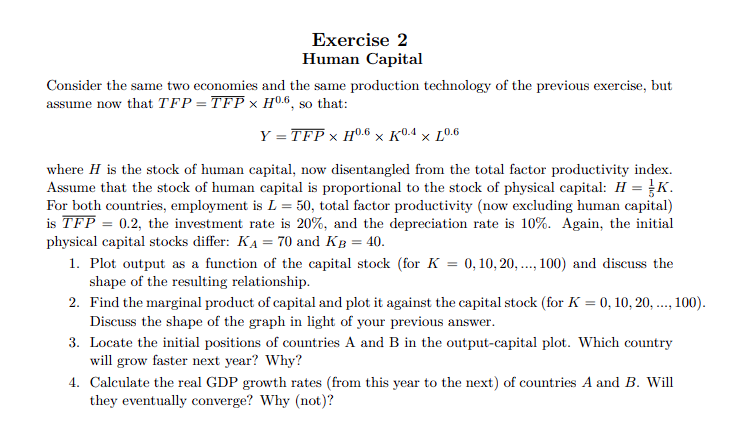
Consider the same two economies and the same production technology of the previous exercise, but assume now that TFP=TFPH0.6, so that: Y=TFPH0.6K0.4L0.6 where H is the stock of human capital, now disentangled from the total factor productivity index. Assume that the stock of human capital is proportional to the stock of physical capital: H=51K. For both countries, employment is L=50, total factor productivity (now excluding human capital) is TFP=0.2, the investment rate is 20%, and the depreciation rate is 10%. Again, the initial physical capital stocks differ: KA=70 and KB=40. 1. Plot output as a function of the capital stock (for K=0,10,20,,100 ) and discuss the shape of the resulting relationship. 2. Find the marginal product of capital and plot it against the capital stock (for K=0,10,20,,100 ). Discuss the shape of the graph in light of your previous answer. 3. Locate the initial positions of countries A and B in the output-capital plot. Which country will grow faster next year? Why? 4. Calculate the real GDP growth rates (from this year to the next) of countries A and B. Will they eventually converge? Why (not)? Consider the same two economies and the same production technology of the previous exercise, but assume now that TFP=TFPH0.6, so that: Y=TFPH0.6K0.4L0.6 where H is the stock of human capital, now disentangled from the total factor productivity index. Assume that the stock of human capital is proportional to the stock of physical capital: H=51K. For both countries, employment is L=50, total factor productivity (now excluding human capital) is TFP=0.2, the investment rate is 20%, and the depreciation rate is 10%. Again, the initial physical capital stocks differ: KA=70 and KB=40. 1. Plot output as a function of the capital stock (for K=0,10,20,,100 ) and discuss the shape of the resulting relationship. 2. Find the marginal product of capital and plot it against the capital stock (for K=0,10,20,,100 ). Discuss the shape of the graph in light of your previous answer. 3. Locate the initial positions of countries A and B in the output-capital plot. Which country will grow faster next year? Why? 4. Calculate the real GDP growth rates (from this year to the next) of countries A and B. Will they eventually converge? Why (not)
Step by Step Solution
There are 3 Steps involved in it

Get step-by-step solutions from verified subject matter experts
 Study Help