







Question: Answer ALL the parts. Post a CLEAR AND STEP BY STEP EXPLANATION. Do not post incomplete solutions Consider a two-period small open endowment economy populated
Answer ALL the parts. Post a CLEAR AND STEP BY STEP EXPLANATION. Do not post incomplete solutions
Consider a two-period small open endowment economy populated by a large number of households with preferences described by the lifetime utility function ln C1+(10/11)lnC2 , where C1 and C2 denote, respectively, consumption in periods 1 and 2. Suppose that households receive exogenous endowments of goods given by Q1 = Q2 = 10 in periods 1 and 2, respectively. Every household enters period 1 with some debt, denoted B0, inherited from the past. Let B0 be equal to -5. The interest rate on these liabilities, denoted r0, is 20 percent. Finally, suppose that the country enjoys free capital mobility and that the world interest rate on assets held between periods 1 and 2, denoted r*, is 10 percent.
Compute the equilibrium levels of consumption, the trade balance, and the current account in periods 1 and 2.
B..
Homework #2 International Trade
1. Consider the numerical examples of exercise 1 and 2 on page 52 in Krugman and Obstfeld (8th Edition).
Draw the production possibility frontier for each country.
Which country has a comparative advantage in apples, which one in bananas?
Which country has an absolute advantage?
Indicate the range of the international prices within which there will be gains from trade for both countries.
Now imagine that Home's technology is different. It turns out that one unit of Home labor can produce 0.2 apples or 1 banana. What would the pattern of production/trade be in this case? Explain the reason why the trade pattern is the way it is.
2.Take the numerical example we used in class to discuss the Ricardo model.
Draw the world production possibility frontier. (Hint: To do so, ask yourself what world output would be for all possible international prices (Pc/Pw)t). Now assume that both countries consume wine and clothing in equal proportions (i.e., their utility function is of the form U(c,w) = min {c,w}. Wine (w) and clothing (c ) are perfect complements) Now indicate on the graph the exact point on the world production possibility frontier at which the world consumes. Compare that point to the world consumption point before trade and before specialization.
As you notice, there are indeed gains from trade.
The question left is whether a world with free trade is the best of all possible worlds. Convince yourself that it is actually not always the best case. Allow for international mobility of labor. In other words, workers are free to decide where they want to work (at home or abroad). Show us how the production possibility frontier will look like in this case. Convince yourself that indeed, under this scenario, the world is better off than in the case of free trade. Now when you consider the international division of production (i.e., where goods will be produced) with internationally mobile labor, would you say that it is in line with the principle of comparative advantage? Discuss
You should realize while doing this exercise how essential the assumption of the international immobility of labor is for international trade and the theory of comparative advantage.
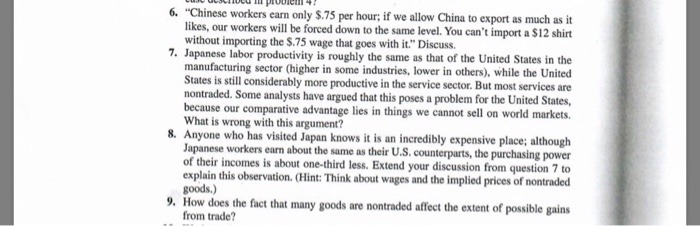
3.Discuss problems 6 and 9 in Krugman and Obstfeld, p. 52.
4.Your country imports high tech products and exports agricultural products.
Suppose you had any control over future technological developments (You have none, but anyway), would you prefer scenario (a), (b) or (c) and why? (Where necessary, illustrate with a graph using the Ricardo nalysis of comparative advantage.)
a. There is a technological revolution abroad in the high tech industry. In other words, productivity increases significantly in the technology sector.
b. There is a productivity increase abroad in the agricultural sector.
c. No technological revolution at all abroad.
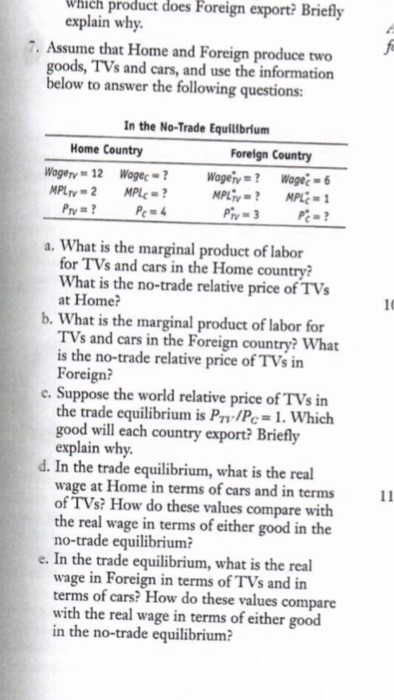
5.Answer the problem 7 in Feenstra and Taylor, p. 57.
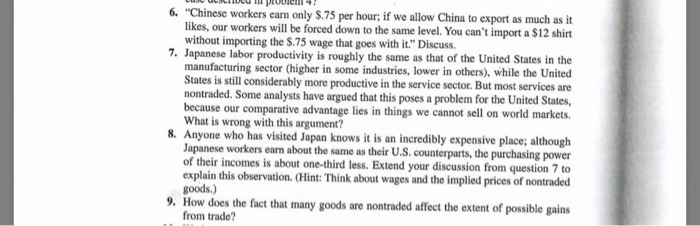
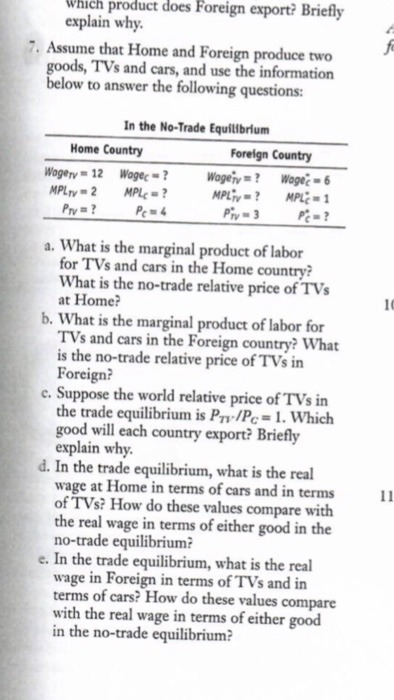
6. "Chinese workers earn only $.75 per hour; if we allow China to export as much as it likes, our workers will be forced down to the same level. You can't import a $12 shirt without importing the $.75 wage that goes with it." Discuss. 7. Japanese labor productivity is roughly the same as that of the United States in the manufacturing sector (higher in some industries, lower in others), while the United States is still considerably more productive in the service sector. But most services are nontraded. Some analysts have argued that this poses a problem for the United States, because our comparative advantage lies in things we cannot sell on world markets. What is wrong with this argument? 8. Anyone who has visited Japan knows it is an incredibly expensive place; although Japanese workers earn about the same as their U.S. counterparts, the purchasing power of their incomes is about one-third less. Extend your discussion from question 7 to explain this observation. (Hint: Think about wages and the implied prices of nontraded goods.) 9. How does the fact that many goods are nontraded affect the extent of possible gains from trade?which product does Foreign export? Briefly explain why. 7. Assume that Home and Foreign produce two goods, TVs and cars, and use the information below to answer the following questions: In the No-Trade Equilibrium Home Country Foreign Country Wagery = 12 Wager - ? Wagery = ? Wager = 6 MPLry = 2 MPLe = ? MPLiv = ? MPLE = 1 Pry = ? Pc=4 Pry = 3 Pe =? a. What is the marginal product of labor for TVs and cars in the Home country? What is the no-trade relative price of TVs at Home? b. What is the marginal product of labor for TVs and cars in the Foreign country? What is the no-trade relative price of TVs in Foreign? c. Suppose the world relative price of TVs in the trade equilibrium is Pry./Pc = 1. Which good will each country export? Briefly explain why. d. In the trade equilibrium, what is the real wage at Home in terms of cars and in terms 11 of TVs? How do these values compare with the real wage in terms of either good in the no-trade equilibrium? e. In the trade equilibrium, what is the real wage in Foreign in terms of TVs and in terms of cars? How do these values compare with the real wage in terms of either good in the no-trade equilibrium
Step by Step Solution
There are 3 Steps involved in it

Get step-by-step solutions from verified subject matter experts
 Study Help