







Question: Help! I need assistance creating a program, using C++, that runs a loop, 20 times, with both the naive transposition and the cache-oblivious transposition and
Help! I need assistance creating a program, using C++, that runs a loop, 20 times, with both the naive transposition and the cache-oblivious transposition and benchmarks their difference in run time. I also need help explaining how and why the cache-oblivious algorithm is faster. It is essential to use matrices with side lengths of 10,000. 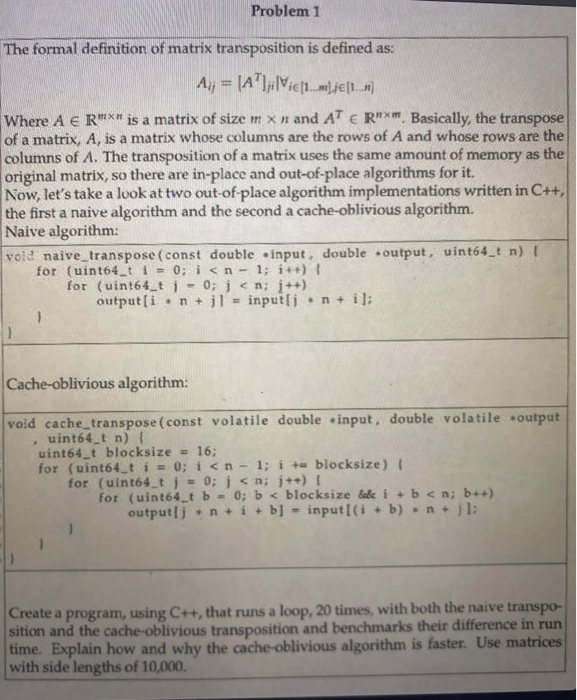
Problem 1 The formal definition of matrix transposition is defined as: Aj; = (A'll Vie...je[] Where A E R*X" is a matrix of size m x n and AT ER" . Basically, the transpose of a matrix, A, is a matrix whose columns are the rows of A and whose rows are the columns of A. The transposition of a matrix uses the same amount of memory as the original matrix, so there are in-place and out-of-place algorithms for it. Now, let's take a look at two out of place algorithm implementations written in C++, the first a naive algorithm and the second a cache-oblivious algorithm. Naive algorithm: void naive_transpose(const double input, double -output, uint64_t n) for (uint64_t i = 0; i
Step by Step Solution
There are 3 Steps involved in it

Get step-by-step solutions from verified subject matter experts
 Study Help