







Question: Help in solving the following questions. 1. A random variable X has a logarithmic distribution with parameter 0, where 0 0 and B > 0
Help in solving the following questions.
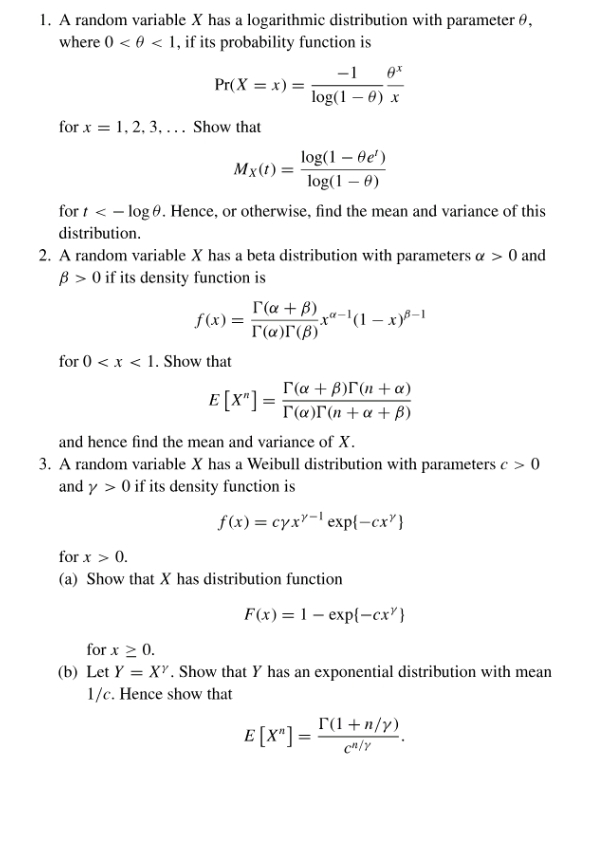
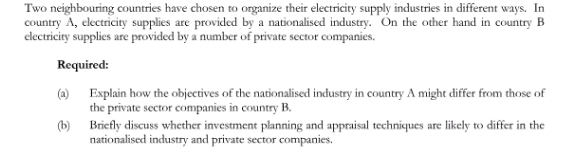
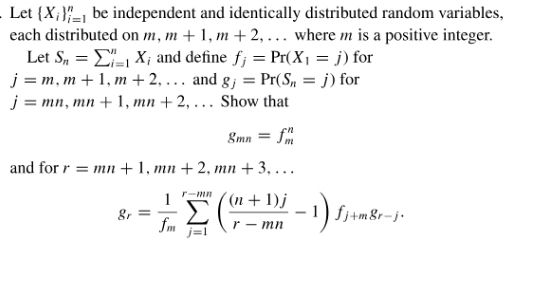
1. A random variable X has a logarithmic distribution with parameter 0, where 0 0 and B > 0 if its density function is r(a + B) f(@)= x"-1(1-x)-1 r(@)I(B) for 0 0 and y > 0 if its density function is f(x) = cyx-'exp(-cx") for x > 0. (a) Show that X has distribution function F(x) = 1 - exp(-cx } for x 2 0. (b) Let Y = XY. Show that Y has an exponential distribution with mean 1/c. Hence show that E [x] [(1 +n/y) onlyTwo neighbouring countries have chosen to organize their electricity supply industries in different ways. In country A, electricity supplies are provided by a nationalised industry. On the other hand in country B electricity supplies are provided by a number of private sector companies. Required: (a) Explain how the objectives of the nationalised industry in country A might differ from those of the private sector companies in country B. (b) Briefly discuss whether investment planning and appraisal techniques are likely to differ in the nationalised industry and private sector companies.Let (X/)" be independent and identically distributed random variables, each distributed on m, m + 1, m + 2. ... where m is a positive integer. Let S, = _ _1 X; and define f; = Pr(X, = j) for = m. m + 1, m + 2. ... and g/ = Pr(S,, = j) for =mn, mn + 1, mn +2, ... Show that &mn = fm and for r = mn + 1, mn + 2. mn + 3. ... F-PIN (n + 1)j & = -1) fj+mgr-j. fm r - mn
Step by Step Solution
There are 3 Steps involved in it

Get step-by-step solutions from verified subject matter experts
 Study Help