







Question: HELP! Matlab Polynomials 1) Plot the polynomial in the domain . First create a vector for x, next use the polyval function to calculate y,
HELP! Matlab Polynomials
1) Plot the polynomial  in the domain
  . First create a vector for x, next use the polyval function to calculate y, and then use the plot function.
2) Divide the polynomial  by the polynomial
  .
.
3) Viscosity is a property of gases and fluids that characterizes their resistance to flow. For most materials viscosity is highly sensitive to temperature. For gases, the variation of viscosity with temperature is frequently modeled by an equation of the form  where
where  is the viscosity, T is the absolute temperature, and C and S are empirical constants. Below is a table that gives the viscosity of air at different temperatures.
| T (C) | -20 | 0 | 40 | 100 | 200 | 300 | 400 | 500 | 1000 |
|
( | 1.63 | 1.71 | 1.87 | 2.17 | 2.53 | 2.98 | 3.32 | 3.64 | 5.04 |


Determine the constants C and S by curve-fitting the equation to the data points. Make a plot of viscosity versus temperature in C. In the plot show the data points with markers and the curve fitted equation with a solid line. The curve fitting can be done by rewriting the equation in the form 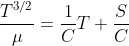 and using a first-order polynomial.
4) When rubber is streched, its elongation is initially proportional to the applied force, but as it reaches about twice its original length, the force required to stretch the rubber increases rapidly. The force, as a function of elongation, that was required to stretch a rubber specimen that was initially 3 in. long is displayed in the following table.
(a) Curve-fit the data with a fourth-order polynomial. Make a plot of the data points and the polynomial. Use the polynomial to estimate the force when the rubber specimen was 11.5 in. long.
(b) Fit the data with spline interpolation (use MATLABS built-in function interp1). Make a plot that shows the data points and a curve made by interpolation. Use interpolation to estimate the force when the rubber specimen was 11.5 in. long.
| Force (lb) | 0 | 0.63 | 0.9 | 1.16 | 1.18 | 1.19 | 1.24 | 1.48 |
| Elongation (in.) | 0 | 1.2 | 2.4 | 3.6 | 4.8 | 6.0 | 7.2 | 8.4 |
| Force (lb) | 1.92 | 3.12 | 4.14 | 5.34 | 6.22 | 7.12 | 7.86 | 8.42 |
| Elongation (in.) | 9.6 | 10.8 | 12.0 | 13.2 | 14.4 | 15.6 | 16.8 | 18 |
Step by Step Solution
There are 3 Steps involved in it

Get step-by-step solutions from verified subject matter experts
 Study Help