







Question: Help me create a DFD, decision table, and decision tree ... You should create a Data Flow Diagram (DFD). This diagram will help the programmers
Help me create a DFD, decision table, and decision tree...
You should create a Data Flow Diagram (DFD). This diagram will help the programmers understand how information is flowing through the proposed system. I suggest that you use the notes from the JAD session (attached below). They have identified the entities and processes and you can use this information to create a context diagram.
P.S. Mae named our new system "SIM", short for "Service Information Management", and everyone loves the name. Let's call this new system "SIM" for now on.
There was a meeting with the owner and store manager this morning. Here are some new rules that will need to be implemented in the SIM system as the result of this meeting:
The owner and store manager have decided to offer customers a service plan were they pay a flat rate once a year. With this plan, customers only pay for the cost of parts when they have their appliance(s) serviced. They can only buy a service plan if they have purchased an appliance from Appliance Warehouse.
With this new service plan, if they have service on their appliance more than 3 times during the year, they will have to pay the full amount of the service fee and cost of parts. If the customer does not buy a service plan but buys their appliance from us, we will give a 20% discount off the service fee for the life of their appliance.
Everyone else will pay the full cost of the service plan and parts cost. Create a decision table from these rules. Further, simplify the decision table so that you can create a decision tree. The programmers find it very helpful to have all the decisions laid out in a decision tree.
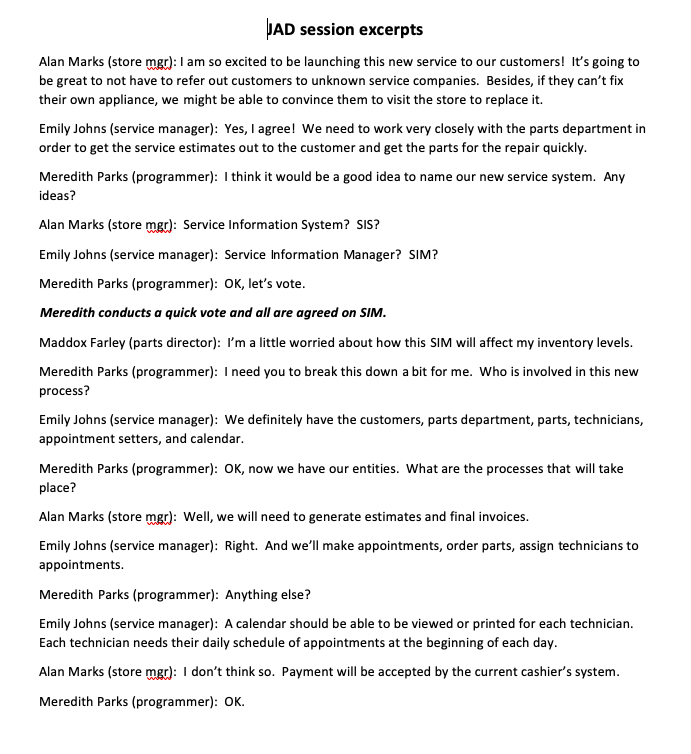
SAD session excerpts Alan Marks (store mgr): I am so excited to be launching this new service to our customers! It's going to be great to not have to refer out customers to unknown service companies. Besides, if they can't fix their own appliance, we might be able to convince them to visit the store to replace it. Emily Johns (service manager): Yes, I agree! We need to work very closely with the parts department in order to get the service estimates out to the customer and get the parts for the repair quickly. Meredith Parks (programmer): I think it would be a good idea to name our new service system. Any ideas? Alan Marks (store mgr): Service Information System? SIS? Emily Johns (service manager): Service Information Manager? SIM? Meredith Parks (programmer): OK, let's vote. Meredith conducts a quick vote and all are agreed on SIM. Maddox Farley (parts director): I'm a little worried about how this SIM will affect my inventory levels. Meredith Parks (programmer): I need you to break this down a bit for me. Who is involved in this new process? Emily Johns (service manager): We definitely have the customers, parts department, parts, technicians, appointment setters, and calendar. Meredith Parks (programmer): OK, now we have our entities. What are the processes that will take place? Alan Marks (store mgr): Well, we will need to generate estimates and final invoices. Emily Johns (service manager): Right. And we'll make appointments, order parts, assign technicians to appointments. Meredith Parks (programmer): Anything else? Emily Johns (service manager): A calendar should be able to be viewed or printed for each technician. Each technician needs their daily schedule of appo nents at the beginning of each day. Alan Marks (store mgr): I don't think so. Payment will be accepted by the current cashier's system. Meredith Parks (programmer): OK
Step by Step Solution
There are 3 Steps involved in it

Get step-by-step solutions from verified subject matter experts
 Study Help