Question: help me in this ass asap 1. When an entity issued a note solely in exchange for cash, the present value of the note at

help me in this ass asap
help me in this ass asap 1. When an entity issuedhelp me in this ass asap 1. When an entity issued
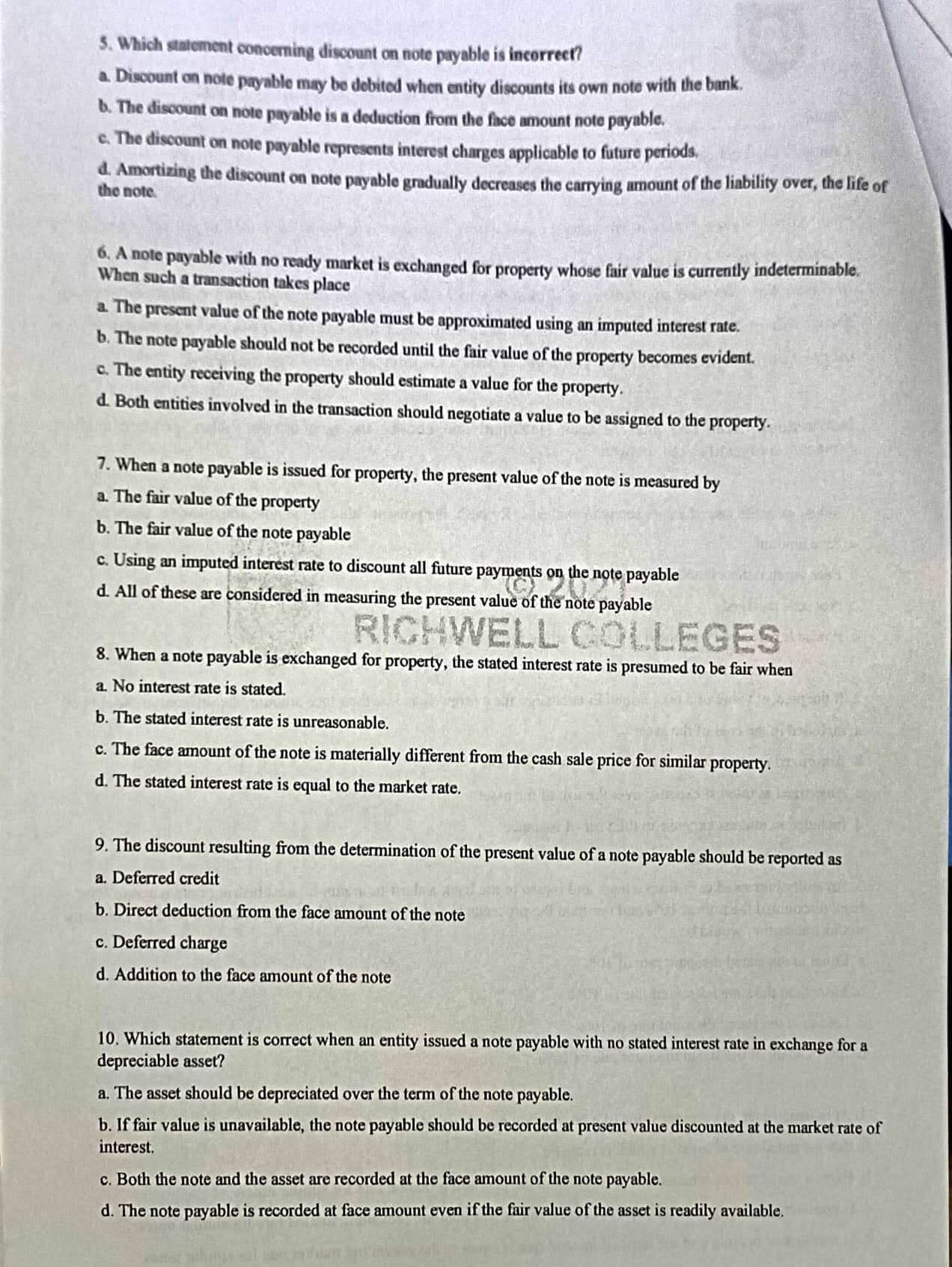
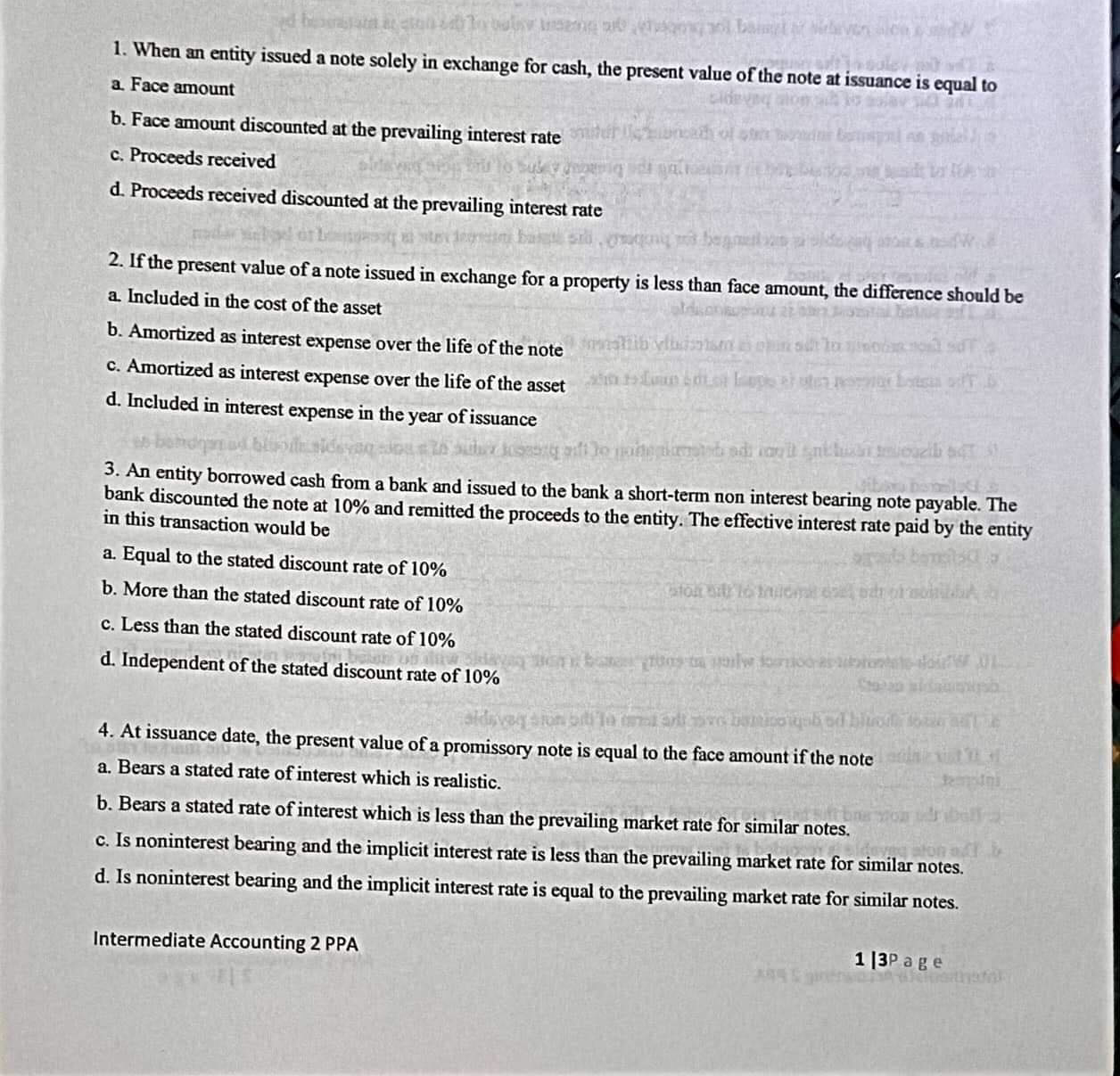
1. When an entity issued a note solely in exchange for cash, the present value of the note at issuance is equal to a. Face amount b. Face amount discounted at the prevailing interest rate c. Proceeds received d. Proceeds received discounted at the prevailing interest rate 2. If the present value of a note issued in exchange for a property is less than face amount, the difference should be a. Included in the cost of the asset b. Amortized as interest expense over the life of the note c. Amortized as interest expense over the life of the asset d. Included in interest expense in the year of issuance 3. An entity borrowed cash from a bank and issued to the bank a short-term non interest bearing note payable. The bank discounted the note at 10% and remitted the proceeds to the entity. The effective interest rate paid by the entity in this transaction would be a. Equal to the stated discount rate of 10% b. More than the stated discount rate of 10% c. Less than the stated discount rate of 10% d. Independent of the stated discount rate of 10% 4. At issuance date, the present value of a promissory note is equal to the face amount if the note a. Bears a stated rate of interest which is realistic. b. Bears a stated rate of interest which is less than the prevailing market rate for similar notes. c. Is noninterest bearing and the implicit interest rate is less than the prevailing market rate for similar notes. d. Is noninterest bearing and the implicit interest rate is equal to the prevailing market rate for similar notes. Intermediate Accounting 2 PPA 1 3Page5. Which statement concerning discount on note payable is incorrect? a. Discount on note payable may be debited when entity discounts its own note with the bank b. The discount on note payable is a deduction from the face amount note payable. c. The discount on note payable represents interest charges applicable to future periods. d. Amortizing the discount on note payable gradually decreases the carrying amount of the liability over, the life of the note. 6. A note payable with no ready market is exchanged for property whose fair value is currently indeterminable. When such a transaction takes place a The present value of the note payable must be approximated using an imputed interest rate. b. The note payable should not be recorded until the fair value of the property becomes evident. c. The entity receiving the property should estimate a value for the property. d. Both entities involved in the transaction should negotiate a value to be assigned to the property. 7. When a note payable is issued for property, the present value of the note is measured by a. The fair value of the property b. The fair value of the note payable c. Using an imputed interest rate to discount all future payments on the note payable d. All of these are considered in measuring the present value of the note payable RICHWELL COLLEGES 8. When a note payable is exchanged for property, the stated interest rate is presumed to be fair when a. No interest rate is stated. b. The stated interest rate is unreasonable. c. The face amount of the note is materially different from the cash sale price for similar property. d. The stated interest rate is equal to the market rate. 9. The discount resulting from the determination of the present value of a note payable should be reported as a. Deferred credit b. Direct deduction from the face amount of the note c. Deferred charge d. Addition to the face amount of the note 10. Which statement is correct when an entity issued a note payable with no stated interest rate in exchange for a depreciable asset? a. The asset should be depreciated over the term of the note payable. b. If fair value is unavailable, the note payable should be recorded at present value discounted at the market rate of interest. c. Both the note and the asset are recorded at the face amount of the note payable. d. The note payable is recorded at face amount even if the fair value of the asset is readily available

Step by Step Solution

There are 3 Steps involved in it

1 Expert Approved Answer
Step: 1 Unlock blur-text-image

Question Has Been Solved by an Expert!

Get step-by-step solutions from verified subject matter experts

Step: 2 Unlock
Step: 3 Unlock

Students Have Also Explored These Related Accounting Questions!