Question: help me please!!! 12. Assume you work for a large international corporation that has just opened a new office in one of the following cities:
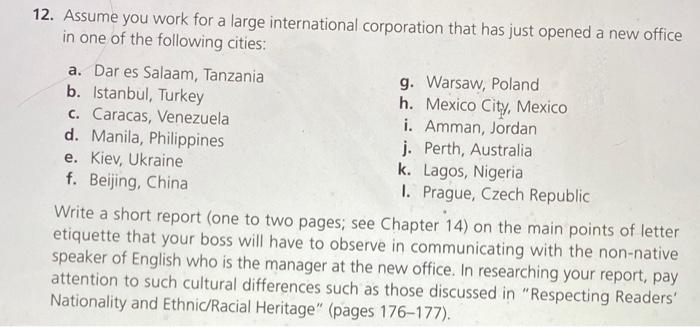
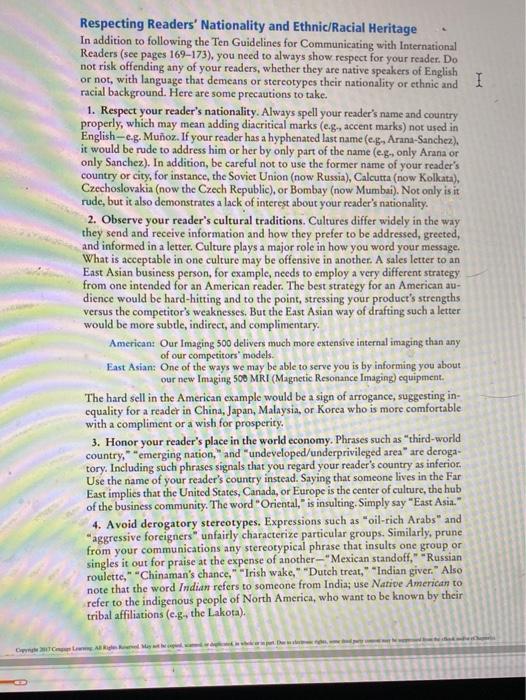
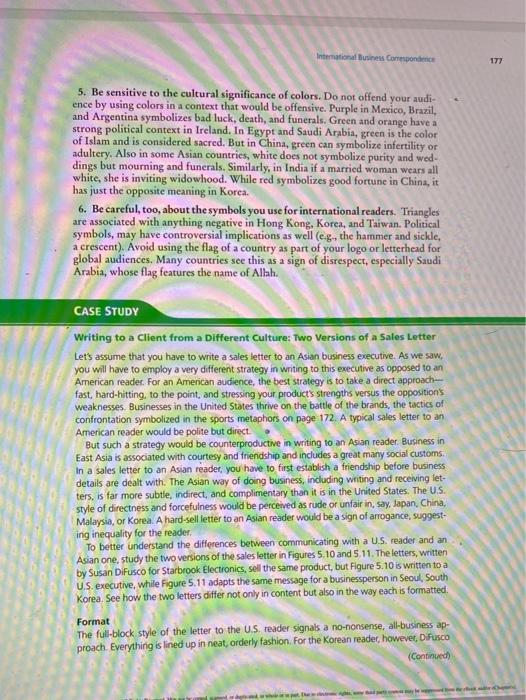
12. Assume you work for a large international corporation that has just opened a new office in one of the following cities: a. Dar es Salaam, Tanzania g. Warsaw, Poland b. Istanbul, Turkey h. Mexico City, Mexico C. Caracas, Venezuela i. Amman, Jordan d. Manila, Philippines j. Perth, Australia e. Kiev, Ukraine k. Lagos, Nigeria f. Beijing, China I. Prague, Czech Republic Write a short report (one to two pages; see Chapter 14) on the main points of letter etiquette that your boss will have to observe in communicating with the non-native speaker of English who is the manager at the new office. In researching your report, pay attention to such cultural differences such as those discussed in "Respecting Readers' Nationality and Ethnic/Racial Heritage" (pages 176-177). I Respecting Readers' Nationality and Ethnic/Racial Heritage In addition to following the Ten Guidelines for Communicating with International Readers (see pages 169-173), you need to always show respect for your reader. Do not risk offending any of your readers, whether they are native speakers of English or not, with language that demeans or stereotypes their nationality or ethnic and racial background. Here are some precautions to take. 1. Respect your reader's nationality. Always spell your reader's name and country properly, which may mean adding diacritical marks (c.g., accent marks) not used in English-c.g. Muoz. If your reader has a hyphenated last name (eg, Arana-Sanchez). it would be rude to address him or her by only part of the name (e.g., only Arana or only Sanchez). In addition, be careful not to use the former name of your reader's country or city, for instance, the Soviet Union (now Russia), Calcutta (now Kolkata), Czechoslovakia (now the Czech Republic), or Bombay (now Mumbai). Not only is it rude, but it also demonstrates a lack of interest about your reader's nationality. 2. Observe your reader's cultural traditions, Cultures differ widely in the way they send and receive information and how they prefer to be addressed, greeted, and informed in a letter. Culture plays a major role in how you word your message. What is acceptable in one culture may be offensive in another. A sales letter to an East Asian business person, for example, needs to employ a very different strategy from one intended for an American reader. The best strategy for an American au- dience would be hard-hitting and to the point, stressing your product's strengths versus the competitor's weaknesses. But the East Asian way of drafting such a letter would be more subtle, indirect, and complimentary American: Our Imaging 500 delivers much more extensive internal imaging than any of our competitors' models East Asian: One of the ways we may be able to serve you is by informing you about our new Imaging 500 MRI (Magnetic Resonance Imaging) equipment. The hard sell in the American example would be a sign of arrogance, suggesting in equality for a reader in China, Japan, Malaysia, or Korca who is more comfortable with a compliment or a wish for prosperity. 3. Honor your reader's place in the world economy. Phrases such as "third-world country, emerging nation," and "undeveloped/underprivileged area" are deroga- tory. Including such phrases signals that you regard your reader's country as inferior. Use the name of your reader's country instead. Saying that someone lives in the Far East implies that the United States, Canada, or Europe is the center of culture, the hub of the business community. The word "Oriental," is insulting. Simply say "East Asia. 4. Avoid derogatory stereotypes. Expressions such as "oil-rich Arabs" and aggressive foreigners" unfairly characterize particular groups. Similarly, prune from your communications any stereotypical phrase that insults one group or singles it out for praise at the expense of another-"Mexican standoff," "Russian roulette," "Chinaman's chance," "Irish wake," "Dutch treat," "Indian giver." Also note that the word Indian refers to someone from India; use Native American to refer to the indigenous people of North America, who want to be known by their tribal affiliations (e.g., the Lakota). CARM International Business Corespondence 177 5. Be sensitive to the cultural significance of colors. Do not offend your audi- ence by using colors in a context that would be offensive. Purple in Mexico, Brazil, and Argentina symbolizes bad luck, death, and funerals. Green and orange have a strong political context in Ireland. In Egypt and Saudi Arabia, green is the color of Islam and is considered sacred. But in China, green can symbolize infertility or adultery. Also in some Asian countries, white does not symbolize purity and wed- dings but mourning and funerals. Similarly, in India if a married woman wears all white, she is inviting widowhood. While red symbolizes good fortune in China, it has just the opposite meaning in Korea. 6. Be careful, too, about the symbols you use for international readers. Triangles are associated with anything negative in Hong Kong, Korea, and Taiwan. Political symbols, may have controversial implications as well (eg, the hammer and sickle, a crescent). Avoid using the flag of a country as part of your logo or letterhead for global audiences. Many countries see this as a sign of disrespect, especially Saudi Arabia, whose flag features the name of Allah. CASE STUDY Writing to a Client from a Different culture: Two Versions of a Sales Letter Let's assume that you have to write a sales letter to an Asian business executive. As we saw, you will have to employ a very different strategy in writing to this executive as opposed to an American reader. For an American audience, the best strategy is to take a direct approach- fast, hard-hitting, to the point, and stressing your product's strengths versus the opposition's weaknesses Businesses in the United States thrive on the battle of the brands, the tactics of confrontation symbolized in the sports metaphors on page 172. A typical sales letter to an American reader would be polite but direct But such a strategy would be counterproductive in writing to an Asian reader. Business in East Asia is associated with courtesy and friendship and includes a great many social customs In a sales letter to an Asian reader, you have to first establish a friendship before business details are dealt with. The Asian way of doing business, including Writing and receiving let- ters, is far more subtle, indirect, and complimentary than it is in the United States. The U.S. style of directness and forcefulness would be perceived as rude or unfair in, say, Japan, China, Malaysia, or Korea. A hard-sell letter to an Asian reader would be a sign of arrogance, suggest- ing inequality for the reader. To better understand the differences between communicating with a U.S. reader and an Asian one, study the two versions of the sales letter in Figures 5.10 and 5.11. The letters, written by Susan Difusco for Starbrook Electronics, sell the same product, but Figure 5.10 is written to a U.S. executive, while figure 5.11 adapts the same message for a businessperson in Seoul, South Korea. See how the two letters differ not only in content but also in the way each is formatted, Format The full-block style of the letter to the U.S. reader signals a no-nonsense, all-business ap- proach. Everything is lined up in neat, orderly fashion. For the Korean reader, however, Difusco (Continued 12. Assume you work for a large international corporation that has just opened a new office in one of the following cities: a. Dar es Salaam, Tanzania g. Warsaw, Poland b. Istanbul, Turkey h. Mexico City, Mexico C. Caracas, Venezuela i. Amman, Jordan d. Manila, Philippines j. Perth, Australia e. Kiev, Ukraine k. Lagos, Nigeria f. Beijing, China I. Prague, Czech Republic Write a short report (one to two pages; see Chapter 14) on the main points of letter etiquette that your boss will have to observe in communicating with the non-native speaker of English who is the manager at the new office. In researching your report, pay attention to such cultural differences such as those discussed in "Respecting Readers' Nationality and Ethnic/Racial Heritage" (pages 176-177). I Respecting Readers' Nationality and Ethnic/Racial Heritage In addition to following the Ten Guidelines for Communicating with International Readers (see pages 169-173), you need to always show respect for your reader. Do not risk offending any of your readers, whether they are native speakers of English or not, with language that demeans or stereotypes their nationality or ethnic and racial background. Here are some precautions to take. 1. Respect your reader's nationality. Always spell your reader's name and country properly, which may mean adding diacritical marks (c.g., accent marks) not used in English-c.g. Muoz. If your reader has a hyphenated last name (eg, Arana-Sanchez). it would be rude to address him or her by only part of the name (e.g., only Arana or only Sanchez). In addition, be careful not to use the former name of your reader's country or city, for instance, the Soviet Union (now Russia), Calcutta (now Kolkata), Czechoslovakia (now the Czech Republic), or Bombay (now Mumbai). Not only is it rude, but it also demonstrates a lack of interest about your reader's nationality. 2. Observe your reader's cultural traditions, Cultures differ widely in the way they send and receive information and how they prefer to be addressed, greeted, and informed in a letter. Culture plays a major role in how you word your message. What is acceptable in one culture may be offensive in another. A sales letter to an East Asian business person, for example, needs to employ a very different strategy from one intended for an American reader. The best strategy for an American au- dience would be hard-hitting and to the point, stressing your product's strengths versus the competitor's weaknesses. But the East Asian way of drafting such a letter would be more subtle, indirect, and complimentary American: Our Imaging 500 delivers much more extensive internal imaging than any of our competitors' models East Asian: One of the ways we may be able to serve you is by informing you about our new Imaging 500 MRI (Magnetic Resonance Imaging) equipment. The hard sell in the American example would be a sign of arrogance, suggesting in equality for a reader in China, Japan, Malaysia, or Korca who is more comfortable with a compliment or a wish for prosperity. 3. Honor your reader's place in the world economy. Phrases such as "third-world country, emerging nation," and "undeveloped/underprivileged area" are deroga- tory. Including such phrases signals that you regard your reader's country as inferior. Use the name of your reader's country instead. Saying that someone lives in the Far East implies that the United States, Canada, or Europe is the center of culture, the hub of the business community. The word "Oriental," is insulting. Simply say "East Asia. 4. Avoid derogatory stereotypes. Expressions such as "oil-rich Arabs" and aggressive foreigners" unfairly characterize particular groups. Similarly, prune from your communications any stereotypical phrase that insults one group or singles it out for praise at the expense of another-"Mexican standoff," "Russian roulette," "Chinaman's chance," "Irish wake," "Dutch treat," "Indian giver." Also note that the word Indian refers to someone from India; use Native American to refer to the indigenous people of North America, who want to be known by their tribal affiliations (e.g., the Lakota). CARM International Business Corespondence 177 5. Be sensitive to the cultural significance of colors. Do not offend your audi- ence by using colors in a context that would be offensive. Purple in Mexico, Brazil, and Argentina symbolizes bad luck, death, and funerals. Green and orange have a strong political context in Ireland. In Egypt and Saudi Arabia, green is the color of Islam and is considered sacred. But in China, green can symbolize infertility or adultery. Also in some Asian countries, white does not symbolize purity and wed- dings but mourning and funerals. Similarly, in India if a married woman wears all white, she is inviting widowhood. While red symbolizes good fortune in China, it has just the opposite meaning in Korea. 6. Be careful, too, about the symbols you use for international readers. Triangles are associated with anything negative in Hong Kong, Korea, and Taiwan. Political symbols, may have controversial implications as well (eg, the hammer and sickle, a crescent). Avoid using the flag of a country as part of your logo or letterhead for global audiences. Many countries see this as a sign of disrespect, especially Saudi Arabia, whose flag features the name of Allah. CASE STUDY Writing to a Client from a Different culture: Two Versions of a Sales Letter Let's assume that you have to write a sales letter to an Asian business executive. As we saw, you will have to employ a very different strategy in writing to this executive as opposed to an American reader. For an American audience, the best strategy is to take a direct approach- fast, hard-hitting, to the point, and stressing your product's strengths versus the opposition's weaknesses Businesses in the United States thrive on the battle of the brands, the tactics of confrontation symbolized in the sports metaphors on page 172. A typical sales letter to an American reader would be polite but direct But such a strategy would be counterproductive in writing to an Asian reader. Business in East Asia is associated with courtesy and friendship and includes a great many social customs In a sales letter to an Asian reader, you have to first establish a friendship before business details are dealt with. The Asian way of doing business, including Writing and receiving let- ters, is far more subtle, indirect, and complimentary than it is in the United States. The U.S. style of directness and forcefulness would be perceived as rude or unfair in, say, Japan, China, Malaysia, or Korea. A hard-sell letter to an Asian reader would be a sign of arrogance, suggest- ing inequality for the reader. To better understand the differences between communicating with a U.S. reader and an Asian one, study the two versions of the sales letter in Figures 5.10 and 5.11. The letters, written by Susan Difusco for Starbrook Electronics, sell the same product, but Figure 5.10 is written to a U.S. executive, while figure 5.11 adapts the same message for a businessperson in Seoul, South Korea. See how the two letters differ not only in content but also in the way each is formatted, Format The full-block style of the letter to the U.S. reader signals a no-nonsense, all-business ap- proach. Everything is lined up in neat, orderly fashion. For the Korean reader, however, Difusco (Continued









 Study Help