







Question: Help please Challenger Launch Decision Assignments The problem faced by NASA managers on January 28,1986 , is simply stated - Given the existing weather conditions,
Help please 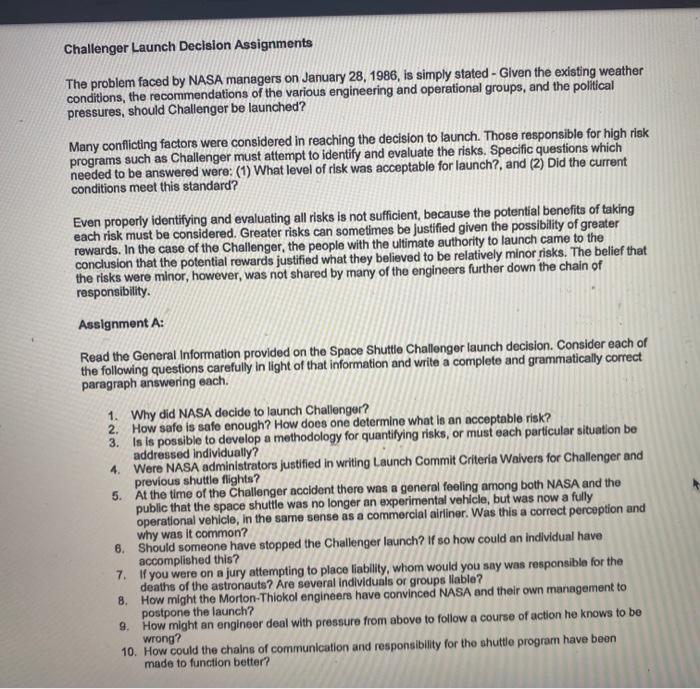
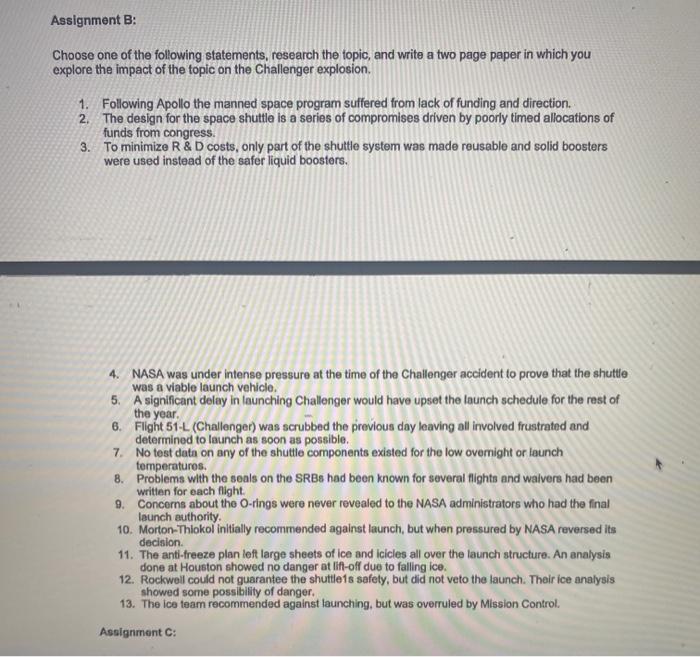
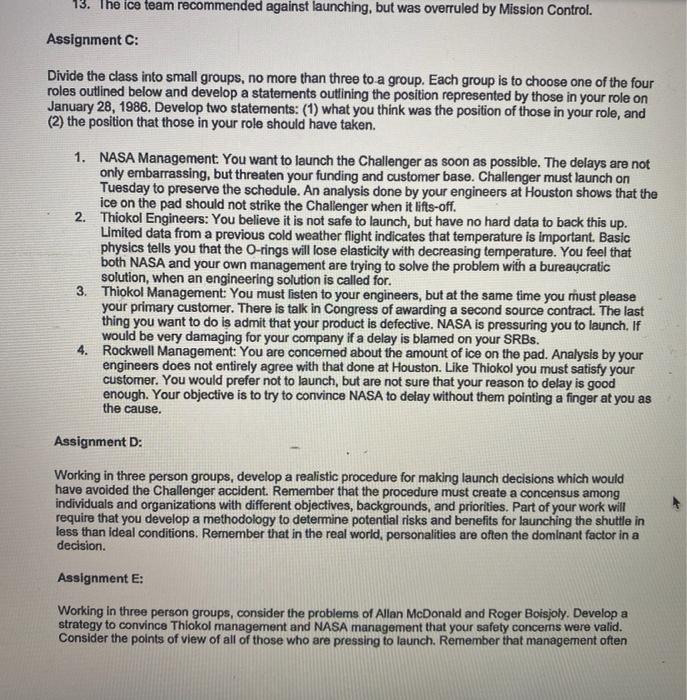
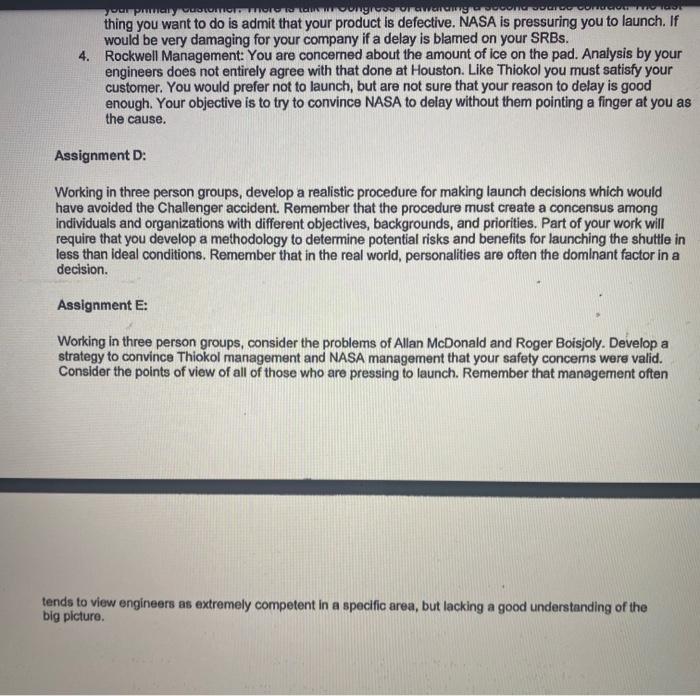
Challenger Launch Decision Assignments The problem faced by NASA managers on January 28,1986 , is simply stated - Given the existing weather conditions, the recommendations of the various engineering and operational groups, and the political pressures, should Challenger be launched? Many conflicting factors were considered in reaching the decision to launch. Those responsible for high riak programs such as Challenger must attempt to identify and evaluate the risks. Specific questions which needed to be answered were: (1) What level of risk was acceptable for launch?, and (2) Did the current conditions meet this standard? Even properly identifying and evaluating all risks is not sufficient, because the potential benefits of taking each risk must be considered. Greater risks can sometimes be justified given the possibility of greater rewards. In the case of the Challenger, the people with the ultimate authority to launch came to the conclusion that the potential rewards justified what they believed to be relatively minor risks. The belief that the risks were minor, however, was not shared by many of the engineers further down the chain of responsibility. Assignment A: Read the General Information provided on the Space Shuttle Challenger launch decision. Consider each of the following questions carefully in light of that information and write a complete and grammatically correct paragraph answering each. 1. Why did NASA decide to launch Challenger? 2. How safe is safe enough? How does one determine what is an acceptable risk? 3. Is is possible to develop a methodology for quantifying risks, or must each particular situation be addressed individually? 4. Were NASA administrators justified in writing Launch Commit Criteria Walvers for Challenger and previous shuttle flights? 5. At the time of the Challenger accident there was a general feeling among both NASA and the public that the space shuttle was no longer an experimental vehicle, but was now a fully operational vehicle, in the same sense as a commercial airliner. Was this a correct perception and why was it common? 6. Should someone have stopped the Challenger launch? If so how could an individual have accomplished this? 7. If you were on a jury attempting to place liability, whom would you say was responsible for the deaths of the astronauts? Are several indlviduals or groups llable? 8. How might the Morton-Thiokol engineers have convinced NASA and their own management to postpone the launch? 9. How might an engineer deal with pressure from above to follow a course of action he knows to be wrong? 10. How could the chains of communication and responsibility for the shuttle program have been made to function better? Assignment B: Choose one of the following statements, research the fopic, and write a two page paper in which you explore the impact of the topic on the Challenger explosion. 1. Following Apollo the manned space program suffered from lack of funding and direction. 2. The design for the space shuttle is a series of compromises driven by poorly timed allocations of funds from congress. 3. To minimize R \& D costs, only part of the shuttle system was made reusable and solid boosters were used instead of the safer liquid boosters. 4. NASA was under intense pressure at the time of the Challenger accident to prove that the shuttle was a viable launch vehicle. 5. A significant delay in launching Challenger would have upset the launch schedule for the rest of the year. 6. Flight 51L (Challenger) was scrubbed the previous day leaving all involved frustrated and determined to launch as soon as possible. 7. No test data on any of the shuttle components existed for the low ovemight or launch temperatures. 8. Problems with the seals on the SRBs had been known for several flights and waivers had been written for each flight. 9. Concerns about the O-rings were never revealed to the NASA administrators who had the final launch authority. 10. Morton-Thlokol initially recommended against launch, but when pressured by NASA reversed its decision. 11. The anti-freeze plan left large sheets of ice and icicles all over the launch structure. An analysis done at Houston showed no danger at liff-off due to falling ice. 12. Rockweil could not guarantee the shuttle1s safety, but did not veto the launch. Their ice analysis showed some possibility of danger. 13. The ice team recommended against launching, but was overruled by Mission Control. Assignment C: Divide the class into small groups, no more than three to a group. Each group is to choose one of the four roles outlined below and develop a statements outlining the position represented by those in your role on January 28, 1986. Develop two statements: (1) what you think was the position of those in your role, and (2) the position that those in your role should have taken. 1. NASA Management: You want to launch the Challenger as soon as possible. The delays are not only embarrassing, but threaten your funding and customer base. Challenger must launch on Tuesday to preserve the schedule. An analysis done by your engineers at Houston shows that the ice on the pad should not strike the Challenger when it lifts-off. 2. Thiokol Engineers: You believe it is not safe to launch, but have no hard data to back this up. Limited data from a previous cold weather flight indicates that temperature is important. Basic physics tells you that the O-rings will lose elasticity with decreasing temperature. You feel that both NASA and your own management are trying to solve the problem with a bureaucratic solution, when an engineering solution is called for. 3. Thiokol Management: You must listen to your engineers, but at the same time you must please your primary customer. There is talk in Congress of awarding a second source contract. The last thing you want to do is admit that your product is defective. NASA is pressuring you to launch, If would be very damaging for your company if a delay is blamed on your SRBs. 4. Rockwell Management: You are concemed about the amount of ice on the pad. Analysis by your engineers does not entirely agree with that done at Houston. Like Thiokol you must satisfy your customer. You would prefer not to launch, but are not sure that your reason to delay is good enough. Your objective is to try to convince NASA to delay without them pointing a finger at you as the cause. Assignment D: Working in three person groups, develop a realistic procedure for making launch decisions which would have avoided the Challenger accident. Remember that the procedure must create a concensus among individuals and organizations with different objectives, backgrounds, and priorities. Part of your work will require that you develop a methodology to determine potential risks and benefits for launching the shuttle in less than ideal conditions. Remember that in the real world, personalities are often the dominant factor in a decision. Assignment E: Working in three person groups, consider the problems of Allan McDonald and Roger Boisjoly. Develop a strategy to convince Thiokol management and NASA management that your safety concems were valid. Consider the points of view of all of those who are pressing to launch. Remember that management often thing you want to do is admit that your product is defective. NASA is pressuring you to launch. If would be very damaging for your company if a delay is blamed on your SRBs. 4. Rockwell Management: You are concerned about the amount of ice on the pad. Analysis by your engineers does not entirely agree with that done at Houston. Like Thiokol you must satisfy your customer. You would prefer not to launch, but are not sure that your reason to delay is good enough. Your objective is to try to convince NASA to delay without them pointing a finger at you as the cause. Assignment D: Working in three person groups, develop a realistic procedure for making launch decisions which would have avoided the Challenger accident. Remember that the procedure must create a concensus among individuals and organizations with different objectives, backgrounds, and priorities. Part of your work will require that you develop a methodology to determine potential risks and benefits for launching the shuttle in less than ideal conditions. Remember that in the real world, personalities are often the dominant factor in a decision. Assignment E: Working in three person groups, consider the problems of Allan McDonald and Roger Boisjoly. Develop a strategy to convince Thiokol management and NASA management that your safety concems were valid. Consider the points of view of all of those who are pressing to launch. Remember that management often tends to view engineers as extremely competent in a specific area, but lacking a good understanding of the big picture. Challenger Launch Decision Assignments The problem faced by NASA managers on January 28,1986 , is simply stated - Given the existing weather conditions, the recommendations of the various engineering and operational groups, and the political pressures, should Challenger be launched? Many conflicting factors were considered in reaching the decision to launch. Those responsible for high riak programs such as Challenger must attempt to identify and evaluate the risks. Specific questions which needed to be answered were: (1) What level of risk was acceptable for launch?, and (2) Did the current conditions meet this standard? Even properly identifying and evaluating all risks is not sufficient, because the potential benefits of taking each risk must be considered. Greater risks can sometimes be justified given the possibility of greater rewards. In the case of the Challenger, the people with the ultimate authority to launch came to the conclusion that the potential rewards justified what they believed to be relatively minor risks. The belief that the risks were minor, however, was not shared by many of the engineers further down the chain of responsibility. Assignment A: Read the General Information provided on the Space Shuttle Challenger launch decision. Consider each of the following questions carefully in light of that information and write a complete and grammatically correct paragraph answering each. 1. Why did NASA decide to launch Challenger? 2. How safe is safe enough? How does one determine what is an acceptable risk? 3. Is is possible to develop a methodology for quantifying risks, or must each particular situation be addressed individually? 4. Were NASA administrators justified in writing Launch Commit Criteria Walvers for Challenger and previous shuttle flights? 5. At the time of the Challenger accident there was a general feeling among both NASA and the public that the space shuttle was no longer an experimental vehicle, but was now a fully operational vehicle, in the same sense as a commercial airliner. Was this a correct perception and why was it common? 6. Should someone have stopped the Challenger launch? If so how could an individual have accomplished this? 7. If you were on a jury attempting to place liability, whom would you say was responsible for the deaths of the astronauts? Are several indlviduals or groups llable? 8. How might the Morton-Thiokol engineers have convinced NASA and their own management to postpone the launch? 9. How might an engineer deal with pressure from above to follow a course of action he knows to be wrong? 10. How could the chains of communication and responsibility for the shuttle program have been made to function better? Assignment B: Choose one of the following statements, research the fopic, and write a two page paper in which you explore the impact of the topic on the Challenger explosion. 1. Following Apollo the manned space program suffered from lack of funding and direction. 2. The design for the space shuttle is a series of compromises driven by poorly timed allocations of funds from congress. 3. To minimize R \& D costs, only part of the shuttle system was made reusable and solid boosters were used instead of the safer liquid boosters. 4. NASA was under intense pressure at the time of the Challenger accident to prove that the shuttle was a viable launch vehicle. 5. A significant delay in launching Challenger would have upset the launch schedule for the rest of the year. 6. Flight 51L (Challenger) was scrubbed the previous day leaving all involved frustrated and determined to launch as soon as possible. 7. No test data on any of the shuttle components existed for the low ovemight or launch temperatures. 8. Problems with the seals on the SRBs had been known for several flights and waivers had been written for each flight. 9. Concerns about the O-rings were never revealed to the NASA administrators who had the final launch authority. 10. Morton-Thlokol initially recommended against launch, but when pressured by NASA reversed its decision. 11. The anti-freeze plan left large sheets of ice and icicles all over the launch structure. An analysis done at Houston showed no danger at liff-off due to falling ice. 12. Rockweil could not guarantee the shuttle1s safety, but did not veto the launch. Their ice analysis showed some possibility of danger. 13. The ice team recommended against launching, but was overruled by Mission Control. Assignment C: Divide the class into small groups, no more than three to a group. Each group is to choose one of the four roles outlined below and develop a statements outlining the position represented by those in your role on January 28, 1986. Develop two statements: (1) what you think was the position of those in your role, and (2) the position that those in your role should have taken. 1. NASA Management: You want to launch the Challenger as soon as possible. The delays are not only embarrassing, but threaten your funding and customer base. Challenger must launch on Tuesday to preserve the schedule. An analysis done by your engineers at Houston shows that the ice on the pad should not strike the Challenger when it lifts-off. 2. Thiokol Engineers: You believe it is not safe to launch, but have no hard data to back this up. Limited data from a previous cold weather flight indicates that temperature is important. Basic physics tells you that the O-rings will lose elasticity with decreasing temperature. You feel that both NASA and your own management are trying to solve the problem with a bureaucratic solution, when an engineering solution is called for. 3. Thiokol Management: You must listen to your engineers, but at the same time you must please your primary customer. There is talk in Congress of awarding a second source contract. The last thing you want to do is admit that your product is defective. NASA is pressuring you to launch, If would be very damaging for your company if a delay is blamed on your SRBs. 4. Rockwell Management: You are concemed about the amount of ice on the pad. Analysis by your engineers does not entirely agree with that done at Houston. Like Thiokol you must satisfy your customer. You would prefer not to launch, but are not sure that your reason to delay is good enough. Your objective is to try to convince NASA to delay without them pointing a finger at you as the cause. Assignment D: Working in three person groups, develop a realistic procedure for making launch decisions which would have avoided the Challenger accident. Remember that the procedure must create a concensus among individuals and organizations with different objectives, backgrounds, and priorities. Part of your work will require that you develop a methodology to determine potential risks and benefits for launching the shuttle in less than ideal conditions. Remember that in the real world, personalities are often the dominant factor in a decision. Assignment E: Working in three person groups, consider the problems of Allan McDonald and Roger Boisjoly. Develop a strategy to convince Thiokol management and NASA management that your safety concems were valid. Consider the points of view of all of those who are pressing to launch. Remember that management often thing you want to do is admit that your product is defective. NASA is pressuring you to launch. If would be very damaging for your company if a delay is blamed on your SRBs. 4. Rockwell Management: You are concerned about the amount of ice on the pad. Analysis by your engineers does not entirely agree with that done at Houston. Like Thiokol you must satisfy your customer. You would prefer not to launch, but are not sure that your reason to delay is good enough. Your objective is to try to convince NASA to delay without them pointing a finger at you as the cause. Assignment D: Working in three person groups, develop a realistic procedure for making launch decisions which would have avoided the Challenger accident. Remember that the procedure must create a concensus among individuals and organizations with different objectives, backgrounds, and priorities. Part of your work will require that you develop a methodology to determine potential risks and benefits for launching the shuttle in less than ideal conditions. Remember that in the real world, personalities are often the dominant factor in a decision. Assignment E: Working in three person groups, consider the problems of Allan McDonald and Roger Boisjoly. Develop a strategy to convince Thiokol management and NASA management that your safety concems were valid. Consider the points of view of all of those who are pressing to launch. Remember that management often tends to view engineers as extremely competent in a specific area, but lacking a good understanding of the big picture Step by Step Solution
There are 3 Steps involved in it
1 Expert Approved Answer
Step: 1 Unlock

Question Has Been Solved by an Expert!
Get step-by-step solutions from verified subject matter experts
Step: 2 Unlock
Step: 3 Unlock
 Study Help