







Question: Assignment A only! Read the General Information provided on the Space Shuttle Challenger launch decision. Consider each of the following questions carefully in light of
Assignment A only! 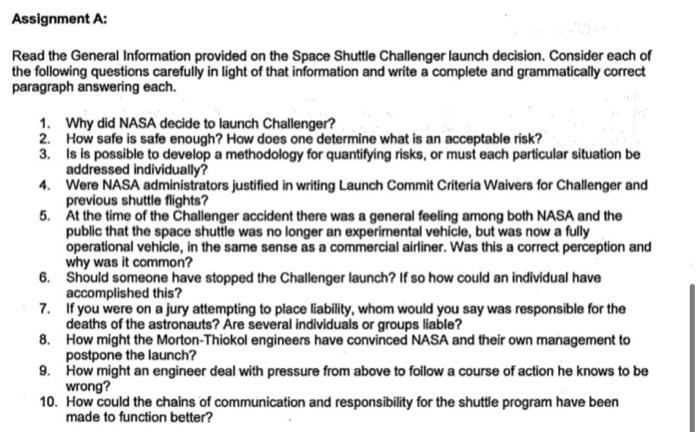
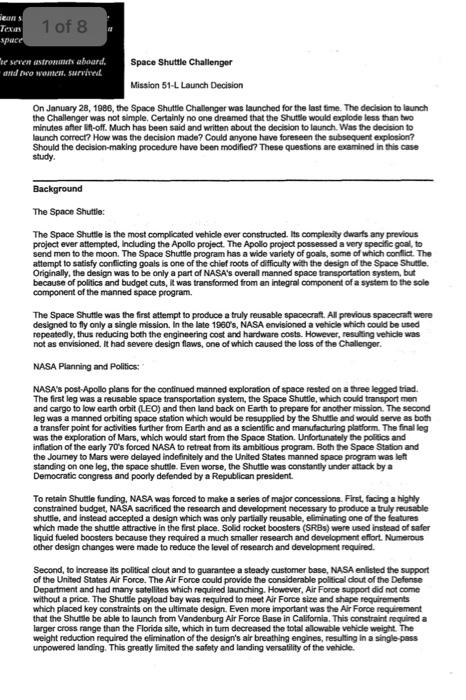
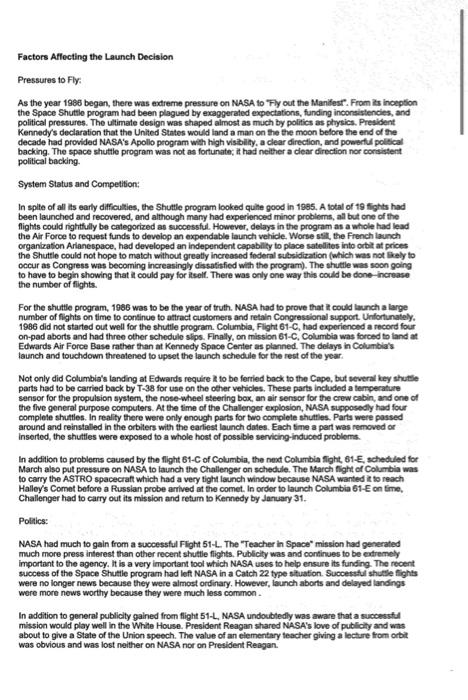
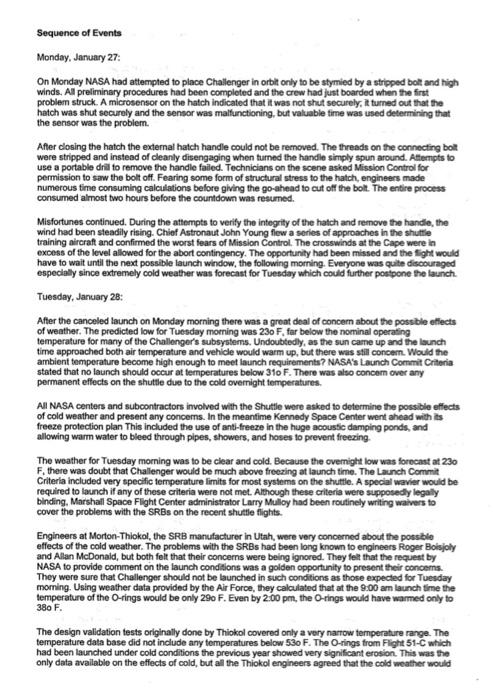
Read the General Information provided on the Space Shuttle Challenger launch decision. Consider each of the following questions carefully in light of that information and write a complete and grammatically correct paragraph answering each. 1. Why did NASA decide to launch Challenger? 2. How safe is safe enough? How does one determine what is an acceptable risk? 3. Is is possible to develop a methodology for quantifying risks, or must each particular situation be addressed individually? 4. Were NASA administrators justified in writing Launch Commit Criteria Waivers for Challenger and previous shuttle flights? 5. At the time of the Challenger accident there was a general feeling among both NASA and the public that the space shuttle was no longer an experimental vehicle, but was now a fully operational vehicle, in the same sense as a commercial airliner. Was this a correct perception and why was it common? 6. Should someone have stopped the Challenger launch? If so how could an individual have accomplished this? 7. If you were on a jury attempting to place liability, whom would you say was responsible for the deaths of the astronauts? Are several individuals or groups liable? 8. How might the Morton-Thiokol engineers have convinced NASA and their own management to postpone the launch? 9. How might an engineer deal with pressure from above to follow a course of action he knows to be wrong? 10. How could the chains of communication and responsibility for the shuttle program have been made to function better? Space Shuttle Challenger Mission 51-L Launch Decision On January 28, 1988, the Space Shuttle Challenger was launched for the last time. The decision to launch the Challenger was not simple. Certainly no one dreamed that the Shutlle would explode less than two minutes after ILt-off. Much has been said and written about the decision to launch. Was the decision to launch correct? How was the decision made? Could anyone have foreseen the subsequent explosion? Should the decision-making procedure have been modified? These questions are examined in this case study. Background The Space Shuttle: The Space Shuttle is the most complicated vehiclo over constructed. Its complexity dwarts any previous project ever attempted, Including the Apoilo project. The Apollo project possessed a very specific goal, to send men to the moon. The Space Shuttle program has a wide variety of goals, some of which conflict. The attempt to satisfy conficting goals is one of the chief roots of difficully with the design of the Space Shuttle. Originally, the design was to be only a part of NASA's overall manned space transportation system, but because of politics and budget cuts, it was transformed from an integral componcot of a system to the sole component of the manned space program. The Space Shuttle was the first attempt to produce a truly reusable spacecraft. All previous spacecraft were designed to fly only a single mission. In the late 1960, NASA envisioned a vehicle which could be used repeatedly, thus reducing both the engineering cost and hardware costs. However, resulting vehicle was not as ervisioned. It had severe design flaws, one of which caused the loss of the Challiengor. NASA Planning and Politics: NASA's post.Apollo plans for the continued manned exploration of space rested on a three legged triad. The first leg was a reusable space transportation systern, the Space Shuttle, which could transport mon and cargo to low earth orbit (LEO) and then land back on Earth to prepare for another mission. The second leg was a manned orbiting space station which would be resupplied by the Shuttle and would serve as both a transfer point for activities further from Earth and as a sclentific and manufachuring platform. The final log was the exploration of Mars, which would start from the Space Station. UnIortunately the poleics and inflation of the early 7O's forced NASA to retreat from its ambitious program. Both the Space Station and the Journey to Mars were delayed indefinitely and the United States manned space program was left standing on one leg, the space shutlle. Even worse, the Shuttle was constantly under attack by a Democratic congress and poorty defended by a Republican president. To retain Shuttle funding, NASA was forced to make a series of major concessions. First, facing a highly constrained budget, NASA sacrificed the research and development necessary to produce a truly reusable shutife, and instead accepted a detign which was only partially reusable, eliminating one of the features which made the shutte attractive in the first place. Solid rocket boosters (SFBs) were used instead of safer liquid fueled boosters because they required a much smaller research and dovelopment effort. Numerous other design changes were made to reduce the level of research and development required. Second, to increase its political clout and to guarantee a steady customer base, NASA enlisted the support of the United States Air Force. The Air Force could provide the considerable poilical dout of the Defense Department and had many satellites which required launching. However, Air Force support did not come without a price. The Shuttfe payload bay was required to meet Air Force size and shape requirements which placed key constraints on the ullimate design. Even more important was the Air Force requirement that the Shutle be able to launch from Vandenburg Air Force Base in California. This constraint required a larger cross range than the Florida slile, which in turn decreased the total alowable vehide weight. The weight reduction required the elimination of the design's air breathing engines, resulting in a single pass unpowered landing. This greatly limited the safety and landing versatility of the vehicle. Factors Affecting the Launch Decision Pressures to Fly: As the year 1986 began, there was exdreme pressure on NASA to Fly out the Manifest. From its inception the Space Shuttle program had been plagued by exaggerated expectations, funding inconsistencies, and political pressures. The ultimate design was shaped alrnost as much by politics as phrysics. President Kennedy's declaration that the United States would land a man on the the moon before the end of the decade had provided NASA's Apollo program with high visbility, a clear direction, and powerful polisical backing. The space shuttle program was not as fortunate; it had neither a dear direction nor consictent political backing. System Status and Competition: In spite of all its early difficurties, the Shuttle program looked quihe good in 1985 . A total of 19 fights had been launched and recovered, and although mary had experienced minor problems, all but one of the flights could rightfully be categorized as successful. However, delays in the program as a whole had lead the Air Force to request funds to develop an expendable launch vehicle. Worse ssiil, the French launch organization Arlanespace, had developed an independent capability to place satellites into ortit at prices the Shuttle could not hope to match without greatly increased federal subsidization (which was not likely to occur as Congress was becoming increasingly dissatisfied with the program). The shutlle was soon going to have to begin showing that in could pay for iself. There was only one way this could be done-increase the number of fights. For the shuttle program, 1966 was to be the year of truth. NASA had to prove that iz could launch a large number of fights on time to continue to attract customers and retain Congressional support. Unfortunately. 1966 did not started out well for the shutlle program. Columbia, Flight 61-C, had experienced a record four on-pad aborts and had three other schedule slips. Finally, on mission 61-C, Columbia was forced to land at Edwards Air Force Base rather than at Kennedy Space Center as planned. The delays in Columbia's launch and touchdown threatened to upset the launch schedule for the rest of the year. Not only did Columbia's landing at Edwards require in to be ferried back to the Cape, but several key shutte parts had to be carried back by T-38 for use on the other vehicles. These parts included a tenperature sensor for the propulsion system, the nose-wheel steering box, an air sensor for the crew cabin, and one of the flve general purpose computers. At the time of the Challenger explosion, NASA supposedly had four complete shutlies. In reality there were only enough parts for two complete shutties. Parta were passed around and reinstalled in the orbilers with the earliest launch dates. Each fime a part was removed or inserted, the shuttles were exposed to a whole host of possible servicing-induced probloms. In addition to problems caused by the flight 61-C of Columbia, the next Columbia fight, 61-E, scheduled for March also put pressure on NASA to launch the Challenger on schedule. The March fight of Columbia was to carry the ASTRO spacecraft which had a very tight launch window because NASA wanted it to reach Halley's Comet before a Russian probe arrived at the comet. In order to launch Columbia 61-E on fime, Challenger had to carry out its mission and return to Kennedy by January 31. Polfics: NASA had much to gain from a successful Fight 51-L. The "Teacher in Space" mission had generated much more press interest than other recent shuttle flights. Publicity was and continues to be exdremely important to the agency, it is a very important tool which NASA uses to help ensure its funding. The recent success of the Space Shutlle program had left NASA in a Catch 22 type situation. Successtul shutte fights were no longer news because they were almost ordinary. However, launch aborts and delayed landings were more news worthy because they were much less common. In addition to general publicity gained from flight 51-L, NASA undoubtedly was aware that a successful mission would play woll in the White House. President Reagan shared NASA's love of publicity and was about to give a State of the Union speech. The value of an elementary teacher giving a lecture from orbit was obvious and was lost neither on NASA nor on President Reagan. Sequence of Events Monday, Jaruary 27: On Monday NASA had attempted to place Challenger in orbit only to be stymied by a stripped bolt and high winds. Al preliminary procedures had been completed and the crew had just boarded when the first problem struck. A microsensor on the hatch indicated that it was not shut securely, it turned out that the hatch was shut securoly and the sensor was malfunctioning, but valuable time was used determining that the sensor was the problem. After closing the hatch the external hatch handle could not be removed. The threads on the connecting boll were stripped and insteed of cleanly disengaging when turned the handle simply spun around. Attempts to use a portable drill to remove the handle failed. Technicians on the scene asked Mission Control for permission to saw the bolt off. Fearing some form of structural stress to the hatch, engineers made numerous time consuming calculations before giving the go-ahead to cut off the bolt. The entire process consumed almost two hours before the countdown was resumed. Misfortunes continued. During the attempts to verify the integrity of the hatch and remove the handle, the wind had been steadily rising. Chief Astronaut John Young flew a sories of approaches in the shuttle training aircraft and confirmed the worst fears of Mission Control. The crosswinds at the Cape were in excess of the level allowed for the abort contingency. The opportunity had been missed and the fight would have to wait until the next possible launch window, the following morning. Everyone was quite discouragod especlally since extremely cold weather was forecast for Tuesday which could further postpone the launch. Tuesday, January 28: After the canceled launch on Monday morning there was a great deal of concern about the possible effects of weather. The predicted low for Tuesday moening was 230F4 far below the nominal operating temperature for many of the Challenger's subsystems. Undoubtedly, as the sun came up and the launch time approached both air ternperature and vehicle would warm up, but there was still concern. Would the ambient temperature become high enough to meet launch requirements? NASA's Launch Commit Criteria stated that no launch should occur at temperatures below 310F. There was also concem over any permanent effects on the shuttle due to the cold overnight temperatures. All NASA centers and subcontractors involved with the Shutlle were asked to determine the possible effects of cold weather and present any concems. In the meantime Kennedy Space Center went ahead with is freeze protection plan This included the use of ant-freeze in the huge acoustic damping ponds, and allowing warm water to bleed through pipes, showers, and hoses to prevent freezing. The weather for Tuesday morning was to be clear and cold. Because the ovemight low was forocast at 23o Criteria included very specific temperature fimits for most systems on the shuttle. A special wavier would be required to launch if any of these criteria were not met. Although these criteria were supposedly legally binding. Marshall Space Flight Center administrator Larry Mulloy had been routinely writing waivers to cover the problems with the SRBs on the recent shutlle flights. Engineers at Morton-Thiokol, the SRB manufacturer in Utah, were very conoerned about the possble effects of the cold weather. The problems with the SRBs had been long known to engineers Roger Boisjoly and Allan McDonald, but both felt that their concerns were being ignored. They felt that the request by NASA to provide comment on the launch condisions was a golden opportunity to present their concerns. They were sure that Challenger should not be launched in such conditions as those expected for Tuesday moming. Using weather data provided by the Air Force, they calculated that at the 9.00 am launch time the temperature of the O-rings would be only 290F. Even by 2.00 pm, the O-rings would have warmed only to 38oF. The design validation tests originally done by Thiokol covered only a very nartow temperature range. The temperature data base did not include any temperatures below 530F. The O-rings from Flight 51 -C which had been launched under cold conditions the previous year showed very significant erosion. This was the only data available on the effects of cold, but all the Thiokol engineers agreed that the cold weather would decrease the elasticity of the synthetic rubber O-rings, which in tum might cause them to seal slowly and allow hot combustion gas to surge through the joint. Based on the these results, the engineers at Thiokol recommend to NASA Marshall that Challenger not be launched until the O-ings reached a temperature of 53oF. The management of Marshall was flabbergasted, and demanded that Thiokol prove that launching was unsafe. This was a complete reversal of normal procedure. Normally, NASA required its subcontractors to prove that something was safe. Now they were requiring their subcontractors to prove that something was unsafe. Faced with this extreme pressure, Thiokol management asked its engineers to reconsider their position. When the engineers stuck to their original recommendations not to tly, Thickol management overruled them and gave NASA its approval to launch. Rockwell, the company which manufactured the Orbller also had concerns about launching in cold and icy conditions. Their major concem was the posslbility of loe from either the shuttle or the launch structure striking and damaging the vehicle. Like Thiokol, they recommended against the launch, and they too were pressed to explain their reasoning. Instead of sticking with their original strong recommendation against launch, the Rockwell team carefuly worded their statement to say that they could not fully guarantee the safety of the shuttle. In its desire to fly out its manifest, NASA was willing to accept this as a recommendation. The final decision to launch, however, belonged to Jesse Moore. He was intormed of Rockwelis concerns, but was also told that they had approved the launch. The engineers and management from NASA Marshall chose not to even mention the original concerns of Thiokol. Somehow, as the warnings and concerns were communicated up each step of the latter of responsibility they became diminished. Late Monday night the decision to push onward with the launch was made. Despite the very real concerns of some of the engineers famillar with the actual vehicle subsystems, the launch was approved. No one at NASA wantod to be responsible for further delaying an already delayed launch. Everyone was aware of the pressure on the agency to fly out the manilest, yet no one would have consciously risked the lives of the seven astronauts. Somehow, the potential rewards had come to outweigh the polential risics. Clearfy, there were many reasons for launching Challenger on that cold Tuesday moming in addition a great deal of frustration from the previous launch attempt remained. Pre-Launch Events: Although the decision to launch on Tuesday had been made late on Monday night, it was still possible that something might force NASA to postpone the launch. However, the decision to launch had been made, and nothing was going to stand in the way, the "press ori" mentality was firmly establshed and even if all of Florida froze over, Challenger would launch. The prelaunch inspection of Chalenger and the launch pad by the ice-team was unusual to say the least. The ice-team's responsibility was to removing any frost or ice on the vehicle or launch structure. What they found during their inspection looked like something out of a science fiction movie. The freeze protection plan implemented by Kennedy personnel had gone very wrong. Hundreds of icicles, some up to 16 inches long. clung the to launch structure. The handrails and walkways near the shuttle entrance were covered in ice, making them extremely dangercus if the crew had to make an emergency evacuation. One solid sheet of ice stretched frorn the 195 foot level to the 235 foot level on the gantry. However, NASA continued to cling to its calculations that there would be no damage due to fying ice shaicen lose during the launch. The Launch: As the SRBs ignited, the cold conditions did not allow the O-rings to properly seat. Wrthin the first 300 miliseconds of ignition, both the primary and secondary O-rings on the lowest section of the right SRB were vaporized across 700 of are by the hot combustion gases. Puflis of smoke with the same frequency as the vibrating booster are clearly present in pictures of the launch. However, soon after clearing the tower, a temporary seal of glassy aluminum-cxides from the propellent formed in place of the burned O-rings and Challenger continued skyward. Unfortunately, at the time of greatest dynamic pressure, the shuttle encountered wind shear. As the Challenger's guidance control lurched the Shuttle to compensate for the wind shear, the fragile aluminumoxide seal shattered. Flame arched out of the joint, struck the external tank and quickly bumed through the insulation and the the aluminum structure. Liquid Hydrogen fuel streamed out and was ignited. The Challenger exploded. When the remains of the cabin were recovered, it became apparent that most of the crew survived the explosion and separation of the Shuttle from the rest of the vehicle. During the 2 minute 45 second fall to the ocean at least four of the personal egress packs were activated and at least three were functioning when the Challenger stuck water. The high speed impact with the water produced a force of 200g and undoubtedly killed all the crew. Post-Crash Events: Since the crash of Challenger, NASA and external investigators have taken a look at both the shuttle and the sequence of events which allowed it to be launched. The SRBs have gone through significant redesign and now include a capture feature on the field joint. The three Marshall administrators most responsible for allowing the SRB problems to go uncorrected have all left NASA. Following the recommendations of the Rogers commission, NASA has attempted to streamline and clean-up its communication lines. A system for reporting suspected problems anonymously now exists within NASA. In addition, the astronauts themselves are now much more active in many decision making aspects of the program. The current NASA Administrator, Admiral Richard Truly, is a former shuttle astronaut Step by Step Solution
There are 3 Steps involved in it
1 Expert Approved Answer
Step: 1 Unlock

Question Has Been Solved by an Expert!
Get step-by-step solutions from verified subject matter experts
Step: 2 Unlock
Step: 3 Unlock
 Study Help