







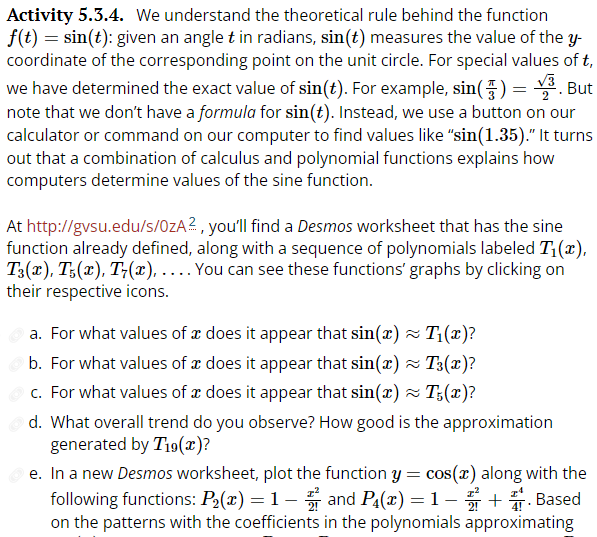
Question: Help please, http://gvsu.edu/s/0zA Activity 5.3.4. We understand the theoretical rule behind the function f(t) = sin(t): given an angle t in radians, sin(t) measures the
Help please, http://gvsu.edu/s/0zA
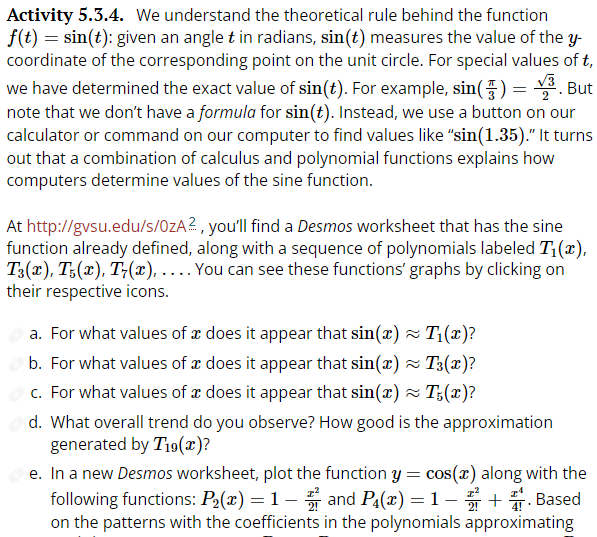
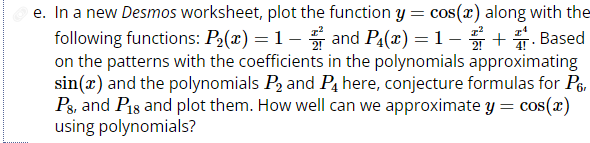
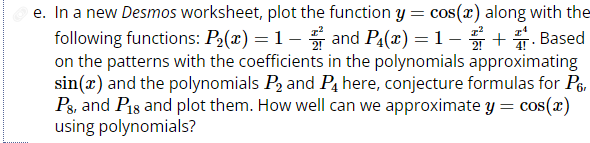
Activity 5.3.4. We understand the theoretical rule behind the function f(t) = sin(t): given an angle t in radians, sin(t) measures the value of the y- coordinate of the corresponding point on the unit circle. For special values of t, we have determined the exact value of sin(t). For example, sin (@ ) = . But note that we don't have a formula for sin(t). Instead, we use a button on our calculator or command on our computer to find values like "sin (1.35)." It turns out that a combination of calculus and polynomial functions explains how computers determine values of the sine function. At http://gvsu.edu/s/OzA2. , you'll find a Desmos worksheet that has the sine function already defined, along with a sequence of polynomials labeled Ti(x), Ta(2), Ts(2), T,(x), .. . . You can see these functions' graphs by clicking on their respective icons. a. For what values of & does it appear that sin(2) ~ Ti(x)? b. For what values of & does it appear that sin(x) ~ Ta(x)? c. For what values of & does it appear that sin() ~ Ts(x)? d. What overall trend do you observe? How good is the approximation generated by Tio()? e. In a new Desmos worksheet, plot the function y = cos(@) along with the following functions: P2(x) =1 - ,, and PA(2) =1 - 27 + 4. Based on the patterns with the coefficients in the polynomials approximationge. In a new Desmos worksheet, plot the function y = cos(@) along with the following functions: P2(2) = 1 - 2 ! and PA(2) = 1 - Based on the patterns with the coefficients in the polynomials approximative sin () and the polynomials , and P, here, conjecture formulas for Po. P&, and Pis and plot them. How well can we approximate y = cos() using polynomials
Step by Step Solution
There are 3 Steps involved in it

Get step-by-step solutions from verified subject matter experts
 Study Help