







Question: Help please! Multi-core and Amdahl' Law. Designers are comparing performance between a multi-core processor equipped with 32 in-order core, and a quad-core superscalar processor has
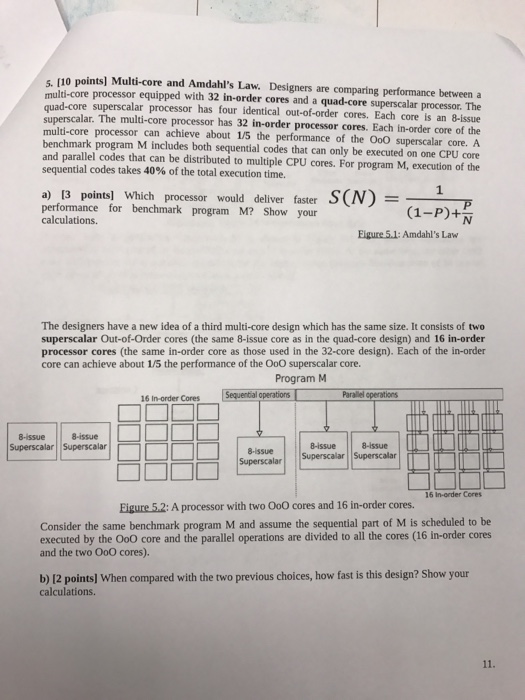
Multi-core and Amdahl' Law. Designers are comparing performance between a multi-core processor equipped with 32 in-order core, and a quad-core superscalar processor has four identical out-of-order cores. Each core is an 8-issue superscalar. The multi-core processor has 32 in-order processor cores. Each in-order core of the multi-core processor can achieve about 1/5 the performance of the OoO superscalar core A benchmark program M includes both sequential codes that can only be executed on one CPU core and parallel codes that can be distributed to multiple CPU cores. For program M, execution of the sequential codes takes 40% of the total execution time. a) Which processor would deliver faster performance for benchmark program M? Show your calculations. S(N) = 1/(1 - P)+ P/N The designers have a new idea of a third multi-core design which has the same size. It consists of two superscalar Out-of-Order cores (the same 8-issue core as in the quad-core design) and 16 in-order processor cores (the same in-order core as those used in the 32-core design). Each of the in-order core can achieve about 1/5 the performance of the OoO superscalar core. Consider the same benchmark program M and assume executed by the OoO core and the parallel operations are divided to all the cores (16 in-order cores and the two OoO cores). b) When compared with the two previous choices, how fast is this design? Show your calculations
Step by Step Solution
There are 3 Steps involved in it

Get step-by-step solutions from verified subject matter experts
 Study Help