







Question: Help Save & Exit Sub: Check my world When Microsoft went public, the company sold 2 million new shares (the primary issue). In addition, existing
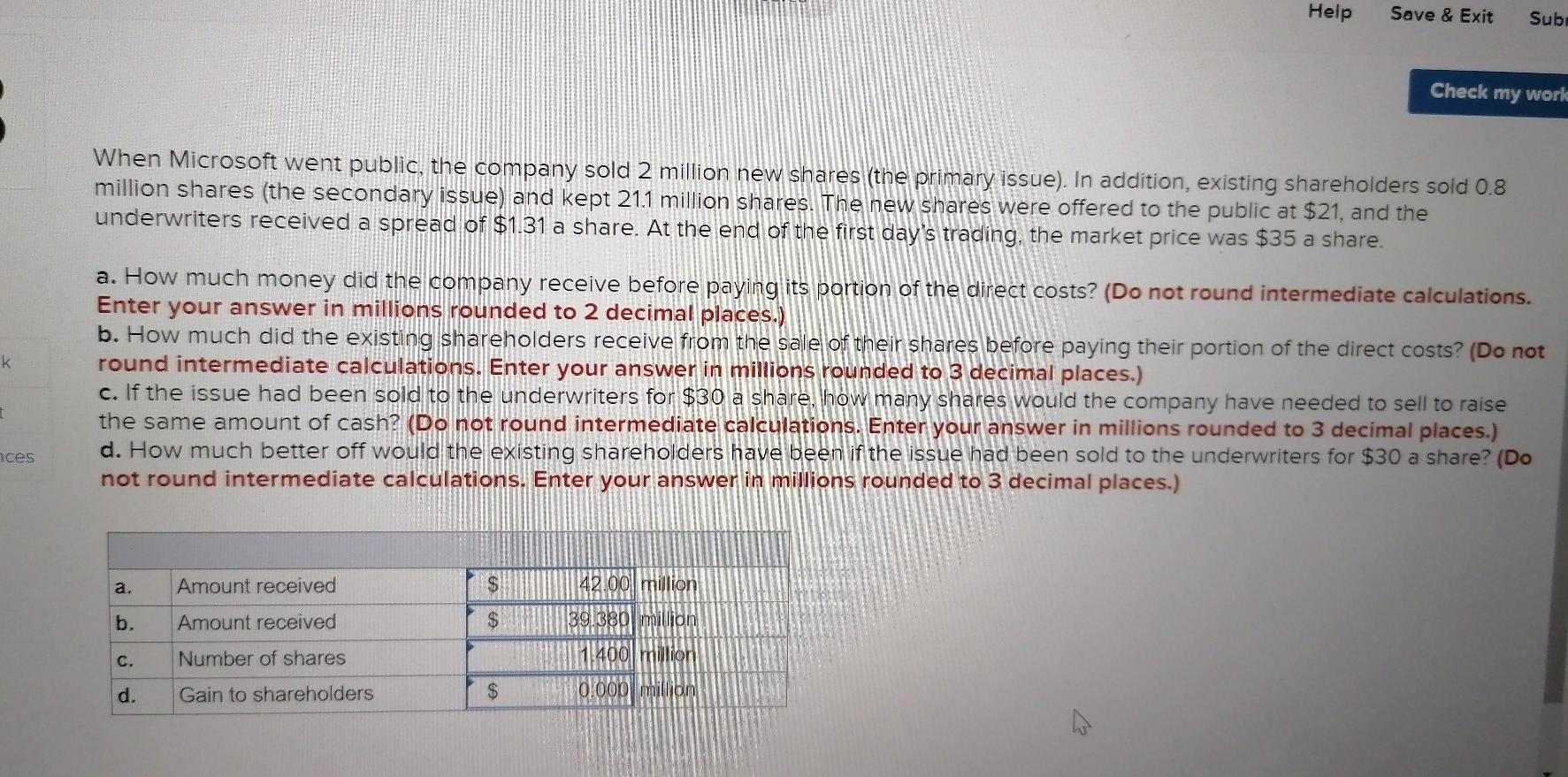
Help Save & Exit Sub: Check my world When Microsoft went public, the company sold 2 million new shares (the primary issue). In addition, existing shareholders sold 0.8 million shares (the secondary issue) and kept 21.1 million shares. The new shares were offered to the public at $21, and the underwriters received a spread of $1.31 a share. At the end of the first day's trading, the market price was $35 a share. k k a. How much money did the company receive before paying its portion of the direct costs? (Do not round intermediate calculations. Enter your answer in millions rounded to 2 decimal places.) b. How much did the existing shareholders receive from the sale of their shares before paying their portion of the direct costs? (Do not round intermediate calculations. Enter your answer in millions rounded to 3 decimal places.) c. If the issue had been sold to the underwriters for $30 a share, how many shares would the company have needed to sell to raise the same amount of cash? (Do not round intermediate calculations. Enter your answer in millions rounded to 3 decimal places.) d. How much better off would the existing shareholders have been if the issue had been sold to the underwriters for $30 a share? (Do not round intermediate calculations. Enter your answer in millions rounded to 3 decimal places.) nces a. Amount received 42.000 million b. Amount received $ 39.880 million C. Number of shares 1400 million d. Gain to shareholders 0.00 million Help Save & Exit Sub: Check my world When Microsoft went public, the company sold 2 million new shares (the primary issue). In addition, existing shareholders sold 0.8 million shares (the secondary issue) and kept 21.1 million shares. The new shares were offered to the public at $21, and the underwriters received a spread of $1.31 a share. At the end of the first day's trading, the market price was $35 a share. k k a. How much money did the company receive before paying its portion of the direct costs? (Do not round intermediate calculations. Enter your answer in millions rounded to 2 decimal places.) b. How much did the existing shareholders receive from the sale of their shares before paying their portion of the direct costs? (Do not round intermediate calculations. Enter your answer in millions rounded to 3 decimal places.) c. If the issue had been sold to the underwriters for $30 a share, how many shares would the company have needed to sell to raise the same amount of cash? (Do not round intermediate calculations. Enter your answer in millions rounded to 3 decimal places.) d. How much better off would the existing shareholders have been if the issue had been sold to the underwriters for $30 a share? (Do not round intermediate calculations. Enter your answer in millions rounded to 3 decimal places.) nces a. Amount received 42.000 million b. Amount received $ 39.880 million C. Number of shares 1400 million d. Gain to shareholders 0.00 million
Step by Step Solution
There are 3 Steps involved in it

Get step-by-step solutions from verified subject matter experts
 Study Help