







Question: The relationship between the book value of shareholders' equityand the firm's Market Value Added (MVA) and Economic Value Added (EVA) Yesterday, Allied Biscuit Co. released
The relationship between the book value of shareholders' equityand the firm's Market Value Added (MVA) and Economic Value Added (EVA)
Yesterday, Allied Biscuit Co. released its 2018 annual report on the company’s website. While reading the report for her boss, Asha came across several terms about which she was unsure. She leaned around the wall of her cubicle and asked her colleague, Rafael, for help.
ASHA: Rafael, do you have a second to help me with my reading of Allied Biscuit’s annual report? I’ve come across several unfamiliar terms, and I want to make sure that I’m interpreting the data and management’s comments correctly.
For example, one of the footnotes to the financial statements uses “the book value of Allied Biscuit’s shares,” and then in another place, it uses “Market Value Added.” I’ve never encountered those terms before. Do you know what they’re talking about?
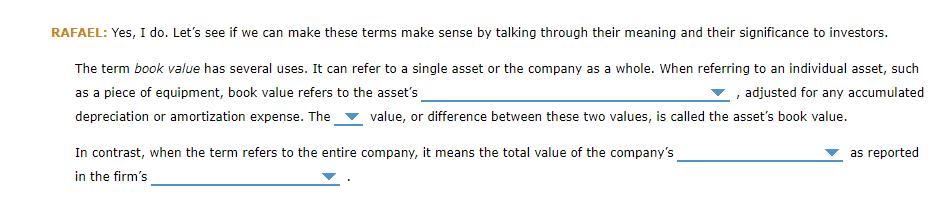


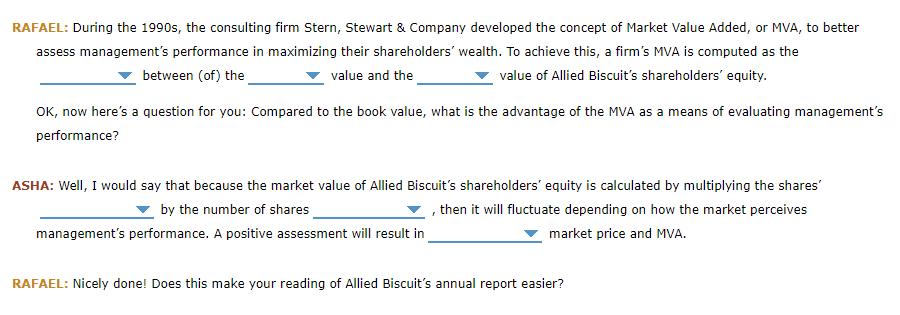
RAFAEL: Yes, I do. Let's see if we can make these terms make sense by talking through their meaning and their significance to investors. The term book value has several uses. It can refer to a single asset or the company as a whole. When referring to an individual asset, such as a piece of equipment, book value refers to the asset's , adjusted for any accumulated depreciation or amortization expense. The value, or difference between these two values, is called the asset's book value. In contrast, when the term refers to the entire company, it means the total value of the company's as reported in the firm's
Step by Step Solution
There are 3 Steps involved in it
1Historical value 2 Net 3 Stock holders equit... View full answer

Get step-by-step solutions from verified subject matter experts
 Study Help