







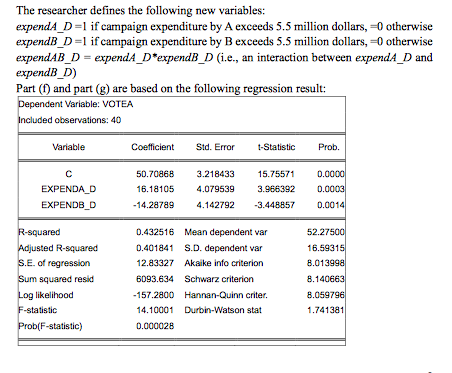
Question: Help with comparing the regressor in part (f)/(g) to regressor in part(h). How do you interpret ExpendAB_D? The researcher defines the following new variables: expendA_D=1
Help with comparing the regressor in part (f)/(g) to regressor in part(h). How do you interpret ExpendAB_D?
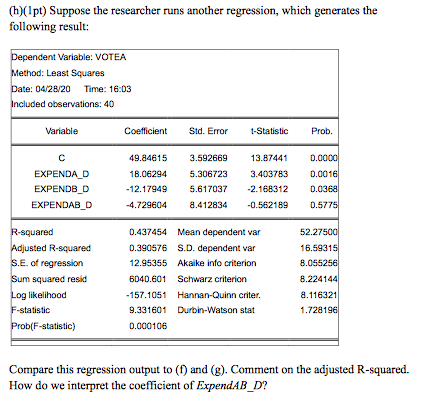
The researcher defines the following new variables: expendA_D=1 if campaign expenditure by A exceeds 5.5 million dollars, =0 otherwise expendB_D=l if campaign expenditure by B exceeds 5.5 million dollars, otherwise expendAB_D = expendA_D*expendB_D (i.e., an interaction between expenda_D and expendB_D) Part (1) and part (g) are based on the following regression result: Dependent Variable: VOTEA Included observations: 40 Variable Coefficient Std. Error t-Statistic Prob. EXPENDA_D EXPENDB_D 50.70868 16.18105 - 14.28789 3.218433 4.079539 4.142792 15.75571 3.966392 -3.448857 0.0000 0.0003 0.0014 R-squared Adjusted R-squared S.E. of regression Sum squared resid Log likelihood F-statistic Prob(F-statistic) 0.432516 Mean dependent var 0.401841 S.D. dependent var 12.83327 Akake into criterion 6093.634 Schwarz criterion -157.2800 Hannan-Quinn criter. 14.10001 Durbin-Watson stat 0.000028 52.27500 16.59315 8.013998 8.140663 8.059796 1.741381 (h)(Ipt) Suppose the researcher runs another regression, which generates the following result: Dependent Variable: VOTEA Method: Least Squares Date: 04/28/20 Time: 16:03 Included observations: 40 Variable Coefficient Std. Error t-Statistic Prob. EXPENDA_D EXPENDB_D EXPENDAB_D 49.84615 18.06294 -12.17949 -4.729604 3.592669 5.306723 5.617037 8.412834 13.87441 3.403783 -2.168312 -0.562189 0.0000 0.0016 0.0368 0.5775 R-squared Adjusted R-squared S.E. of regression Sum squared resid Log likelihood F-statistic Prob(F-statistic) 0.437454 Mean dependent var 0.390576 S.D. dependent var 12.95355 Akalke info criterion 6040.601 Schwarz criterion -157.1051 Hannan-Quinn criter. 9.331601 Durbin-Watson stat 0.000106 52.27500 16.59315 8.055256 8.224144 8.116321 1.728196 Compare this regression output to (1) and (g). Comment on the adjusted R-squared. How do we interpret the coefficient of ExpendAB_DStep by Step Solution
There are 3 Steps involved in it
1 Expert Approved Answer
Step: 1 Unlock

Question Has Been Solved by an Expert!
Get step-by-step solutions from verified subject matter experts
Step: 2 Unlock
Step: 3 Unlock
 Study Help