







Question: Help with lab please.YOU CAN START ANSWERING FROM QUESTION 7 TO 13 and ignore the other questions. Please provide clear explanations. Thank you!!Pictures might be
Help with lab please.YOU CAN START ANSWERING FROM QUESTION 7 TO 13 and ignore the other questions. Please provide clear explanations. Thank you!!Pictures might be a little blurry but zoom in a little and you should be able to see it.
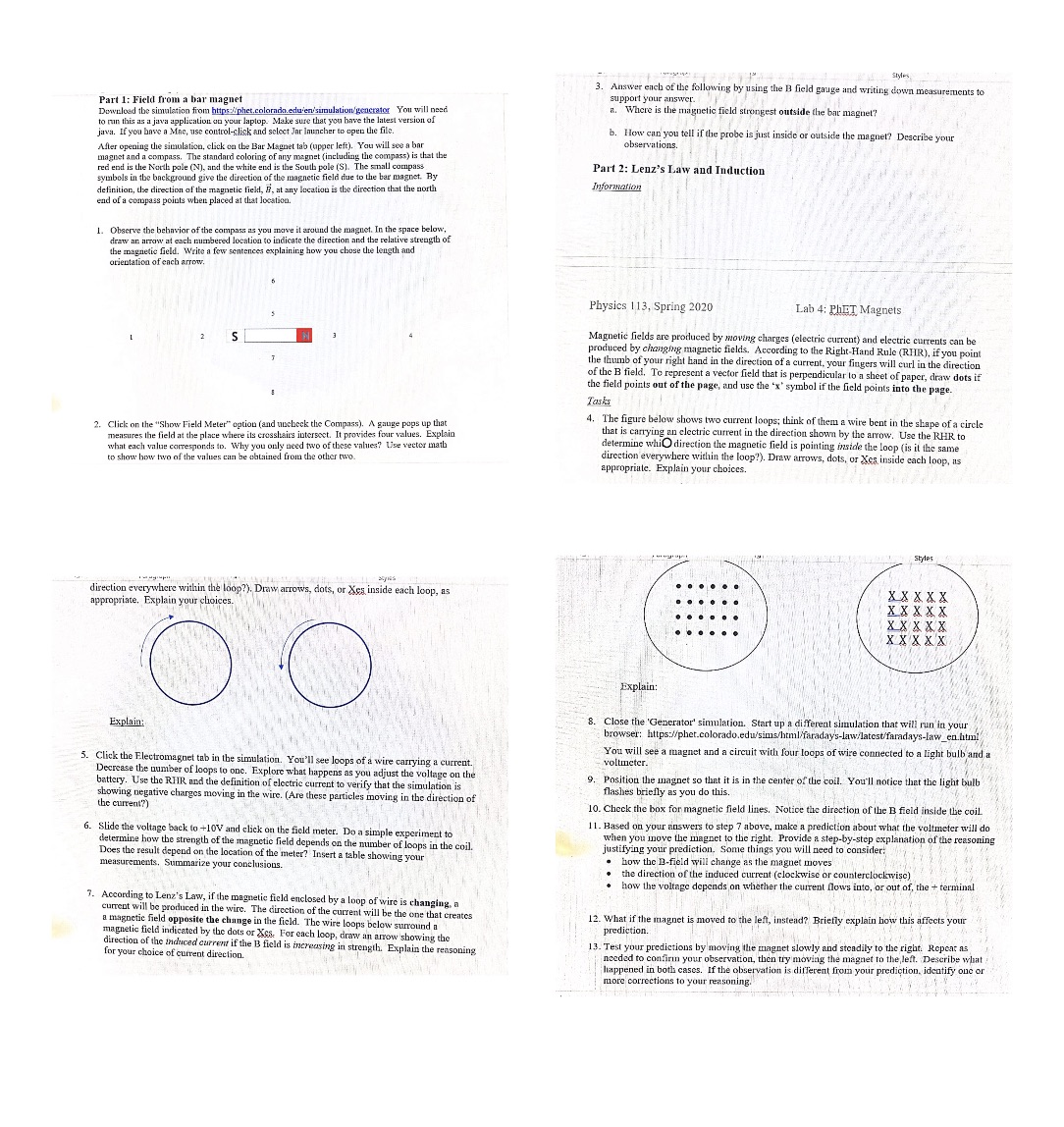
styles Answer each of the following by using the B field gauge and writing down measurements to Part 1: Field from a bar magnet support your answer. ( Download the simulation from https:/phet.colorado.edufen/simulation/generator You will need a. Where is the magnetic field strongest outside the bar magnet? to run this as a java application on your laptop. Make sure that you have the latest version of java. If you have a Mac, use control-click and select Jar Inuncher to open the file. . How can you tell if the probe is just inside or outside the magnet? Describe your After opening the simulation, click on the Bar Magnet tab (upper left). You will see a bar observations. magnet and a compass. The stan pass. The standard coloring of any magnet (including the compass) is that the red end is the North pale (N), and e end is the South pole (S). The small compass Part 2: Lenz's Law and Induction symbols in the background give the direction of the map wad of the magnetic field due to the bar magnet. By definition, the direction of the magnetic field, $, at any location is the direction that the north Information end of a compass points when placed at that location. 1. Observe the behavior of the compass as you move it around the magnet. In the space below, draw an arrow at each numbered location to indicate the direction and the relative strength of the magnetic field. Write a few sentences explaining how you chose the length and orientation of each arrow. Physics 1 13, Spring 2020 Lab 4: PhET, Magnets S Magnetic fields are produced by moving charges (electric current) and electric currents can be produced by changing magnetic fields. According to the Right-Hand Rule (RHR), if you point the thumb of your right hand in the direction of a current, your fingers will curl in the direction of the B field. To represent a vector field that is perpendicular to a sheet of paper, draw dots if the field points out of the page, and use the 'x' symbol if the field points into the page. Tasks 2. Click on the "Show Field Meter" option (and uncheck the Compass). A gauge pops up that 4. The figure below shows two current loops; think of them a wire bent in the shape of a circle measures the field at the place where its crosshairs intersect. It provides four values. Explain that is carrying an electric current in the direction shown by the arrow. Use the RHR to what each value carremon alue corresponds to. Why you only Why you only need two of these values? Use vector math determine whi direction the magnetic field is pointing inside the loop (is it the same to show how two of the values can be obtained from the other two. direction everywhere within the loop?). Draw arrows, dots, or Mes inside each loop, as appropriate. Explain your choices. Styles direction everywhere within the loop?). Draw arrows, dots, or Xes inside each loop, as appropriate. Explain your choices. XXXXX XXXXX . . . . . XXXXX X XXXX Explain: Explain: 8. Close the 'Generator' simulation. Start up a different simulation that will run in your browser: https://phet.colorado.edu/sims/html/faradays-law/latest/faradays-law_en.html" You will see a magnet and a circuit with four loops of wire connected to a light bulb and a 5. Click the Electromagnet tab in the simulation. You'll see loops of a wire carrying a current. voltmeter. Decrease the number of loops to one. Explore what happens as you adjust the voltage on the battery. Use the RHR and the definition of electric current to verify that the simulation is 9. Position the magnet so that it is in the center of the coil. You'll notice that the light bulb he current?)" showing negative charges moving in the wire. (Are these particles moving in the direction of flashes briefly as you do this. 10. Check the box for magnetic field lines. Notice the direction of the B field inside the coil . Slide the voltage back to +10V and click on the field meter. Do a simple experiment to 1. Based on your answers to step 7 above, make a prediction about what the voltmeter will do determine how the strength of the magnetic field depends on the number of loops in the coil. when you move the magnet to the right. Provide a step-by-step explanation of the reasoning Does the result depend on the location of the meter? Insert a table showing your justifying your prediction. Some things you will need to consider! measurements, Summarize your conclusions. . how the B-field will change as the magnet moves the direction of the induced current (clo uced current (clockwise or counterclockwise) how the voltage depends on whether the current flows into, or out of, the + terr 7. According to Lenz's Law, if the magnetic field enclosed by a loop of wire is changing, a current will be produced in the wire. The direction of the current will be the one that creates a magnetic field opposite the char games in the field. The wire loops below surround a 2. What if the magnet is moved to the left, instead? Briefly explain how this affects your Id indicated by the dots or Xes. For each loop, draw an arrow show prediction. direction of the induced current if red current if the B field is increasing in strength showing the for your choice of current direction. n strength. Explain the reasoning 13. Test your predictions by moving the magnet slowly and steadily to the right. Repeat as needed to confirm your observation, then try moving the magnet to the left. Describe what happened in both cases. If the observation is different from your prediction. identify one or more corrections to your reasoning
Step by Step Solution
There are 3 Steps involved in it

Get step-by-step solutions from verified subject matter experts
 Study Help