







Question: Help with MATLAB 3.2 Nulling Filters for Frequency Rejection Nulling filters are filters that completely eliminate some frequency component. These can be useful to remove
Help with MATLAB
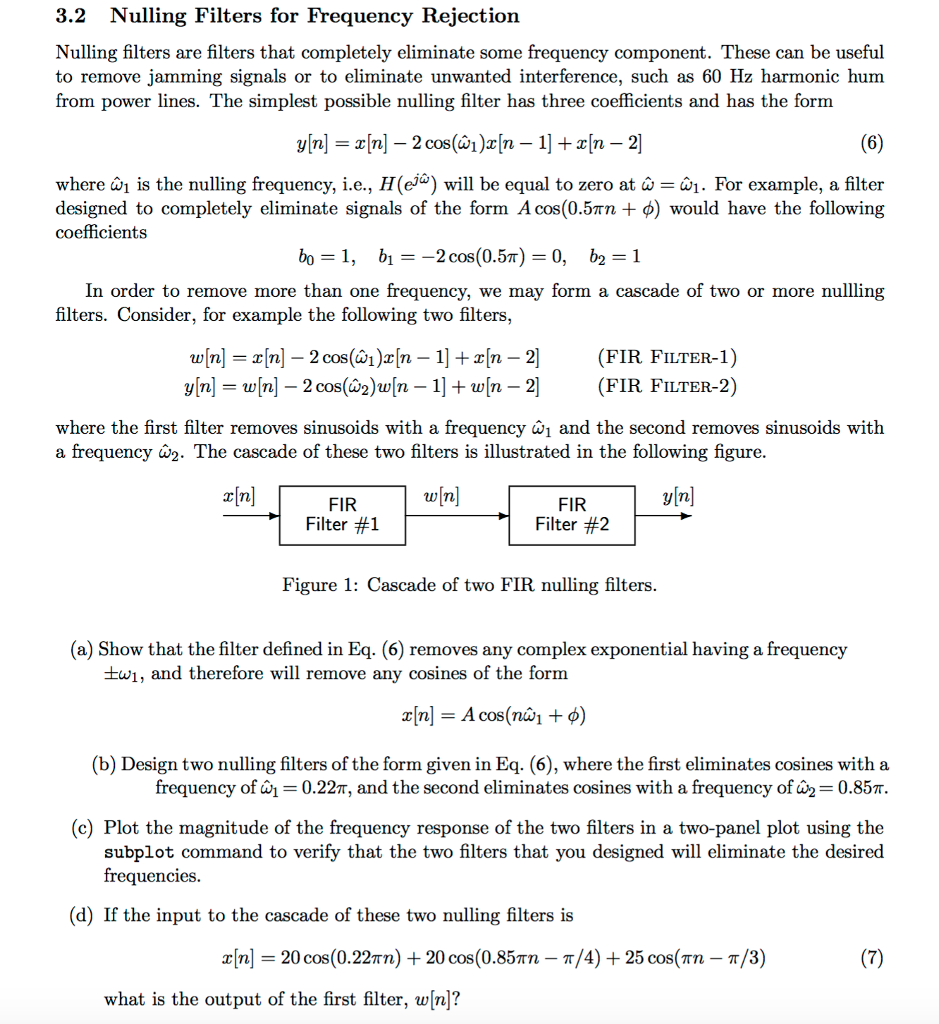
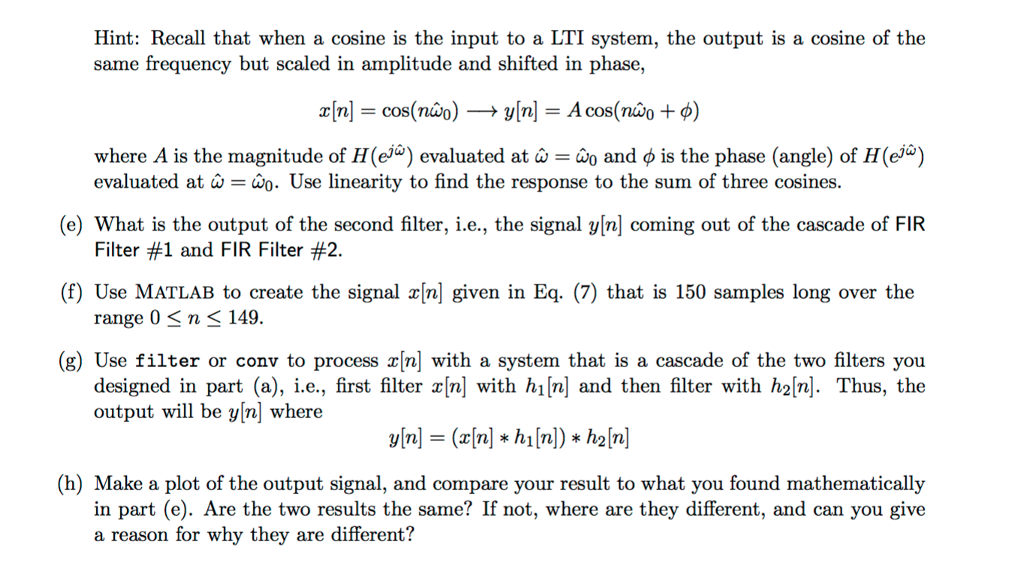
3.2 Nulling Filters for Frequency Rejection Nulling filters are filters that completely eliminate some frequency component. These can be useful to remove jamming signals or to eliminate unwanted interference, such as 60 Hz harmonic hum from power lines. The simplest possible nulling filter has three coefficients and has the form where 1 is the nulling frequency, i.e., H(ejaj will be equal to zero at -wi. For example, a filter designed to completely eliminate signals of the form Acos(0.5n+ ) would have the following coefficients bo=1, b1=-2 cos(0.5m)= 0, b2=1 In order to remove more than one frequency, we may form a cascade of two or more nullling filters. Consider, for example the following two filters w[n] = x[n] _ 2 cos(w1)2[n-1] +z[n-2 y[n] = w[n]-2 cos(w2)w[n-1] + w[n-2 (FIR FILTER-1) (FIR FILTER-2) where the first filter removes sinusoids with a frequency a frequency u2. The cascade of these two filters is illustrated in the following figure and the second removes sinusoids with r[n] y[n] FIR Filter #1 FIR Filter #2 Figure 1: Cascade of two FIR nulling filters (a) Show that the filter defined in Eq. (6) removes any complex exponential having a frequency tol, and therefore will remove any cosines of the form (b) Design two nulling filters of the form given in Eq. (6), where the first eliminates cosines with a frequency ofw,-0.22T, and the second eliminates cosines with a frequency of w2 = 0.85T. (c) Plot the magnitude of the frequency response of the two filters in a two-panel plot using the subplot command to verify that the two filters that you designed will eliminate the desired frequencies. d) If the input to the cascade of these two nulling filters is 20 cos(0.22mn) + 20 cos (0.85-/4) + 25 cos(nn-/3) what is the output of the first filter, wfn]? 3.2 Nulling Filters for Frequency Rejection Nulling filters are filters that completely eliminate some frequency component. These can be useful to remove jamming signals or to eliminate unwanted interference, such as 60 Hz harmonic hum from power lines. The simplest possible nulling filter has three coefficients and has the form where 1 is the nulling frequency, i.e., H(ejaj will be equal to zero at -wi. For example, a filter designed to completely eliminate signals of the form Acos(0.5n+ ) would have the following coefficients bo=1, b1=-2 cos(0.5m)= 0, b2=1 In order to remove more than one frequency, we may form a cascade of two or more nullling filters. Consider, for example the following two filters w[n] = x[n] _ 2 cos(w1)2[n-1] +z[n-2 y[n] = w[n]-2 cos(w2)w[n-1] + w[n-2 (FIR FILTER-1) (FIR FILTER-2) where the first filter removes sinusoids with a frequency a frequency u2. The cascade of these two filters is illustrated in the following figure and the second removes sinusoids with r[n] y[n] FIR Filter #1 FIR Filter #2 Figure 1: Cascade of two FIR nulling filters (a) Show that the filter defined in Eq. (6) removes any complex exponential having a frequency tol, and therefore will remove any cosines of the form (b) Design two nulling filters of the form given in Eq. (6), where the first eliminates cosines with a frequency ofw,-0.22T, and the second eliminates cosines with a frequency of w2 = 0.85T. (c) Plot the magnitude of the frequency response of the two filters in a two-panel plot using the subplot command to verify that the two filters that you designed will eliminate the desired frequencies. d) If the input to the cascade of these two nulling filters is 20 cos(0.22mn) + 20 cos (0.85-/4) + 25 cos(nn-/3) what is the output of the first filter, wfn]
Step by Step Solution
There are 3 Steps involved in it

Get step-by-step solutions from verified subject matter experts
 Study Help