







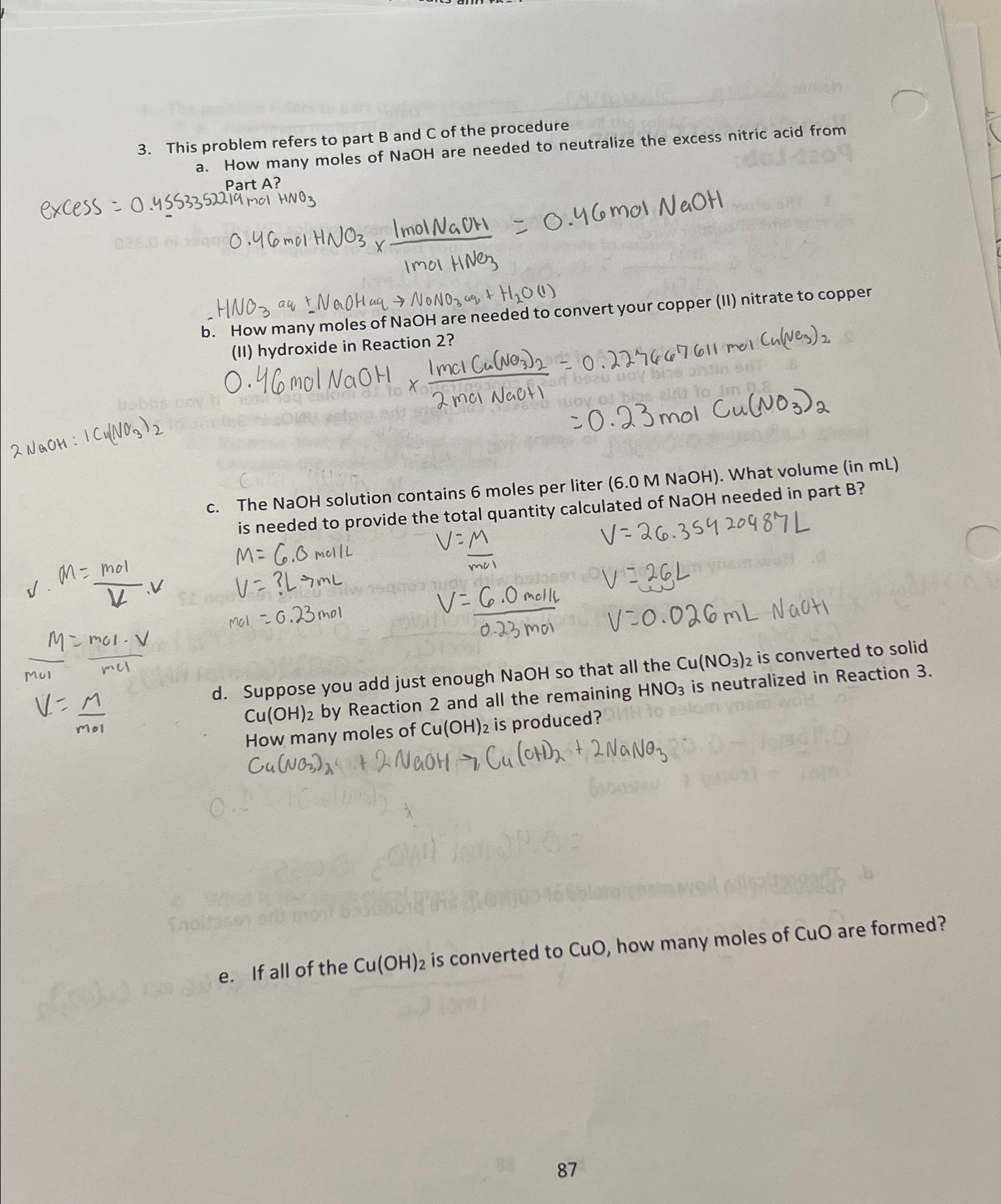
Question: Help With parts D and E please. This problem refers to part B and C of the procedure a . How many moles of NaOH
Help With parts D and E please.
This problem refers to part and of the procedure
a How many moles of NaOH are needed to neutralize the excess nitric acid from Part A
excess mal
mal molNaOH
NaOHaq
b How many moles of NaOH are needed to convert your copper II nitrate to copper
II hydroxide in Reaction
molNaOHmolCu
molCu
NaOH:
v
c The NaOH solution contains moles per liter MNaOH What volume in is needed to provide the total quantity calculated of NaOH needed in part
mollL,
malmol,mLNaOt
mLNaOHI
d Suppose you add just enough NaOH so that all the is converted to solid by Reaction and all the remaining is neutralized in Reaction How many moles of is produced?
NaOH
e If all of the is converted to CuO, how many moles of CuO are formed?
Step by Step Solution
There are 3 Steps involved in it
1 Expert Approved Answer
Step: 1 Unlock

Question Has Been Solved by an Expert!
Get step-by-step solutions from verified subject matter experts
Step: 2 Unlock
Step: 3 Unlock
 Study Help