







Question: help with python coding printed:- (A) Using fs = 4000 Hz, create a time vector t for the range [0, 500ms). Use t to create
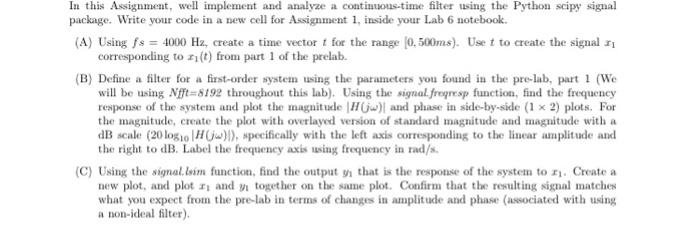

In this Assignment, well implement and analyze a continuous-time filter using the Python scipy signal package. Write your code in a new cell for Assignment 1. inside your Lab 6 notebook. (A) Using fs = 4000 Hz, create a time vector for the range (0,500ms). Use t to create the signal 11 corresponding to 2.(t) from part 1 of the prelab. (B) Define a filter for a first-order system using the parameters you found in the pre-lab, part 1 (We will be using Nfft=8192 throughout this lab). Using the signal frepresp function, find the frequency response of the system and plot the magnitude | H(jw) and pluse in side-by-side (1 x 2) plots. For the magnitude, create the plot with overlayed version of standard magnitude and magnitude with a dB scale (2010510 HOW!), specifically with the left axis corresponding to the lincar amplitude and the right to dB. Label the frequency axis using frequency in rad/s. (C) Using the signal,Isim function, find the outputy that is the response of the system to n. Create a new plot, and plot 1 and together on the same plot. Confirm that the resulting signal matches what you expect from the pre-lab in terms of changes in amplitude and phase (associated with using a non-ideal filter). From Prelabi X, (t) = cos(loot) ,Y, (t) = 0.8944 cos (1006) HOW) = 6.3944 fs = 4000 Hz for sooms Length of time vector = 500 wl angle: 0.25 44+0.894 cos (100+) - 26.5809) + - 2001 In this Assignment, well implement and analyze a continuous-time filter using the Python scipy signal package. Write your code in a new cell for Assignment 1. inside your Lab 6 notebook. (A) Using fs = 4000 Hz, create a time vector for the range (0,500ms). Use t to create the signal 11 corresponding to 2.(t) from part 1 of the prelab. (B) Define a filter for a first-order system using the parameters you found in the pre-lab, part 1 (We will be using Nfft=8192 throughout this lab). Using the signal frepresp function, find the frequency response of the system and plot the magnitude | H(jw) and pluse in side-by-side (1 x 2) plots. For the magnitude, create the plot with overlayed version of standard magnitude and magnitude with a dB scale (2010510 HOW!), specifically with the left axis corresponding to the lincar amplitude and the right to dB. Label the frequency axis using frequency in rad/s. (C) Using the signal,Isim function, find the outputy that is the response of the system to n. Create a new plot, and plot 1 and together on the same plot. Confirm that the resulting signal matches what you expect from the pre-lab in terms of changes in amplitude and phase (associated with using a non-ideal filter). From Prelabi X, (t) = cos(loot) ,Y, (t) = 0.8944 cos (1006) HOW) = 6.3944 fs = 4000 Hz for sooms Length of time vector = 500 wl angle: 0.25 44+0.894 cos (100+) - 26.5809) + - 2001
Step by Step Solution
There are 3 Steps involved in it

Get step-by-step solutions from verified subject matter experts
 Study Help