







Question: python coding help please A) Create two signals to communicate (i) Using sampling frequency fs = 4000 Hz, create signals x1 and x0 corresponding to:
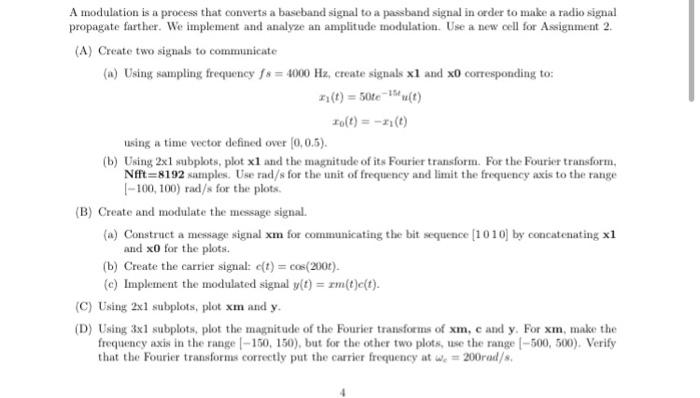
A modulation is a process that converts a baseband signal to a passband signal in order to make a radio signal propagate farther. We implement and analyze an amplitude modulation. Use a new cell for Assignment 2. (A) Create two signals to communicate (a) Using sampling frequency fs = 4000 Hz, create signals xl and XO corresponding to: =>(t) = 5000 () *o(t) = -27() using a time vector defined over (0,0.5). (b) Using 2x1 subplots, plot xl and the magnitude of its Fourier transform. For the Fourier transform, Nfft=18192 samples. Use rad/s for the unit of frequency and limit the frequency axis to the range |-100,100) rad/s for the plots. (B) Create and modulate the message signal (a) Construct a message signal xm for communicating the bit sequence [1010 by concatenating x1 and x0 for the plots. (b) Create the carrier signal: o(t) = cos(2008). (c) Implement the modulated signal y(t) = m(t)o(t). (C) Using 2x1 subplots, plot xm and y. (D) Using 3x1 subplots, plot the magnitude of the Fourier transforms of xm, cand y. For xm, make the frequency axis in the range -150, 150), but for the other two plots, use the range -500, 500). Verify that the Fourier transforms correctly put the carrier frequency at we = 200rad/ A modulation is a process that converts a baseband signal to a passband signal in order to make a radio signal propagate farther. We implement and analyze an amplitude modulation. Use a new cell for Assignment 2. (A) Create two signals to communicate (a) Using sampling frequency fs = 4000 Hz, create signals xl and XO corresponding to: =>(t) = 5000 () *o(t) = -27() using a time vector defined over (0,0.5). (b) Using 2x1 subplots, plot xl and the magnitude of its Fourier transform. For the Fourier transform, Nfft=18192 samples. Use rad/s for the unit of frequency and limit the frequency axis to the range |-100,100) rad/s for the plots. (B) Create and modulate the message signal (a) Construct a message signal xm for communicating the bit sequence [1010 by concatenating x1 and x0 for the plots. (b) Create the carrier signal: o(t) = cos(2008). (c) Implement the modulated signal y(t) = m(t)o(t). (C) Using 2x1 subplots, plot xm and y. (D) Using 3x1 subplots, plot the magnitude of the Fourier transforms of xm, cand y. For xm, make the frequency axis in the range -150, 150), but for the other two plots, use the range -500, 500). Verify that the Fourier transforms correctly put the carrier frequency at we = 200rad/
Step by Step Solution
There are 3 Steps involved in it

Get step-by-step solutions from verified subject matter experts
 Study Help