







Question: Help with question/table #4 4. Provided data for Exp 6.2 are given in Tables 3. Table 3 Data from Measurement in Exp 6.2 Current I
Help with question/table #4
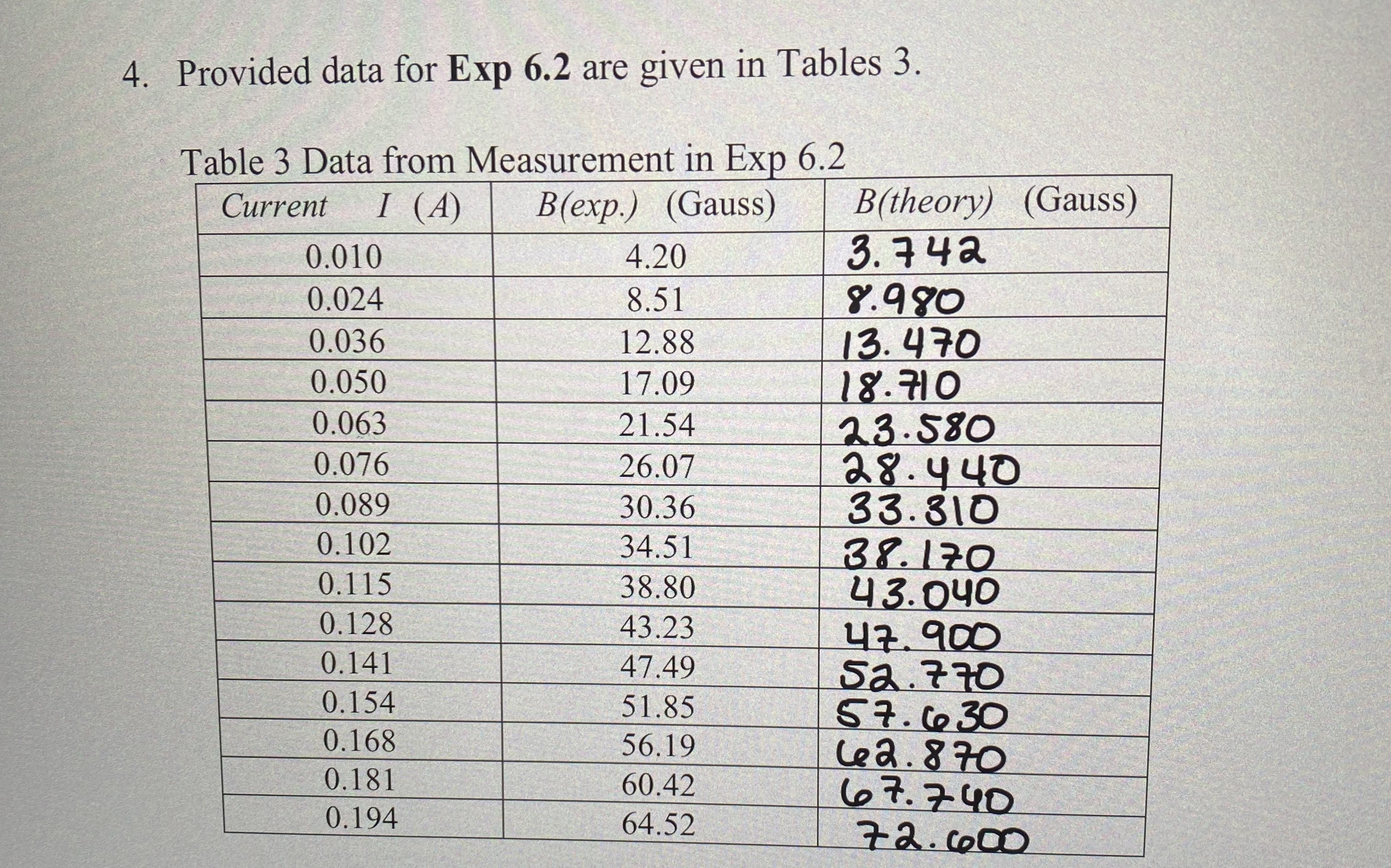
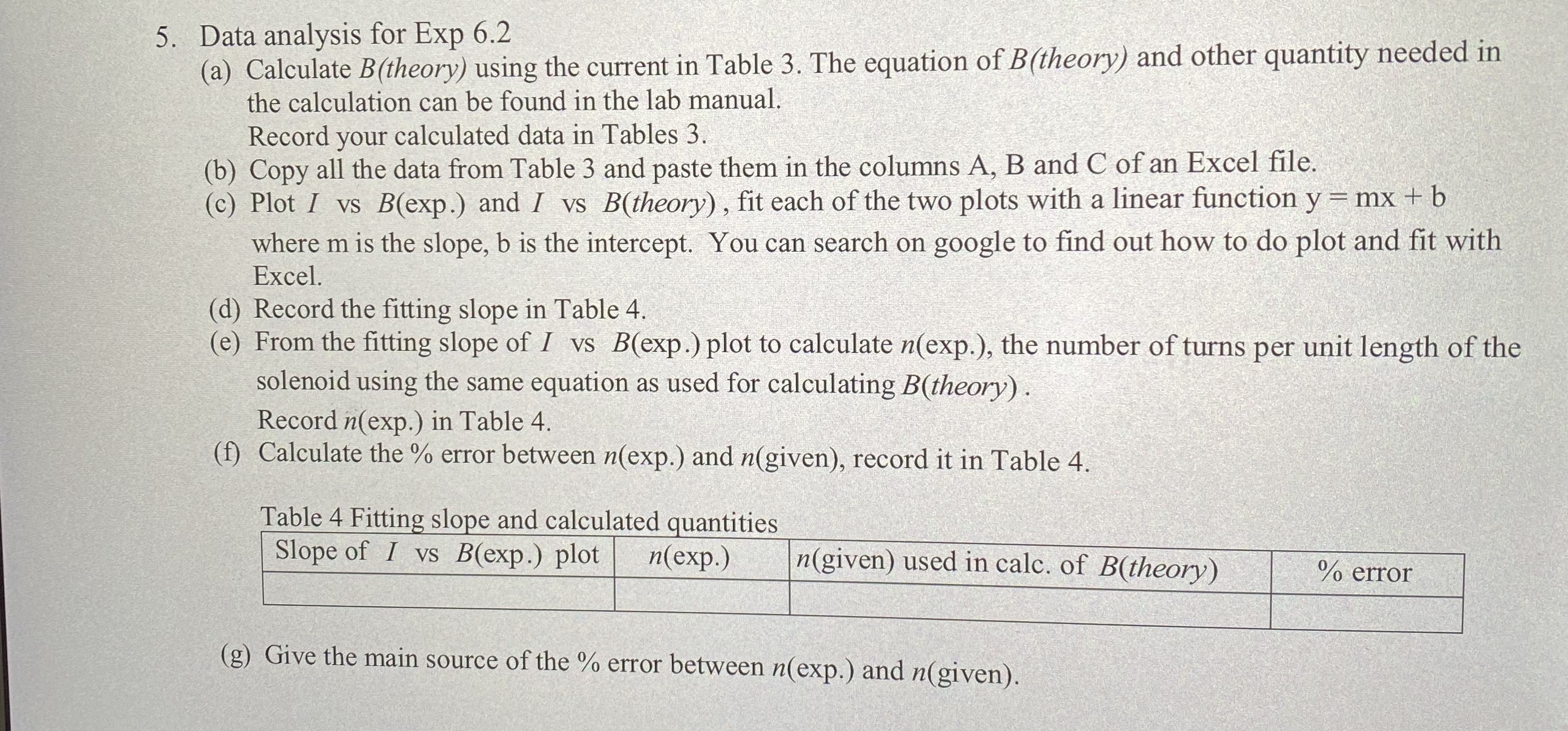
4. Provided data for Exp 6.2 are given in Tables 3. Table 3 Data from Measurement in Exp 6.2 Current I (A) B(exp.) (Gauss) B(theory) (Gauss) 0.010 4.20 3.742 0.024 8.51 8.980 0.036 12.88 13. 470 0.050 17.09 18.710 0.063 21.54 23.580 0.076 26.07 28. 4 40 0.089 30.36 33.310 0.102 34.51 38. 170 0.115 38.80 4 3.040 0.128 43.23 47. 900 0.141 47.49 52.770 0.154 51.85 57. 630 0.168 56.19 42. 870 0.181 60.42 67. 740 0.194 64.52 72. 6005. Data analysis for Exp 6.2 (a) Calculate B(theory) using the current in Table 3. The equation of B(theory) and other quantity needed in the calculation can be found in the lab manual. Record your calculated data in Tables 3. (b) Copy all the data from Table 3 and paste them in the columns A, B and C of an Excel file. (c) Plot I vs B(exp.) and I vs B(theory) , fit each of the two plots with a linear function y = mx + b where m is the slope, b is the intercept. You can search on google to find out how to do plot and fit with Excel. (d) Record the fitting slope in Table 4. (e) From the fitting slope of I vs B(exp.) plot to calculate n(exp.), the number of turns per unit length of the solenoid using the same equation as used for calculating B(theory) Record n(exp.) in Table 4. (f) Calculate the % error between n(exp.) and n(given), record it in Table 4. Table 4 Fitting slope and calculated quantities Slope of I vs B(exp. ) plot n(exp.) n(given) used in calc. of B(theory) % error (g) Give the main source of the % error between n(exp.) and n(given)
Step by Step Solution
There are 3 Steps involved in it

Get step-by-step solutions from verified subject matter experts
 Study Help