







Question: help with this function. for some reason the function filter =rampFilter(n) does not work. directions are included in the pic along with it. function filter
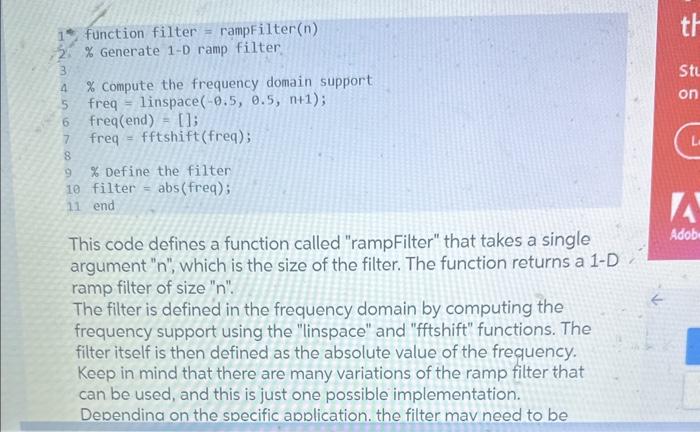
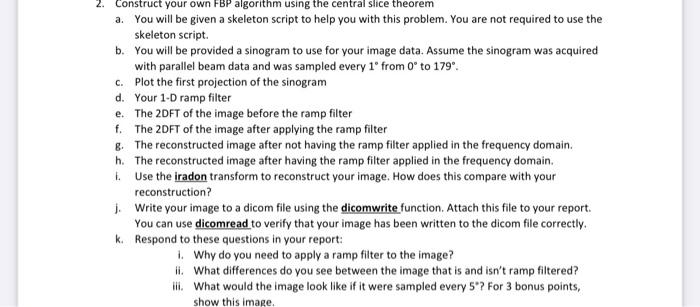
function filter = rampFilter (n) \% Generate 1-D ramp filter. % compute the frequency domain support freq = linspace (0.5,0.5,n+1); freq(end) = []; freq =fft shift (freq) \% Define the filter 10 filter = abs(freq); 11 end This code defines a function called "rampFilter" that takes a single argument " n ", which is the size of the filter. The function returns a 1-D ramp filter of size " n ". The filter is defined in the frequency domain by computing the frequency support using the "linspace" and "fftshift" functions. The filter itself is then defined as the absolute value of the frequency. Keep in mind that there are many variations of the ramp filter that can be used, and this is just one possible implementation. Dependina on the specific apolication. the filter mav need to be 2. Construct your own FBP algorithm using the central slice theorem a. You will be given a skeleton script to help you with this problem. You are not required to use the skeleton script. b. You will be provided a sinogram to use for your image data. Assume the sinogram was acquired with parallel beam data and was sampled every 1 from 0 to 179. c. Plot the first projection of the sinogram d. Your 1-D ramp filter e. The 2DFT of the image before the ramp filter f. The 2DFT of the image after applying the ramp filter g. The reconstructed image after not having the ramp filter applied in the frequency domain. h. The reconstructed image after having the ramp filter applied in the frequency domain. i. Use the iradon transform to reconstruct your image. How does this compare with your reconstruction? j. Write your image to a dicom file using the dicomwrite function. Attach this file to your report. You can use dicomread to verify that your image has been written to the dicom file correctly. k. Respond to these questions in your report: i. Why do you need to apply a ramp filter to the image? ii. What differences do you see between the image that is and isn't ramp filtered? iii. What would the image look like if it were sampled every 5 ? For 3 bonus points, show this image
Step by Step Solution
There are 3 Steps involved in it

Get step-by-step solutions from verified subject matter experts
 Study Help