



Question: Here (attachment) is the case study about McDonald's Global Expansion: Adaptation and Differences in Taste. Please provide 5 Alternatives (includes advantages and disadvantage for each
Here (attachment) is the case study about McDonald's Global Expansion: Adaptation and Differences in Taste.
Please provide 5 Alternatives (includes advantages and disadvantage for each alternative) for the problem mentioned in this case study (Refer to the below).
identification of problem: The problem identified in the case study is that McDonald's struggles to maintain its global brand identity as it expands into new markets. The company is facing challenges in adapting its menu to local tastes and preferences and managing franchisees who may have different ideas about how the brand should be operated. McDonald's needs to find a way to balance its need for global uniformity with the need to be flexible and responsive to local markets. For example, in India, McDonald's has been forced to change its menu to include vegetarian options and to make other adjustments to cater to local preferences. The company has also faced criticism from franchisees in China who have accused McDonald's of being too slow to adapt to local tastes and preferences.
Please Include the outsourse references if yes (need to be relevant to the case study).
References
11 Global McDonald's Menu Items (2010, March24). Woman's Day (Online). Retrieved from http://www.womansday.com/food-recipes/food-drinks/a1404/11-global-mcdonalds-menu-items-104999/ McDonald's
Global Sales Drive Second Quarter Earnings up 15% (2010, July23). PR Newswire. Retrieved from http://www.prnewswire.comews-releases/mcdonalds-global-sales-drive-second-quarter-earningsup-15-99094629.html. https://dx.doi.org/10.4135/9781506322872
Thanks!
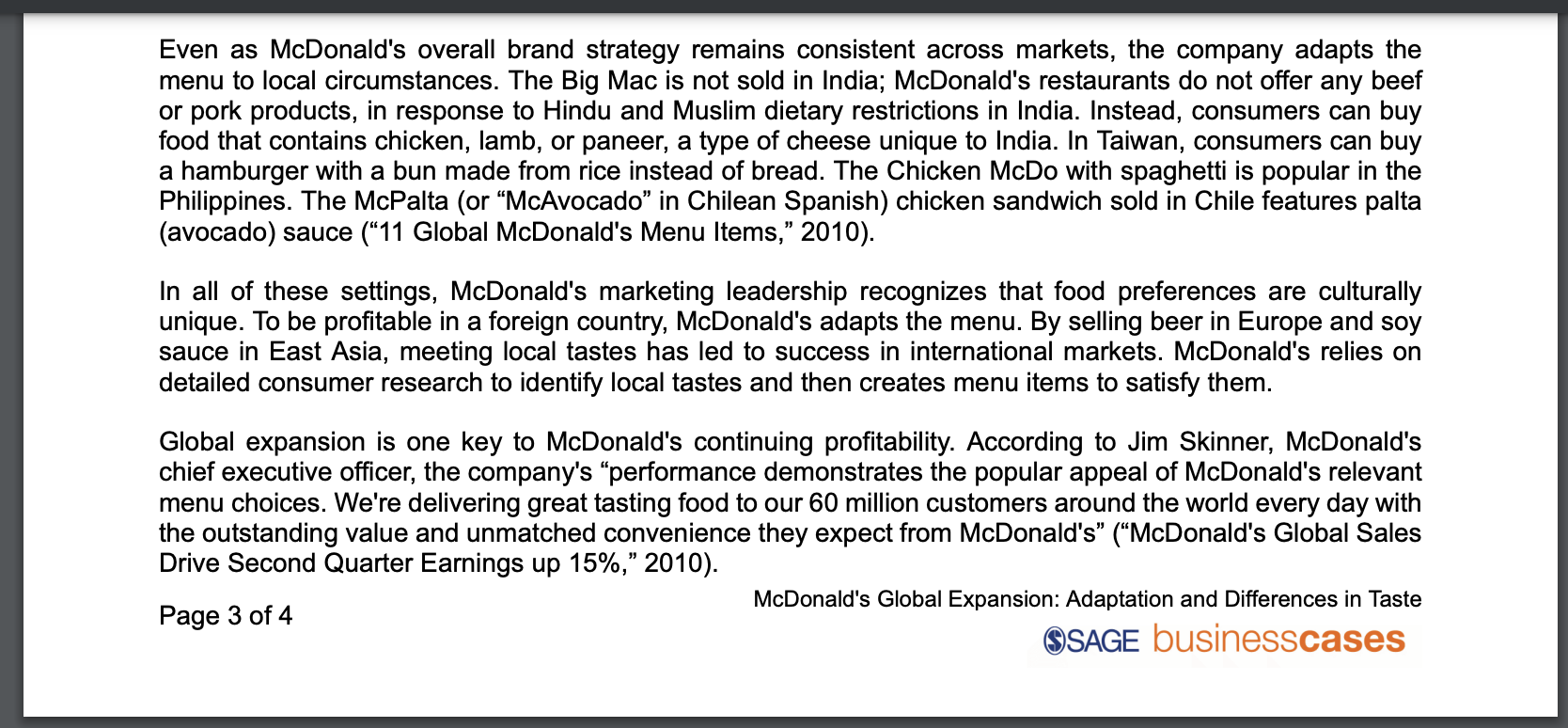
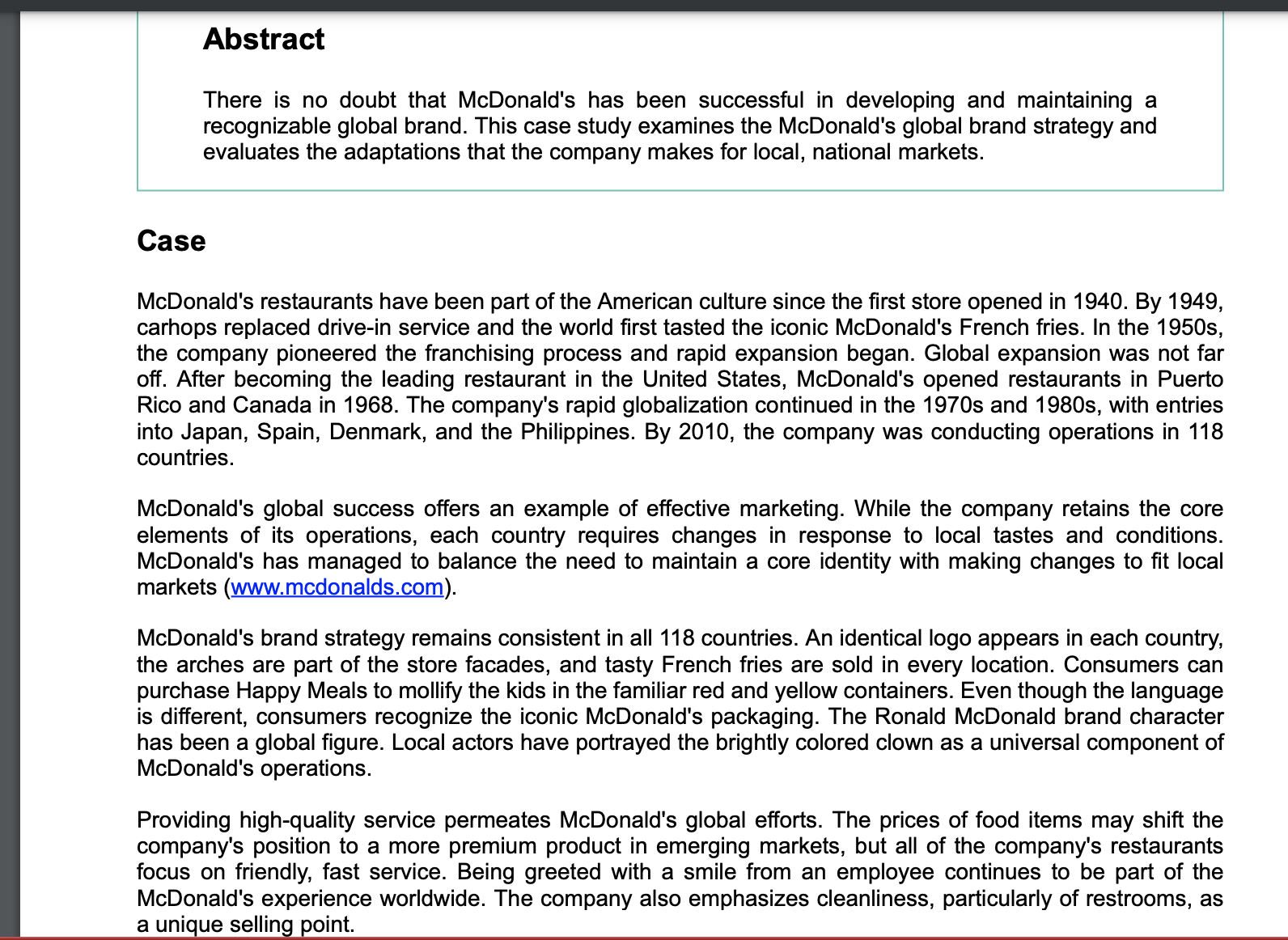
Even as Mcdonald's overall brand strategy remains consistent across markets, the company adapts the menu to local circumstances. The Big Mac is not sold in India; Mcdonald's restaurants do not offer any beef or pork products, in response to Hindu and Muslim dietary restrictions in India. Instead, consumers can buy food that contains chicken, lamb, or paneer, a type of cheese unique to India. In Taiwan, consumers can buy a hamburger with a bun made from rice instead of bread. The Chicken McDo with spaghetti is popular in the Philippines. The McPalta (or "McAvocado" in Chilean Spanish) chicken sandwich sold in Chile features palta (avocado) sauce ("11 Global Mcdonald's Menu Items," 2010). In all of these settings, Mcdonald's marketing leadership recognizes that food preferences are culturally unique. To be profitable in a foreign country, Mcdonald's adapts the menu. By selling beer in Europe and soy sauce in East Asia, meeting local tastes has led to success in international markets. Mcdonald's relies on detailed consumer research to identify local tastes and then creates menu items to satisfy them. Global expansion is one key to Mcdonald's continuing profitability. According to Jim Skinner, Mcdonald's chief executive officer, the company's "performance demonstrates the popular appeal of Mcdonald's relevant menu choices. We're delivering great tasting food to our 60 million customers around the world every day with the outstanding value and unmatched convenience they expect from Mcdonald's" ("Mcdonald's Global Sales Drive Second Quarter Earnings up 15%," 2010). Page 3 of 4 Mcdonald's Global Expansion: Adaptation and Differences in Taste OSAGE businesscasesAbstract There is no doubt that McDonald's has been successful in developing and maintaining a recognizable global brand. This case study examines the McDonald's global brand strategy and evaluates the adaptations that the company makes for local, national markets. Case McDonald's restaurants have been part of the American culture since the rst store opened in 1940. By 1949, carhops replaced drive-in service and the world rst tasted the iconic McDonald's French fries. In the 19503, the company pioneered the franchising process and rapid expansion began. Global expansion was not far off. After becoming the leading restaurant in the United States, McDonald's opened restaurants in Puerto Rico and Canada in 1968. The company's rapid globalization continued in the 1970s and 1980s, with entries into Japan, Spain, Denmark, and the Philippines. By 2010, the company was conducting operations in 118 countries. McDonald's global success offers an example of effective marketing. While the company retains the core elements of its operations, each country requires changes in response to local tastes and conditions. McDonald's has managed to balance the need to maintain a core identity with making changes to t local markets (www.mcdonalds.com). McDonald's brand strategy remains consistent in all 118 countries. An identical logo appears in each country, the arches are part of the store facades, and tasty French fries are sold in every location. Consumers can purchase Happy Meals to mollify the kids in the familiar red and yellow containers. Even though the language is different, consumers recognize the iconic McDonald's packaging. The Ronald McDonald brand character has been a global figure. Local actors have portrayed the brightly colored clown as a universal component of McDonald's operations. Providing high-quality service permeates McDonald's global efforts. The prices of food items may shift the company's position to a more premium product in emerging markets, but all of the company's restaurants focus on friendly, fast service. Being greeted with a smile from an employee continues to be part of the McDonald's experience worldwide. The company also emphasizes cleanliness, particularly of restrooms, as a uni ue sellin oint
Step by Step Solution
There are 3 Steps involved in it

Get step-by-step solutions from verified subject matter experts