







Question: here is a high resolution one:) Let's say we want to eliminate nand operator a @ b => ite(a,ite(b, false, true), ite(b,true,false)) now i want
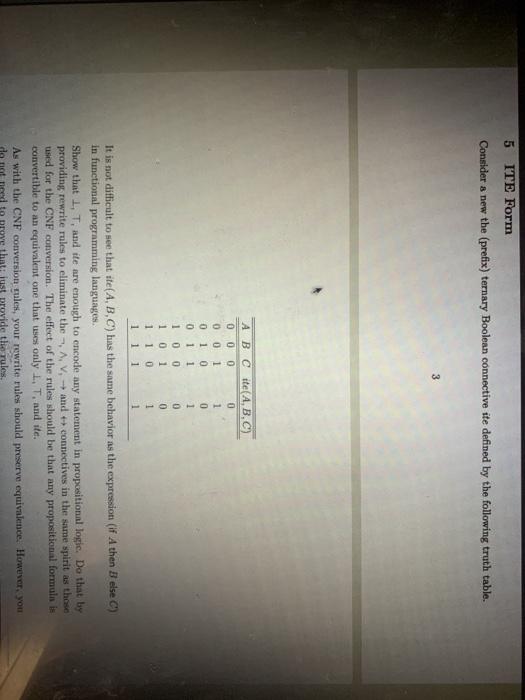
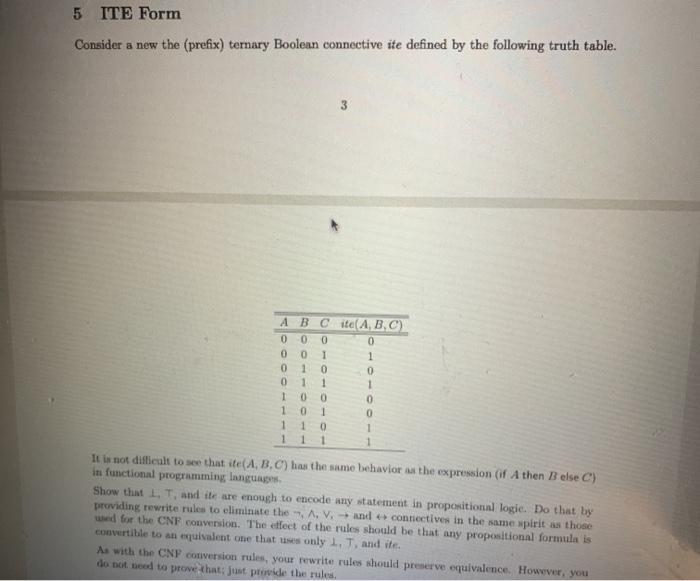
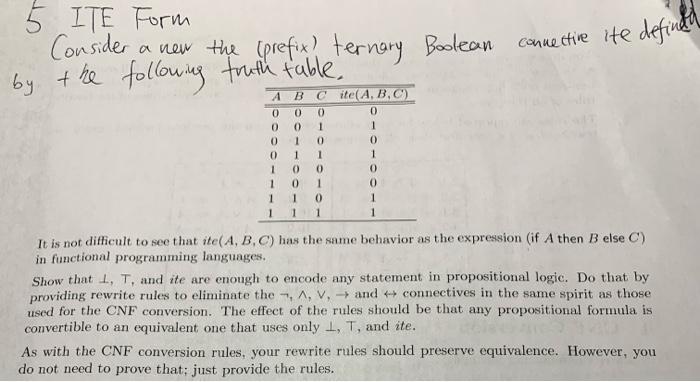
5 ITE Form Consider a new the (prefix) ternary Boolean connective ite defined by the following truth table. ABC ite(A,B,C) 0 0 0 0 0 1 0 1 0 0 1 1 1 0 0 1 0 1 0 1 1 0 1 1 1 1 11 OOO It is not difficult to see that ite(A,B,C) has the same behavior as the expression (if Athen Belse C) in functional programming languages. Show that I, T, and ite are enough to encode any statement in propositional logic. Da that by providing rewrite rules to eliminate the , A, V, -and connectives in the same spirit as those used for the CNF conversion. The effect of the rules should be that any propositional formula is convertible to an equivalent one that was only 1. T. and ite. As with the CNF conversion rules, your rewrite rules should preserve equivalence. However, you da that just provide the rules 5 ITE Form Consider a new the (prefix) ternary Boolean connective ite defined by the following truth table. 3 A B Cite A, B, C) 0 0 0 0 0 0 1 1 0 1 0 0 0 1 1 1 1 0 0 0 1 0 1 0 1 1 0 1 1 1 1 1 It is not difficult to see that ite(A,B,C) has the same behavior as the expression (if Athen Belse C) in functional programming languages Show that I, T, and ite are enough to encode any statement in propositional logic. Do that by providing rewrite rules to eliminate the A, V, and connectives in the same spirit as those wed for the CNF conversion. The effect of the rules should be that any propositional formula is convertible to an equivalent one that uses only 1. T. and ite. As with the CNF Conversion rules, your rewrite rules should preserve equivalence. However, you do not need to prove that just provide the rules 5 ITE Form Consider a new the (prefix ternary Boolean connective ite defined by the following truth table. A B C ite(A, B, C) 0 0 0 0 0 0 1 1 0 1 0 0 0 1 1 1 1 0 0 0 1 0 1 0 1 1 0 1 1 1 1 1 It is not difficult to see that ite(A, B, C) has the same behavior as the expression (if A then B else C) in functional programming languages. Show that I, T, and ite are enough to encode any statement in propositional logic. Do that by providing rewrite rules to eliminate the A, V, and connectives in the same spirit as those used for the CNF conversion. The effect of the rules should be that any propositional formula is convertible to an equivalent one that uses only 1, T, and ite. As with the CNF conversion rules, your rewrite rules should preserve equivalence. However, you do not need to prove that; just provide the rules. 5 ITE Form Consider a new the (prefix) ternary Boolean connective ite defined by the following truth table. ABC ite(A,B,C) 0 0 0 0 0 1 0 1 0 0 1 1 1 0 0 1 0 1 0 1 1 0 1 1 1 1 11 OOO It is not difficult to see that ite(A,B,C) has the same behavior as the expression (if Athen Belse C) in functional programming languages. Show that I, T, and ite are enough to encode any statement in propositional logic. Da that by providing rewrite rules to eliminate the , A, V, -and connectives in the same spirit as those used for the CNF conversion. The effect of the rules should be that any propositional formula is convertible to an equivalent one that was only 1. T. and ite. As with the CNF conversion rules, your rewrite rules should preserve equivalence. However, you da that just provide the rules 5 ITE Form Consider a new the (prefix) ternary Boolean connective ite defined by the following truth table. 3 A B Cite A, B, C) 0 0 0 0 0 0 1 1 0 1 0 0 0 1 1 1 1 0 0 0 1 0 1 0 1 1 0 1 1 1 1 1 It is not difficult to see that ite(A,B,C) has the same behavior as the expression (if Athen Belse C) in functional programming languages Show that I, T, and ite are enough to encode any statement in propositional logic. Do that by providing rewrite rules to eliminate the A, V, and connectives in the same spirit as those wed for the CNF conversion. The effect of the rules should be that any propositional formula is convertible to an equivalent one that uses only 1. T. and ite. As with the CNF Conversion rules, your rewrite rules should preserve equivalence. However, you do not need to prove that just provide the rules 5 ITE Form Consider a new the (prefix ternary Boolean connective ite defined by the following truth table. A B C ite(A, B, C) 0 0 0 0 0 0 1 1 0 1 0 0 0 1 1 1 1 0 0 0 1 0 1 0 1 1 0 1 1 1 1 1 It is not difficult to see that ite(A, B, C) has the same behavior as the expression (if A then B else C) in functional programming languages. Show that I, T, and ite are enough to encode any statement in propositional logic. Do that by providing rewrite rules to eliminate the A, V, and connectives in the same spirit as those used for the CNF conversion. The effect of the rules should be that any propositional formula is convertible to an equivalent one that uses only 1, T, and ite. As with the CNF conversion rules, your rewrite rules should preserve equivalence. However, you do not need to prove that; just provide the rules
Step by Step Solution
There are 3 Steps involved in it

Get step-by-step solutions from verified subject matter experts
 Study Help