







Question: Here is some code given to us by our teacher if it helps: Node Header: https://codeshare.io/2KWvWP Node Implementation: https://codeshare.io/G8XVXZ Sequence Header: https://codeshare.io/aJ7y7y Sequence Implementation: https://codeshare.io/5XLvLn
Here is some code given to us by our teacher if it helps:
Node Header: https://codeshare.io/2KWvWP
Node Implementation: https://codeshare.io/G8XVXZ
Sequence Header: https://codeshare.io/aJ7y7y
Sequence Implementation: https://codeshare.io/5XLvLn
Main File: https://codeshare.io/5zlql4
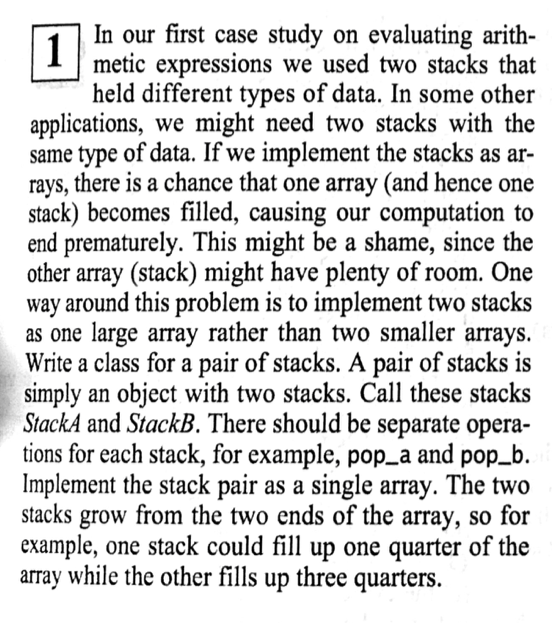
In our first case study on evaluating arith- metic expressions we used two stacks that held different types of data. In some other applications, we might need two stacks with the same type of data. If we implement the stacks as ar- rays, there is a chance that one array (and hence one stack becomes filled, causing our computation to end prematurely. This might be a shame, since the other array (stack) might have plenty of room. One way around this problem is to implement two stacks as one large array rather than two smaller arrays. Write a class for a pair of stacks. A pair of stacks is simply an object with two stacks. Call these stacks Stack and StackB. There should be separate opera- tions for each stack, for example, pop a and pop b. Implement the stack pair as a single array. The two stacks grow from the two ends of the array, so for example, one stack could fill up one quarter of the array while the other fills up three quarters
Step by Step Solution
There are 3 Steps involved in it

Get step-by-step solutions from verified subject matter experts
 Study Help