







Question: here is the code, please answer reflection questions 8 9 5 def count_type (map_data, map. type): count = 0 + count variable to store the
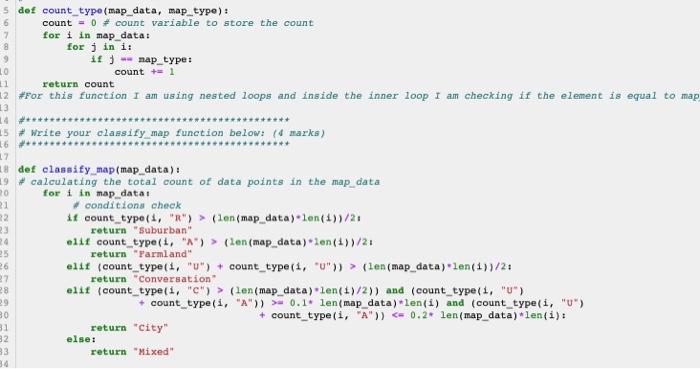

8 9 5 def count_type (map_data, map. type): count = 0 + count variable to store the count for 1 in map data: for j in i: if ) - map_type: 10 count += 1 11 return count 2 #For this function I am using nested loops and inside the inner loop I am checking if the element is equal to map 13 14 +++ *+++ 5 # write your classify_map function below: (4 marks) 16 17 # def classify_map (map data): 19 calculating the total count of data points in the map data 20 for i in map data! 21 conditions check 22 it count_typo(, **") > (len(map_data)-len(1))/2 return "Suburban 24 elit count_type(1, "^*) > (len (map_data)-len(1))/21 25 return "Farmland 26 elit (count_type(1, "U") + count_type(i, "")) > (len(map_data)len(1)}/2: 27 return "Conversation 28 elit (count_type(1, "c") > (len(map_data) len(1)/2)) and (count_type(1, "U") + count_type( i, "A")) > 0.1* len(map_data) len(i) and (count_type(i, "U") 30 + count_type(i, "A"))
Step by Step Solution
There are 3 Steps involved in it

Get step-by-step solutions from verified subject matter experts
 Study Help