







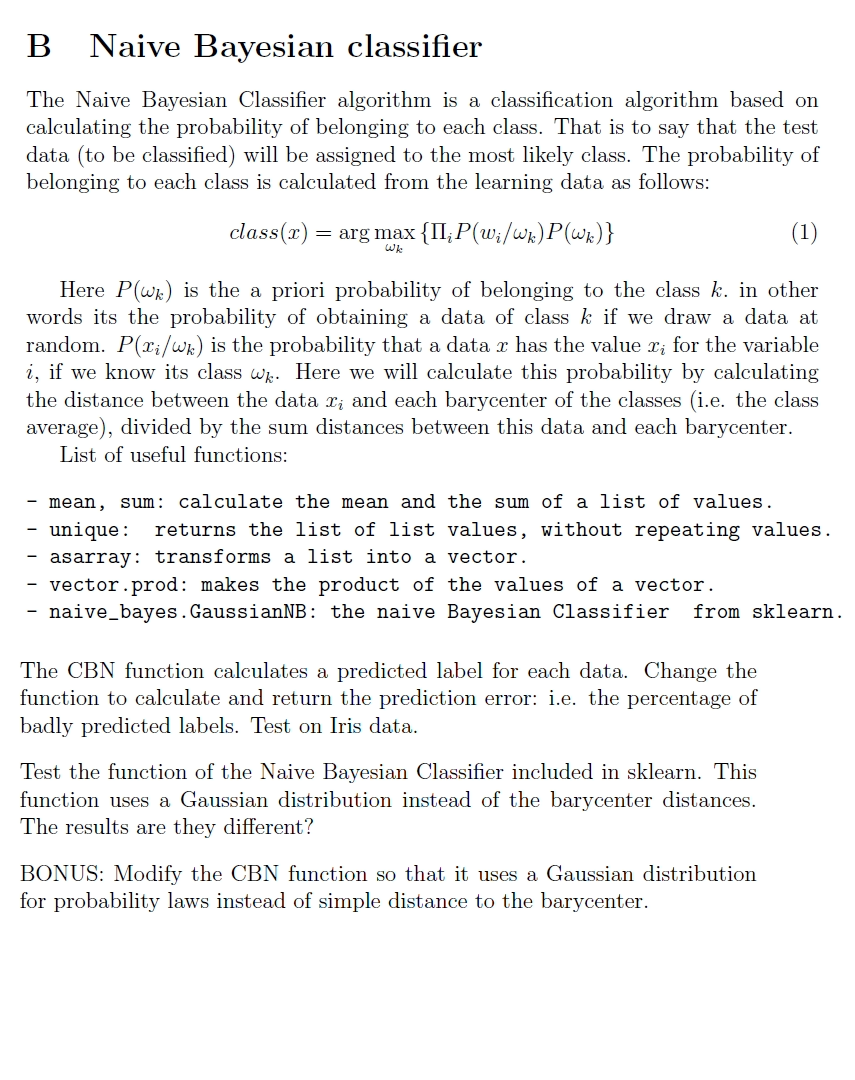
Question: Here is the function below : import numpy as np from sklearn.naive _ bayes import GaussianNB def CBN ( X , Y ) : #
Here is the function below :
import numpy as np
from sklearn.naivebayes import GaussianNB
def CBNX Y:
# Calculate the class means barycenters
classmeans label: npmeanXY label axis for label in npuniqueY
# Calculate the class prior probabilities Pwk
classpriors label: npsumY label lenY for label in npuniqueY
def calculateconditionalprobabilitydatapoint, classlabel:
# Calculate the conditional probability Pxiwk for each variable
probabilities
npexpnpsumdatapoint classmeansclasslabeli npvarX: i
npsqrt nppi npvarX: i
for i in rangeXshape
return npprodprobabilities
def predictsingledatapoint:
# Predict the most likely class for a single data point
classprobabilities
label: calculateconditionalprobabilitydatapoint, label classpriorslabel
for label in npuniqueY
return maxclassprobabilities, keyclassprobabilities.get
# Apply the prediction function to each data point
predictedlabels predictsingledatapoint for datapoint in X
return predictedlabels
# Example usage:
# Assuming X is your feature matrix and Y is your target labels
# predictedlabels CBNX Y
Step by Step Solution
There are 3 Steps involved in it
1 Expert Approved Answer
Step: 1 Unlock

Question Has Been Solved by an Expert!
Get step-by-step solutions from verified subject matter experts
Step: 2 Unlock
Step: 3 Unlock
 Study Help