







Question: Here is the problem 3. [Heat Enduring Glass] [18 points] A firm producing plate glass has developed a new process meant to allow glass for
Here is the problem
![Here is the problem 3. [Heat Enduring Glass] [18 points] A firm](https://s3.amazonaws.com/si.experts.images/answers/2024/07/668e0cef3df91_455668e0cef1a39c.jpg)
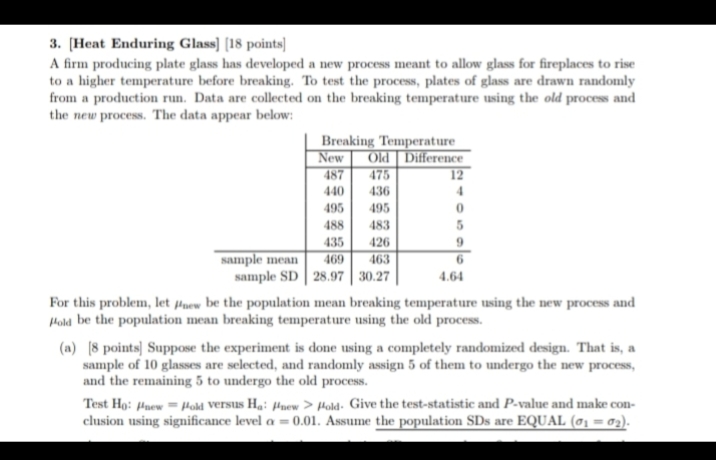
3. [Heat Enduring Glass] [18 points] A firm producing plate glass has developed a new process meant to allow glass for fireplaces to rise to a higher temperature before breaking. To test the process, plates of glass are drawn randomly from a production run. Data are collected on the breaking temperature using the old process and the new process. The data appear below: Breaking Temperature New Old Difference 487 475 12 440 436 495 495 488 483 435 426 sample mean 469 463 sample SD 28.97 30.27 4.64 For this problem, let ew be the population mean breaking temperature using the new process and Hold be the population mean breaking temperature using the old process. (a) [8 points] Suppose the experiment is done using a completely randomized design. That is, a sample of 10 glasses are selected, and randomly assign 5 of them to undergo the new process, and the remaining 5 to undergo the old process. Test Ho: Anew = Hold versus Ha: Anew > Hold. Give the test-statistic and P-value and make con- clusion using significance level o = 0.01. Assume the population SDs are EQUAL (01 = 02).3. [Heat Enduring Glass] [18 points] A firm producing plate glass has developed a new process meant to allow glass for fireplaces to rise to a higher temperature before breaking. To test the process, plates of glass are drawn randomly from a production run. Data are collected on the breaking temperature using the old process and the new process. The data appear below: Breaking Temperature New Old Difference 487 475 12 440 436 495 495 0 488 483 5 135 426 9 sample mean 469 463 sample SD 28.97 30.27 4.64 For this problem, let ew be the population mean breaking temperature using the new process and Hold be the population mean breaking temperature using the old process. (a) [8 points] Suppose the experiment is done using a completely randomized design. That is, a sample of 10 glasses are selected, and randomly assign 5 of them to undergo the new process, and the remaining 5 to undergo the old process. Test Ho: Anew = Hold Versus Ha: "new > Hold. Give the test-statistic and P-value and make con- clusion using significance level o = 0.01. Assume the population SDs are EQUAL (1 = 02)
Step by Step Solution
There are 3 Steps involved in it

Get step-by-step solutions from verified subject matter experts
 Study Help