







Question: Here, we reconsider the branched flow example, Where the flow is produced because of the water level in the very large reservoir, as shown in
Here, we reconsider the branched flow example, Where the flow is
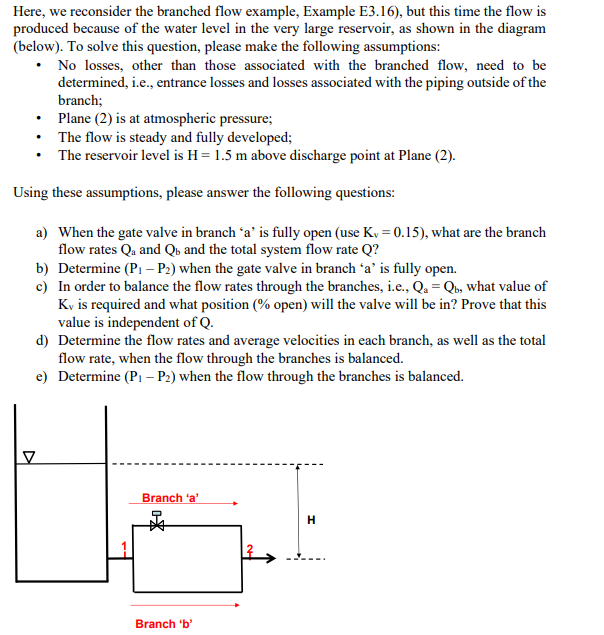
produced because of the water level in the very large reservoir, as shown in the diagram
below Branch a includes a inch Schedule steel pipe, standard flanged elbows Kand a gate valve, while branch b includes a inch schedule steel pipe, standard flanged elbows K The piping in each branch is m long and both pipes can be assumed to have a friction factor of f To solve this question, please make the following assumptions:
No losses, other than those associated with the branched flow, need to be determined, ie entrance losses and losses associated with the piping outside of the branch;
Plane is at atmospheric pressure;
The flow is steady and fully developed;
The reservoir level is above discharge point at Plane
Using these assumptions, please answer the following questions:
a When the gate valve in branch is fully open use what are the branch
flow rates and and the total system flow rate
b Determine when the gate valve in branch is fully open.
c In order to balance the flow rates through the branches, ie what value of
is required and what position open will the valve will be in Prove that this
value is independent of
d Determine the flow rates and average velocities in each branch, as well as the total
flow rate, when the flow through the branches is balanced.
e Determine when the flow through the branches is balanced.
Step by Step Solution
There are 3 Steps involved in it
1 Expert Approved Answer
Step: 1 Unlock

Question Has Been Solved by an Expert!
Get step-by-step solutions from verified subject matter experts
Step: 2 Unlock
Step: 3 Unlock
 Study Help