







Question: hey I really need some help with this homework program problem please let me know if you can help. the assignment starts on the first
hey I really need some help with this homework program problem please let me know if you can help. the assignment starts on the first picture below here.
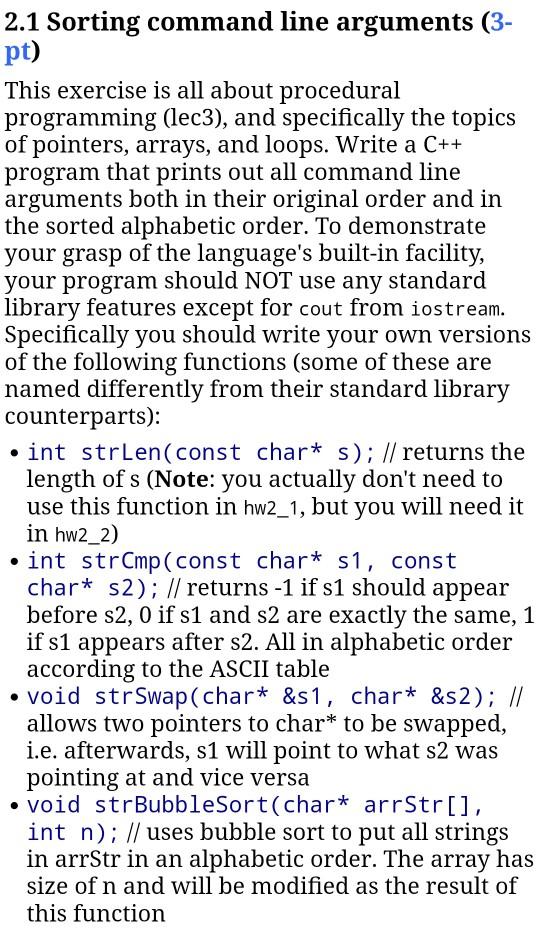
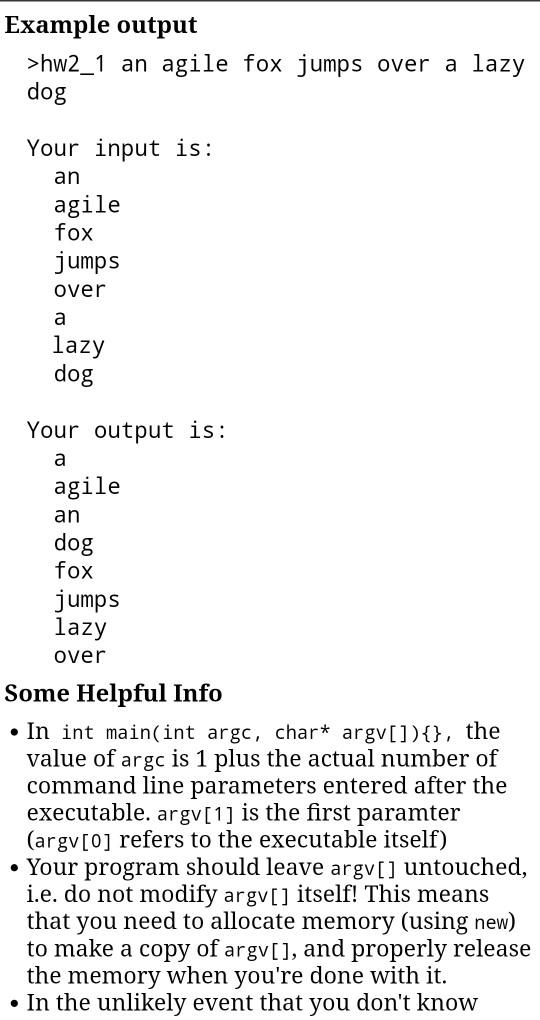
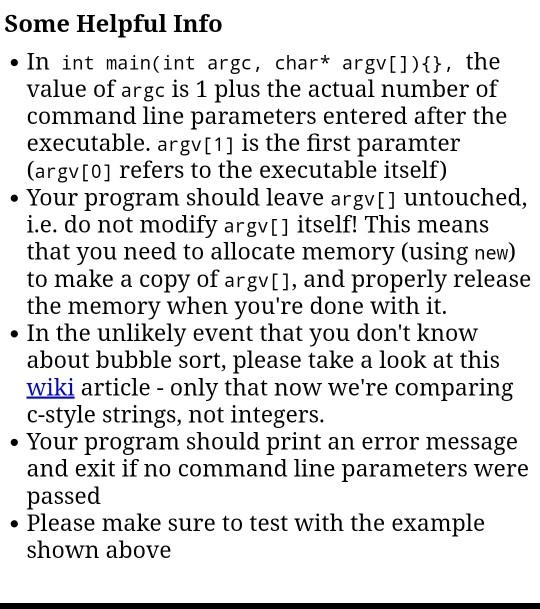
2.1 Sorting command line arguments (3- pt) This exercise is all about procedural programming (lec3), and specifically the topics of pointers, arrays, and loops. Write a C++ program that prints out all command line arguments both in their original order and in the sorted alphabetic order. To demonstrate your grasp of the language's built-in facility, your program should NOT use any standard library features except for cout from iostream. Specifically you should write your own versions of the following functions (some of these are named differently from their standard library counterparts): int strlen(const char* s); // returns the length of s (Note: you actually don't need to use this function in hw2_1, but you will need it in hw2_2) int strcmp(const char* s1, const char* s2); // returns -1 if s1 should appear before s2, 0 if s1 and s2 are exactly the same, 1 if s1 appears after s2. All in alphabetic order according to the ASCII table void str Swap(char* &s1, char* &s2); // allows two pointers to char* to be swapped, i.e. afterwards, s1 will point to what s2 was pointing at and vice versa void strBubbleSort(char* arrStr[], int n); // uses bubble sort to put all strings in arrStr in an alphabetic order. The array has size of n and will be modified as the result of this function Example output >hw2_1 an agile fox jumps over a lazy dog Your input is: an agile fox jumps over a lazy dog Your output is: a agile an dog fox jumps lazy over Some Helpful Info In int main(int argc, char* argv[]){}, the value of argc is 1 plus the actual number of command line parameters entered after the executable. argv[1] is the first paramter (argv[O] refers to the executable itself) Your program should leave argv[] untouched, i.e. do not modify argv[] itself! This means that you need to allocate memory (using new) to make a copy of argv[], and properly release the memory when you're done with it. In the unlikely event that you don't know Some Helpful Info In int main(int argc, char* argv[]){}, the value of argc is 1 plus the actual number of command line parameters entered after the executable. argv[1] is the first paramter (argv[0] refers to the executable itself) Your program should leave argv[] untouched, i.e. do not modify argv[] itself! This means that you need to allocate memory (using new) to make a copy of argv[], and properly release the memory when you're done with it. In the unlikely event that you don't know about bubble sort, please take a look at this wiki article - only that now we're comparing C-style strings, not integers. Your program should print an error message and exit if no command line parameters were passed Please make sure to test with the example shown above
Step by Step Solution
There are 3 Steps involved in it

Get step-by-step solutions from verified subject matter experts
 Study Help