







Question: Hey it's 1 question that has 3 problems please do all. thanks is common stocks, an investor's goal is to purchase stocks that are undervalued
Hey it's 1 question that has 3 problems please do all. thanks
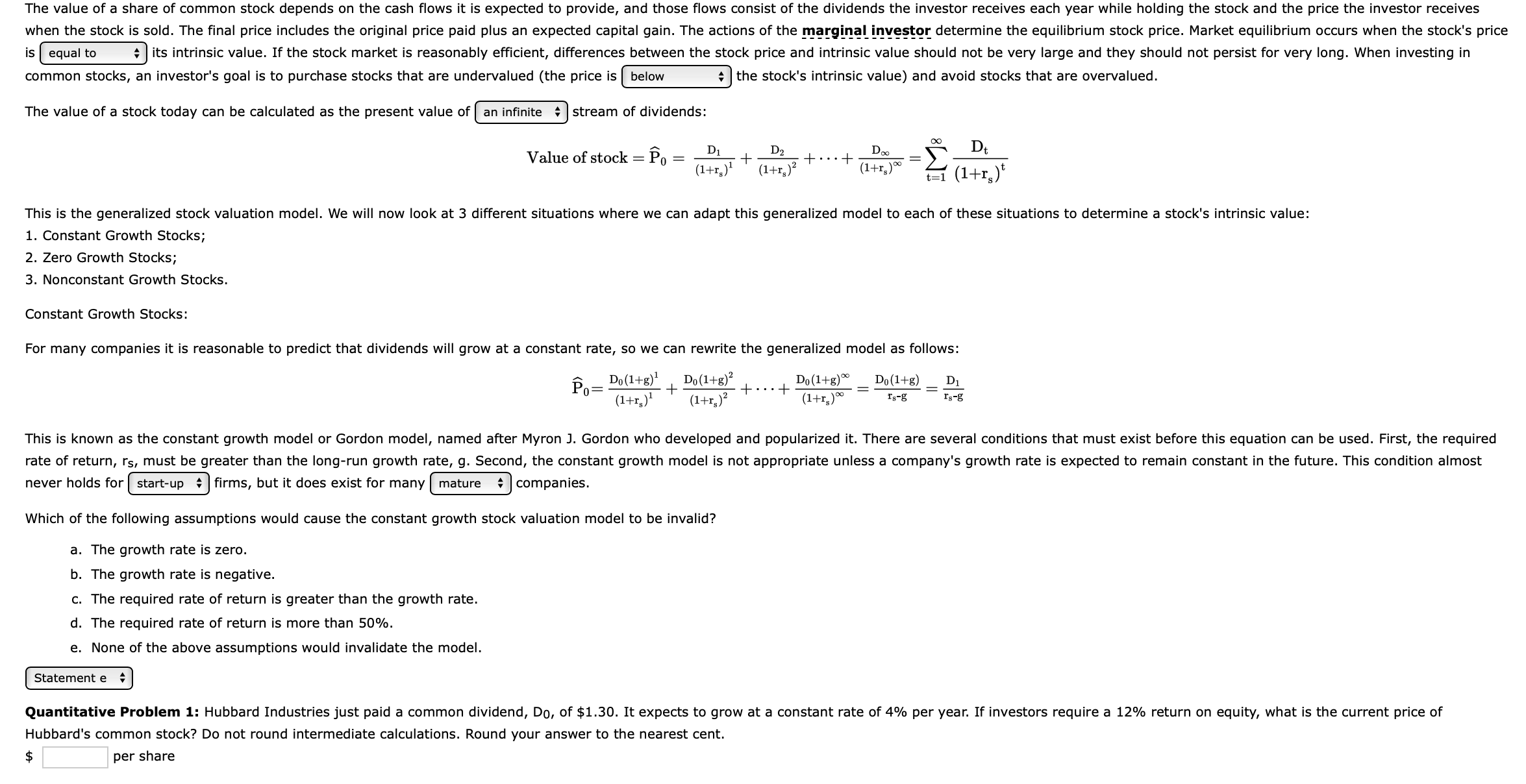
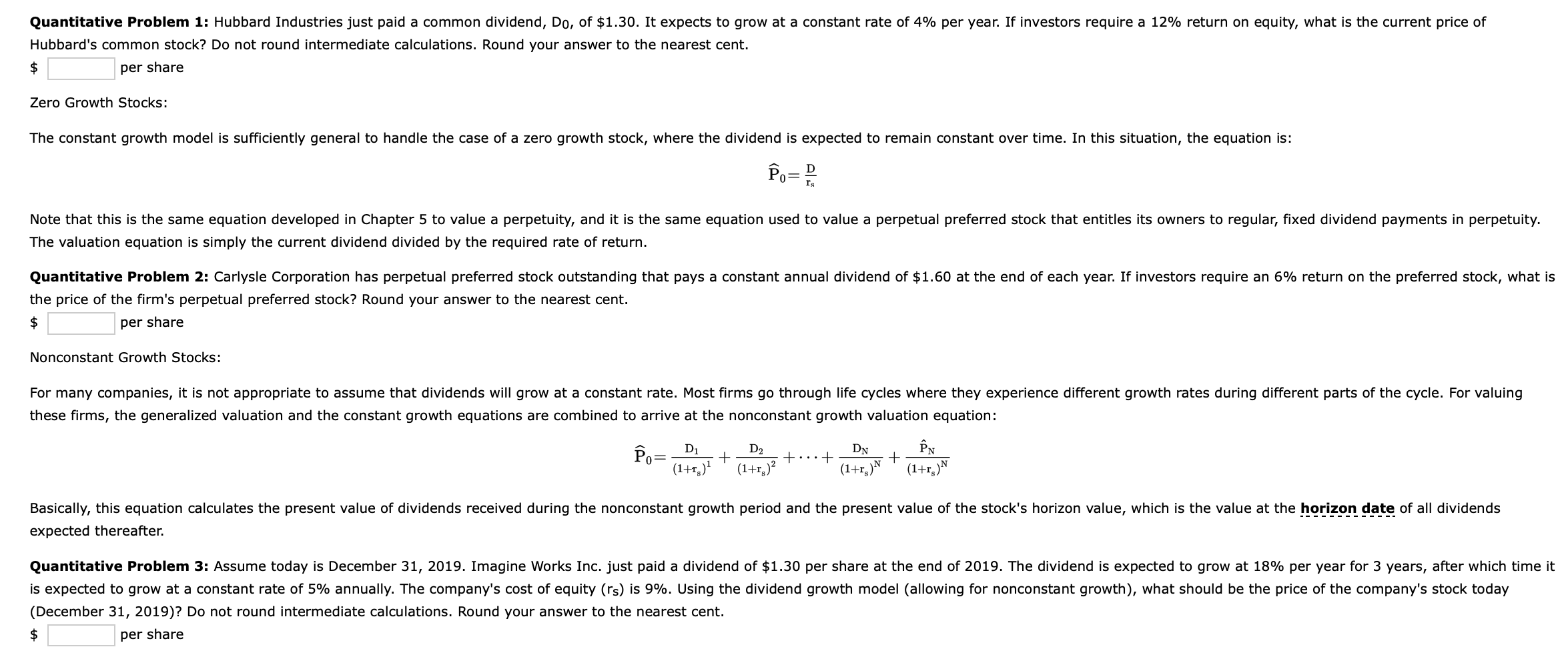
is common stocks, an investor's goal is to purchase stocks that are undervalued (the price is the stock's intrinsic value) and avoid stocks that are overvalued. The value of a stock today can be calculated as the present value of stream of dividends: Valueofstock=P0=(1+rs)1D1+(1+rs)2D2++(1+rs)D=t=1(1+rs)tDt 1. Constant Growth Stocks; 2. Zero Growth Stocks; 3. Nonconstant Growth Stocks. Constant Growth Stocks: For many companies it is reasonable to predict that dividends will grow at a constant rate, so we can rewrite the generalized model as follows: P0=(1+rs)1D0(1+g)1+(1+rs)2D0(1+g)2++(1+rs)D0(1+g)=rsgD0(1+g)=rsgD1 never holds for firms, but it does exist for many companies. Which of the following assumptions would cause the constant growth stock valuation model to be invalid? a. The growth rate is zero. b. The growth rate is negative. c. The required rate of return is greater than the growth rate. d. The required rate of return is more than 50%. e. None of the above assumptions would invalidate the model. Hubbard's common stock? Do not round intermediate calculations. Round your answer to the nearest cent. \$ per share Hubbard's common stock? Do not round intermediate calculations. Round your answer to the nearest cent. per share Zero Growth Stocks: The constant growth model is sufficiently general to handle the case of a zero growth stock, where the dividend is expected to remain constant over time. In this situation, the equation is: P0=rsD The valuation equation is simply the current dividend divided by the required rate of return. the price of the firm's perpetual preferred stock? Round your answer to the nearest cent. per share Nonconstant Growth Stocks: these firms, the generalized valuation and the constant growth equations are combined to arrive at the nonconstant growth valuation equation: P0=(1+rs)1D1+(1+rs)2D2++(1+rs)NDN+(1+rs)NP^N expected thereafter. (December 31, 2019)? Do not round intermediate calculations. Round your answer to the nearest cent. $ per share
Step by Step Solution
There are 3 Steps involved in it

Get step-by-step solutions from verified subject matter experts
 Study Help