







Question: Hi expert, i know it is a bit overload, so I posted three time, if you think it is worth to do it you can
Hi expert, i know it is a bit overload, so I posted three time, if you think it is worth to do it you can copy it twice in my other post to gain more. Thank you very much
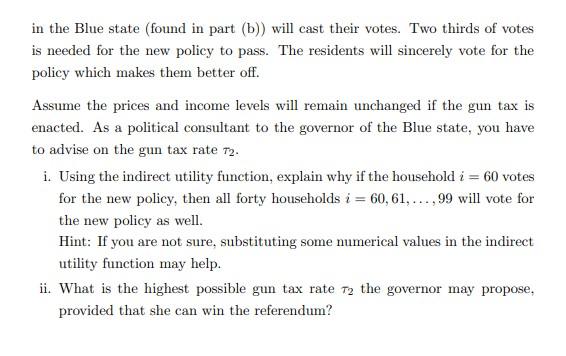
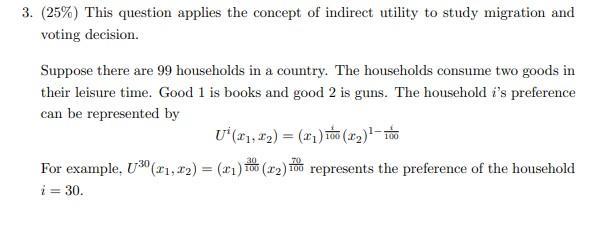
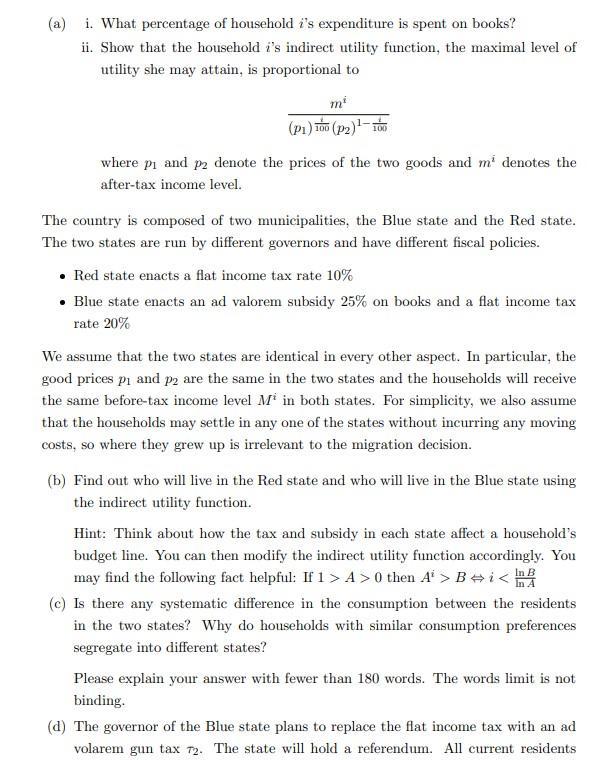
in the Blue state (found in part (b)) will cast their votes. Two thirds of votes is needed for the new policy to pass. The residents will sincerely vote for the policy which makes them better off. Assume the prices and income levels will remain unchanged if the gun tax is enacted. As a political consultant to the governor of the Blue state, you have to advise on the gun tax rate 72. i. Using the indirect utility function, explain why if the household i = 60 votes for the new policy, then all forty households i = 60, 61, ...,99 will vote for the new policy as well. Hint: If you are not sure, substituting some numerical values in the indirect utility function may help. ii. What is the highest possible gun tax rate 2 the governor may propose, provided that she can win the referendum? 3. (25%) This question applies the concept of indirect utility to study migration and voting decision. Suppose there are 99 households in a country. The households consume two goods in their leisure time. Good 1 is books and good 2 is guns. The household i's preference can be represented by U' (11, 12) = (x1) 16 (12)-100 For example, U-30(11, 12) = (21) (1:2) io represents the preference of the household i = 30. (a) i. What percentage of household i's expenditure is spent on books? ii. Show that the household i's indirect utility function, the maximal level of utility she may attain, is proportional to mi (P1) 160 (p2)-16 where p and p2 denote the prices of the two goods and m denotes the after-tax income level. The country is composed of two municipalities, the Blue state and the Red state. The two states are run by different governors and have different fiscal policies. Red state enacts a flat income tax rate 10% Blue state enacts an ad valorem subsidy 25% on books and a flat income tax rate 20% We assume that the two states are identical in every other aspect. In particular, the good prices pi and P2 are the same in the two states and the households will receive the same before-tax income level M' in both states. For simplicity, we also assume that the households may settle in any one of the states without incurring any moving costs, so where they grew up is irrelevant to the migration decision. (b) Find out who will live in the Red state and who will live in the Blue state using the indirect utility function. Hint: Think about how the tax and subsidy in each state affect a household's budget line. You can then modify the indirect utility function accordingly. You may find the following fact helpful: If 1 > A> 0 then A > Boich (c) Is there any systematic difference in the consumption between the residents in the two states? Why do households with similar consumption preferences segregate into different states? Please explain your answer with fewer than 180 words. The words limit is not binding. (d) The governor of the Blue state plans to replace the flat income tax with an ad volarem gun tax 72. The state will hold a referendum. All current residents in the Blue state (found in part (b)) will cast their votes. Two thirds of votes is needed for the new policy to pass. The residents will sincerely vote for the policy which makes them better off. Assume the prices and income levels will remain unchanged if the gun tax is enacted. As a political consultant to the governor of the Blue state, you have to advise on the gun tax rate 72. i. Using the indirect utility function, explain why if the household i = 60 votes for the new policy, then all forty households i = 60, 61, ...,99 will vote for the new policy as well. Hint: If you are not sure, substituting some numerical values in the indirect utility function may help. ii. What is the highest possible gun tax rate 2 the governor may propose, provided that she can win the referendum? 3. (25%) This question applies the concept of indirect utility to study migration and voting decision. Suppose there are 99 households in a country. The households consume two goods in their leisure time. Good 1 is books and good 2 is guns. The household i's preference can be represented by U' (11, 12) = (x1) 16 (12)-100 For example, U-30(11, 12) = (21) (1:2) io represents the preference of the household i = 30. (a) i. What percentage of household i's expenditure is spent on books? ii. Show that the household i's indirect utility function, the maximal level of utility she may attain, is proportional to mi (P1) 160 (p2)-16 where p and p2 denote the prices of the two goods and m denotes the after-tax income level. The country is composed of two municipalities, the Blue state and the Red state. The two states are run by different governors and have different fiscal policies. Red state enacts a flat income tax rate 10% Blue state enacts an ad valorem subsidy 25% on books and a flat income tax rate 20% We assume that the two states are identical in every other aspect. In particular, the good prices pi and P2 are the same in the two states and the households will receive the same before-tax income level M' in both states. For simplicity, we also assume that the households may settle in any one of the states without incurring any moving costs, so where they grew up is irrelevant to the migration decision. (b) Find out who will live in the Red state and who will live in the Blue state using the indirect utility function. Hint: Think about how the tax and subsidy in each state affect a household's budget line. You can then modify the indirect utility function accordingly. You may find the following fact helpful: If 1 > A> 0 then A > Boich (c) Is there any systematic difference in the consumption between the residents in the two states? Why do households with similar consumption preferences segregate into different states? Please explain your answer with fewer than 180 words. The words limit is not binding. (d) The governor of the Blue state plans to replace the flat income tax with an ad volarem gun tax 72. The state will hold a referendum. All current residents
Step by Step Solution
There are 3 Steps involved in it

Get step-by-step solutions from verified subject matter experts
 Study Help