







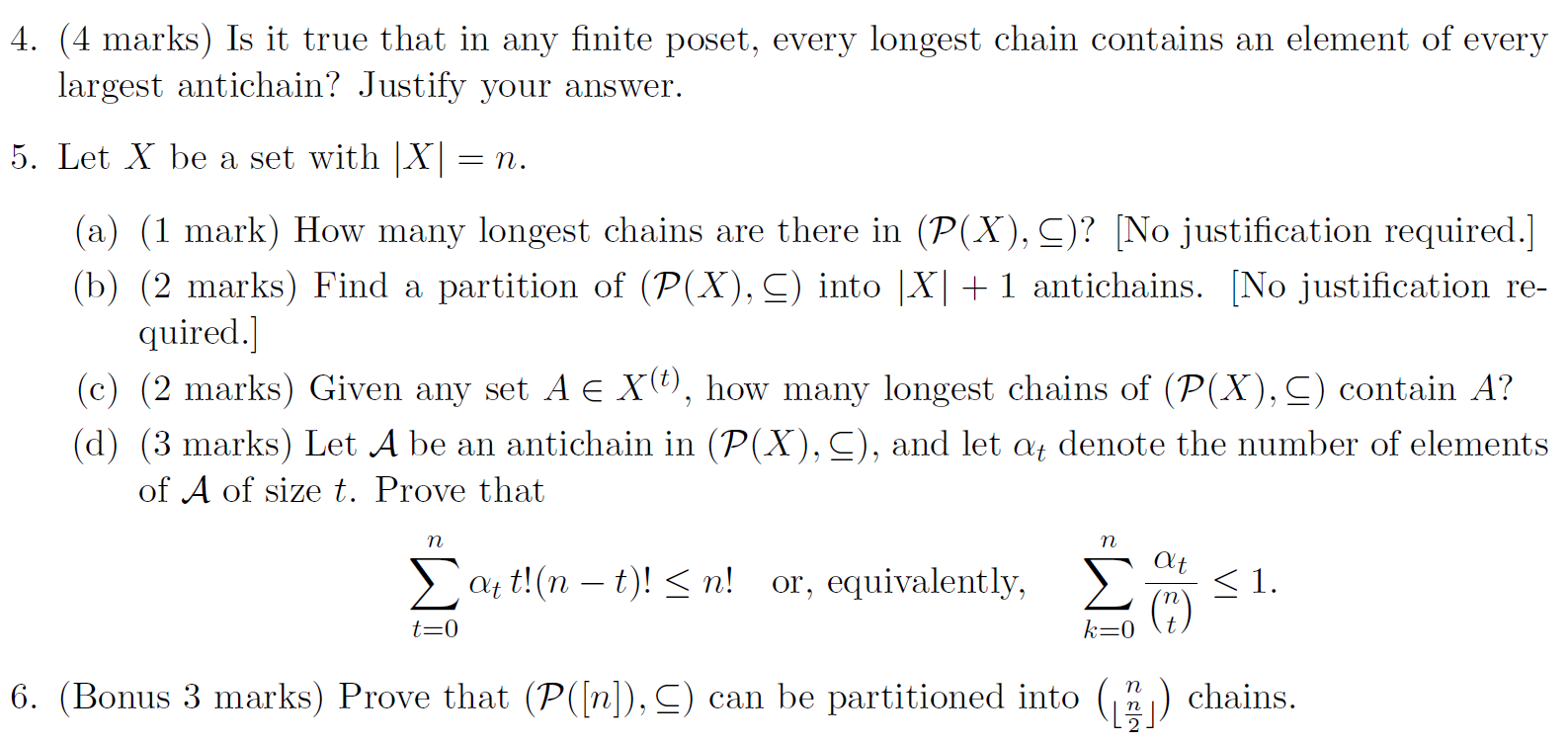
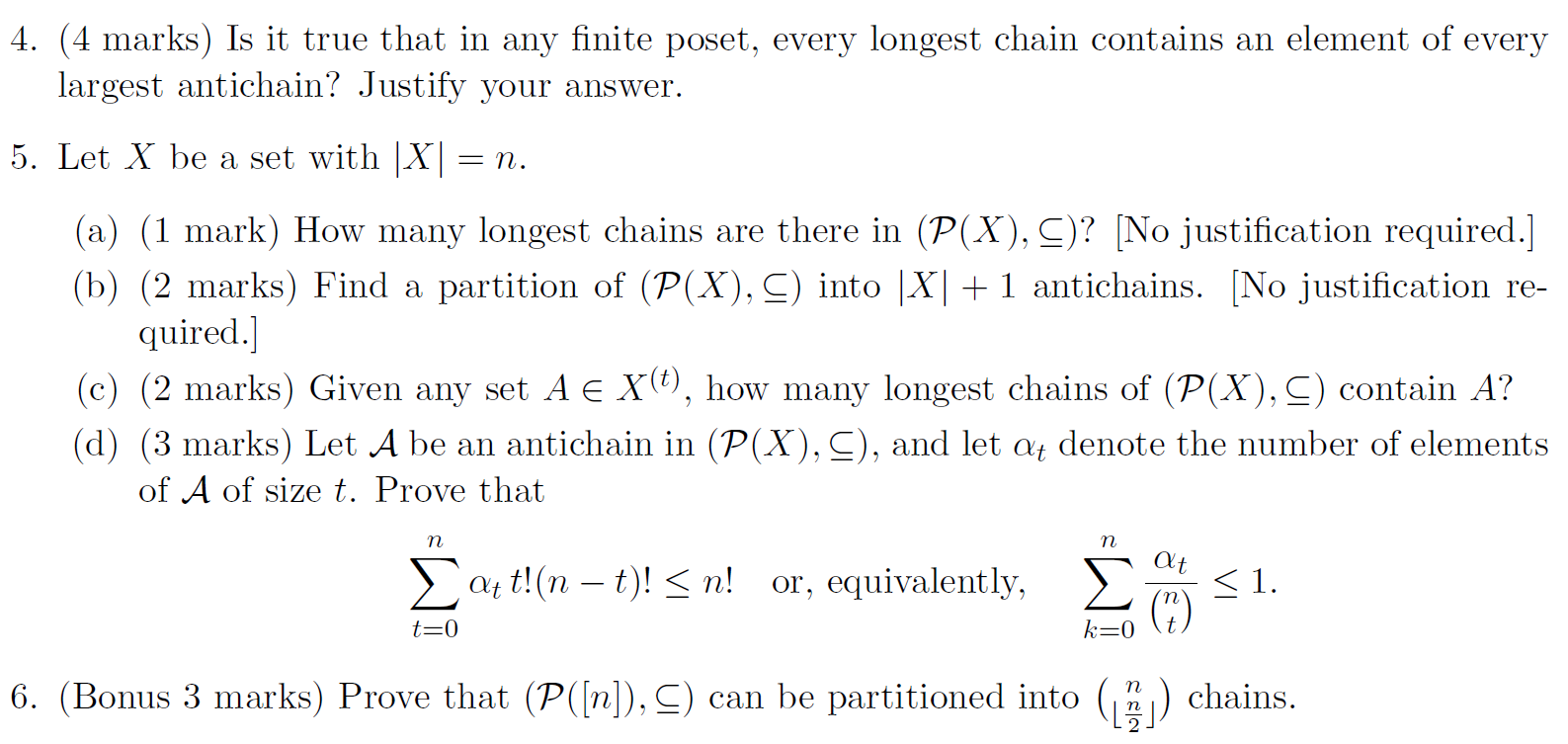
Question: Hi, I have a discrete and combinatorial math question. I need your help. Thank you so much. 4. (4 marks) Is it true that in
Hi, I have a discrete and combinatorial math question.
I need your help.
Thank you so much.
![(If) 6. (Bonus 3 marks) Prove that (73([n.]), g) can be partitioned](https://s3.amazonaws.com/si.experts.images/answers/2024/06/66682fb11d49e_98466682fb0f33b7.jpg)
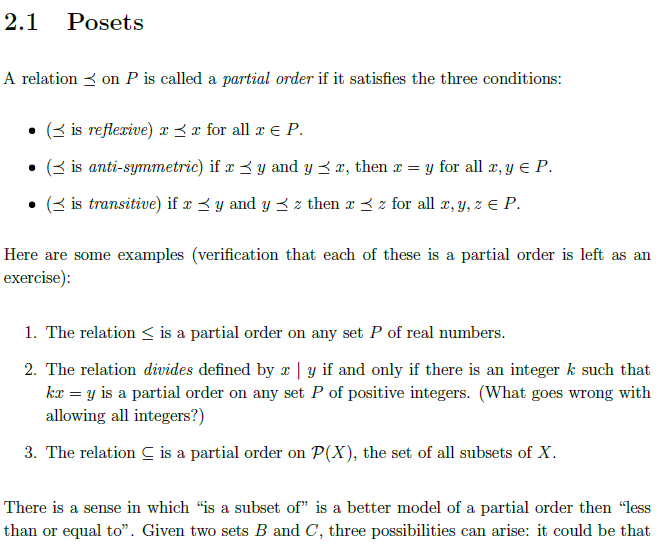
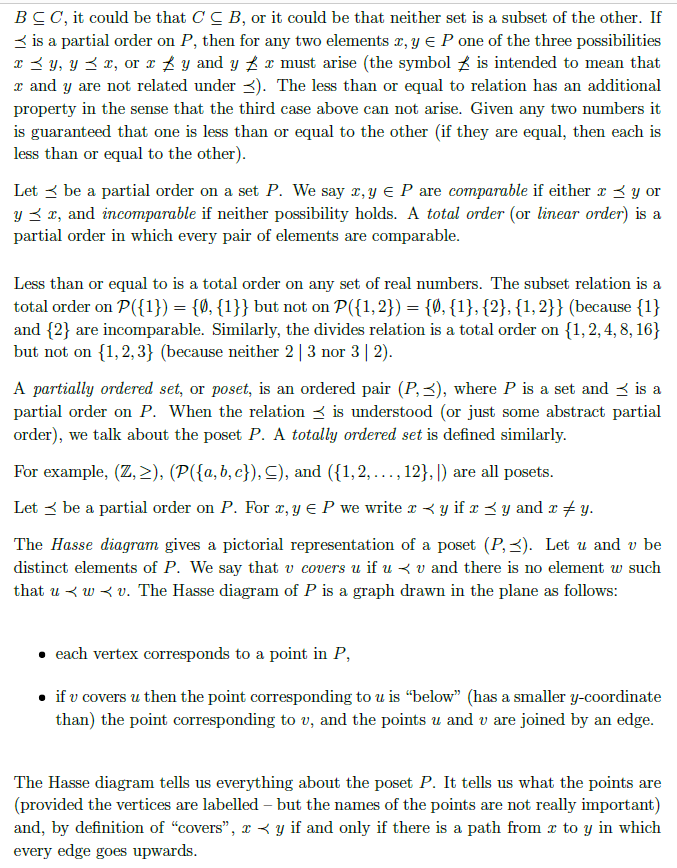
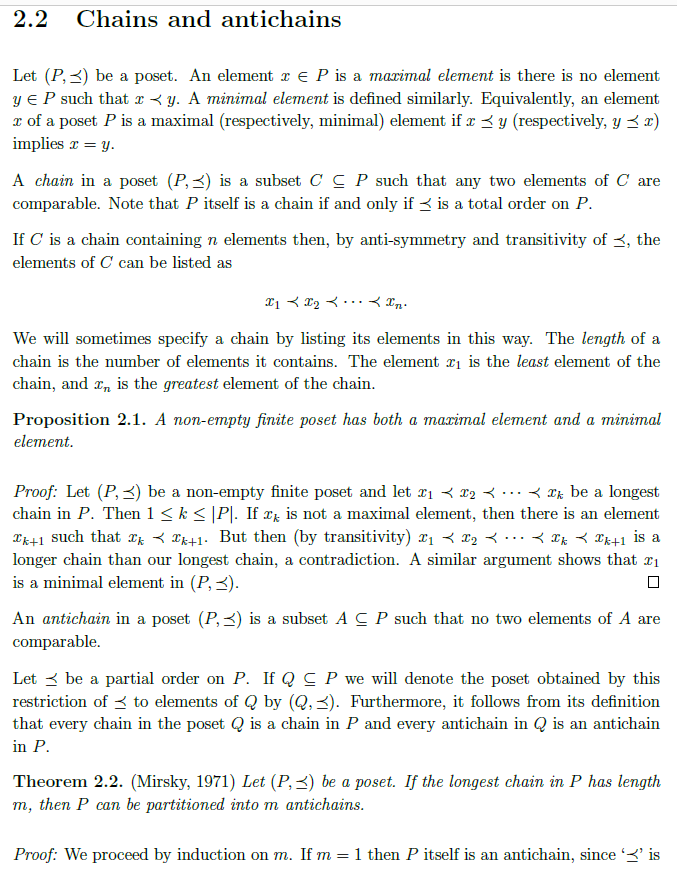
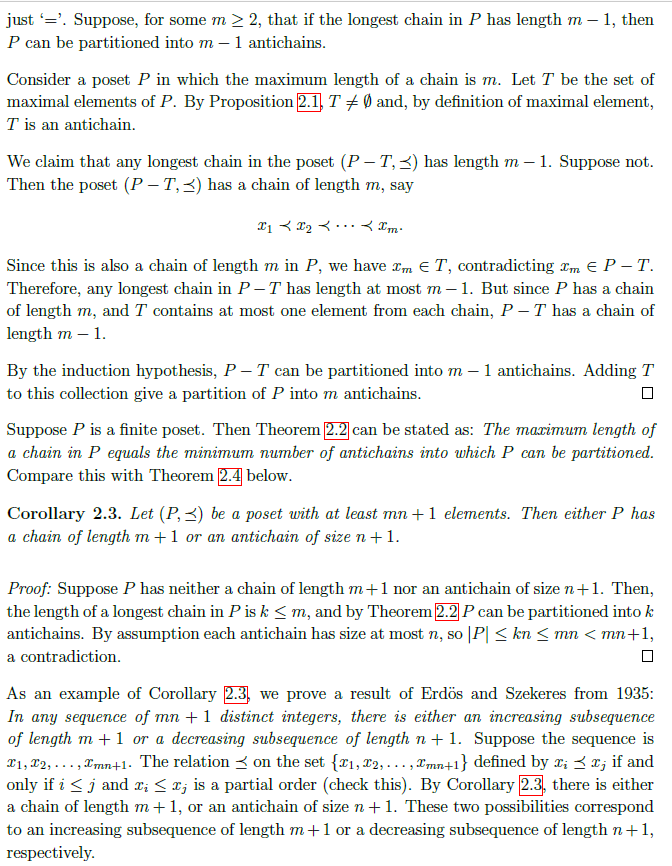
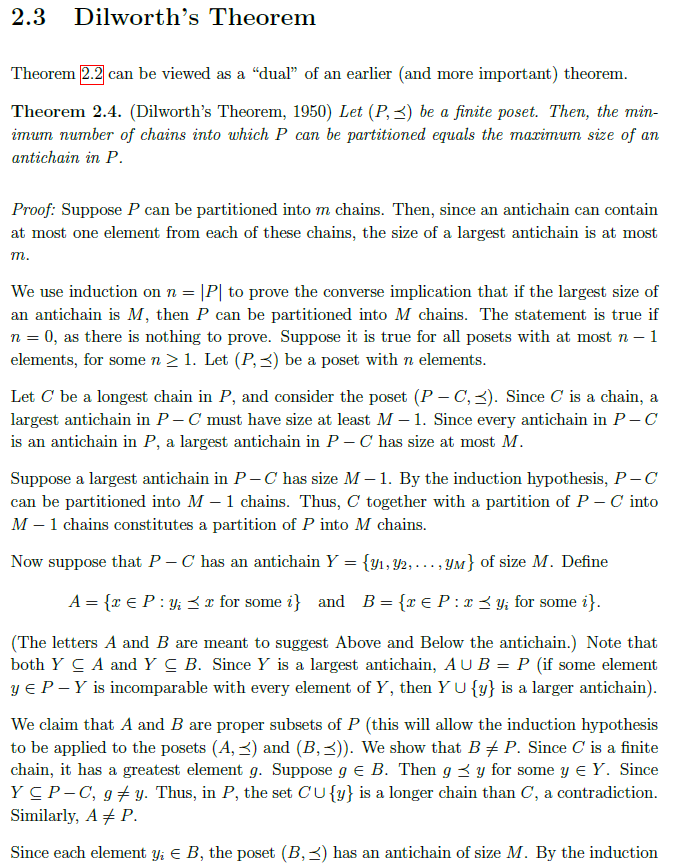
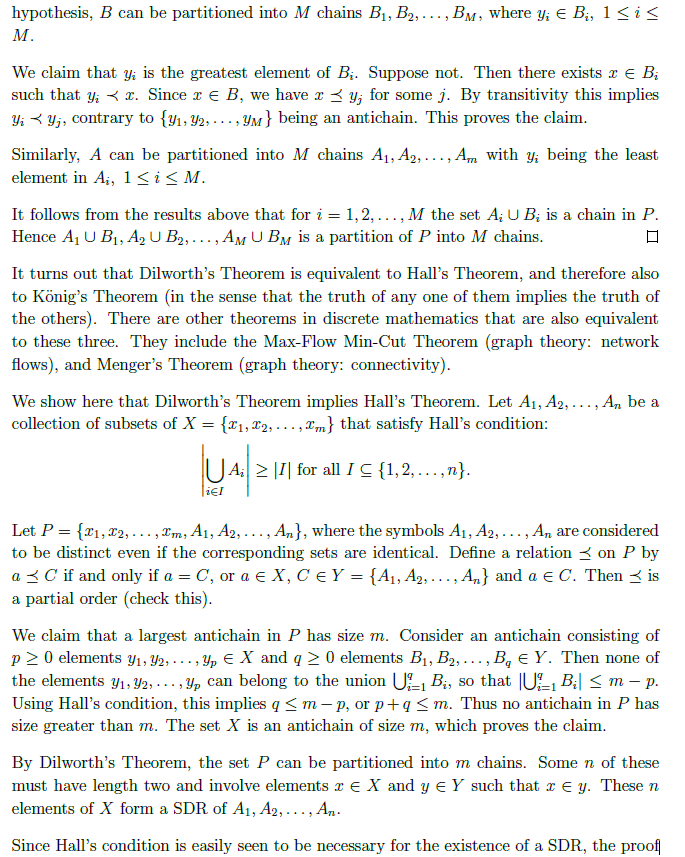
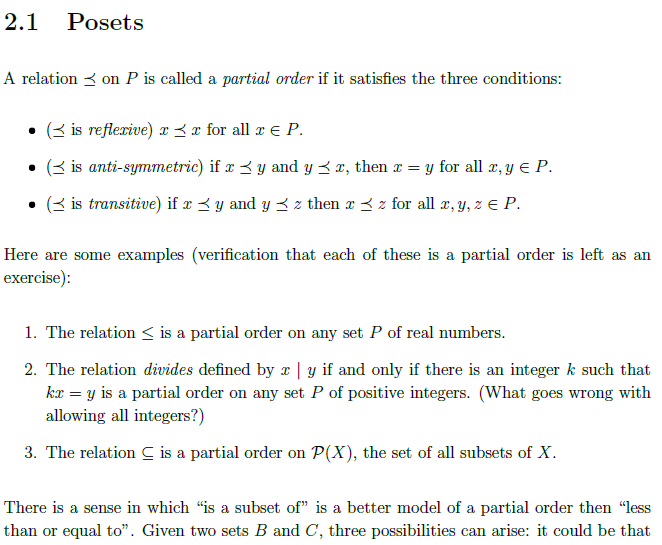
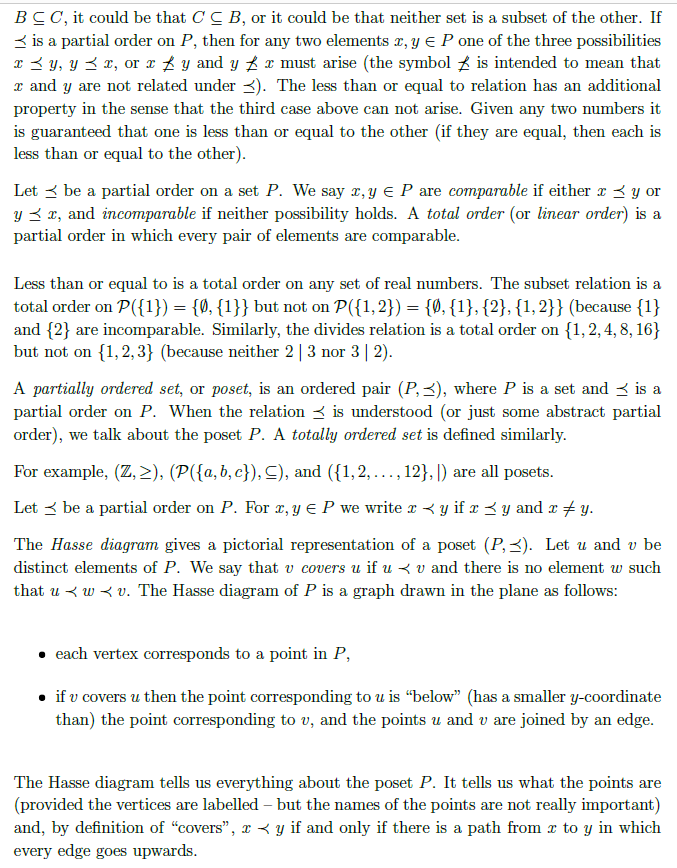
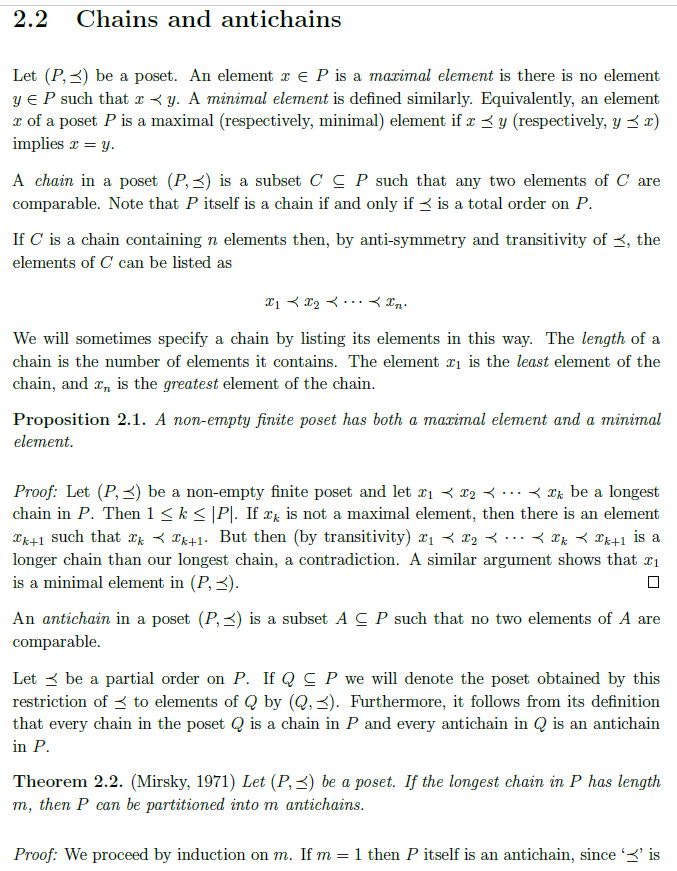
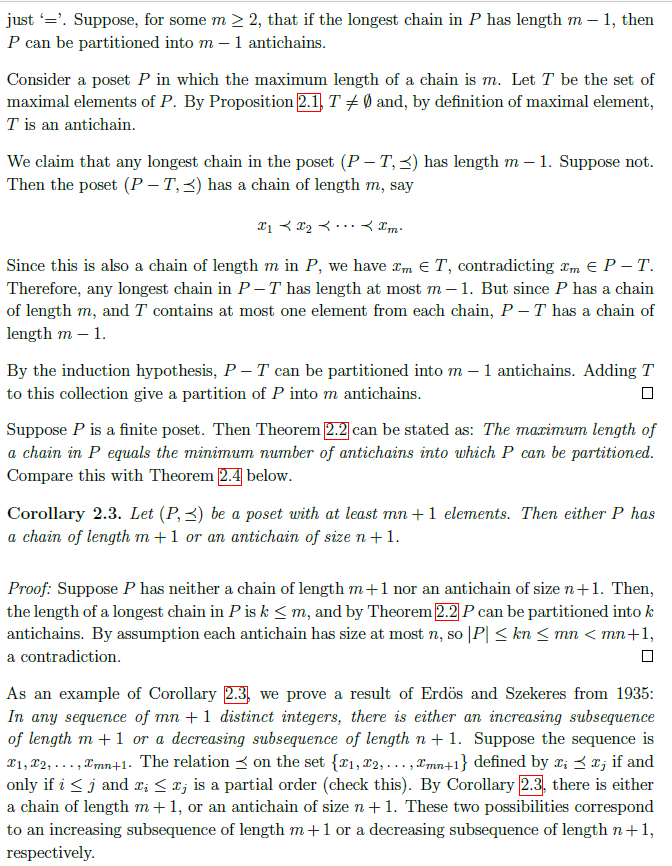
4. (4 marks) Is it true that in any finite poset? every longest Chain contains an element of every largest antichain'? Justify your answer. .5. Let X be a set With lXI : 71.. (a) (1 mark) How many longest Chains are there in (73(X), g)? [No justication required.) (b) (2 marks) Find a partition of (73(X) g) into |X| + 1 antiehains. [No justication re quired.) (C) (2 marks) Given any set A E X (t)? how many longest Chains of (73(X), Q) contain A? (d) (3 marks) Let A be an antichain in ('P(X), g)? and let at denote the number of elements of A of size t. Prove that n 71 Z at t!(-n t)! S n! or, equivalently, Z (:t g 1. t:0 k:0 (If) 6. (Bonus 3 marks) Prove that (73([n.]), g) can be partitioned into (lgl) Chains. 2 2.1 Posets A relation _ on P is called a partial order if it satisfies the three conditions: . (
Step by Step Solution
There are 3 Steps involved in it

Get step-by-step solutions from verified subject matter experts
 Study Help