







Question: Hi I ' m trying to undersand the classical method of control unit design through the book I ' m using, but I can't make
Hi Im trying to undersand the classical method of control unit design through the book Im using, but I can't make anything out of them such as its connection to the gcd processor presented on the figures please help!
I'll definitely upvote when you're able to help me understand it Thanks!Classical method. The major steps of the classical design method are as fol
lows:
Construct a row state table that defines the desired inputoutput behavior.
Select the minimum number of Dtype flipflops and assign a bit binary
code to each state.
Design a combinational circuit that generates the primary output signals
and the secondary outputs that must be applied to the flipflops.
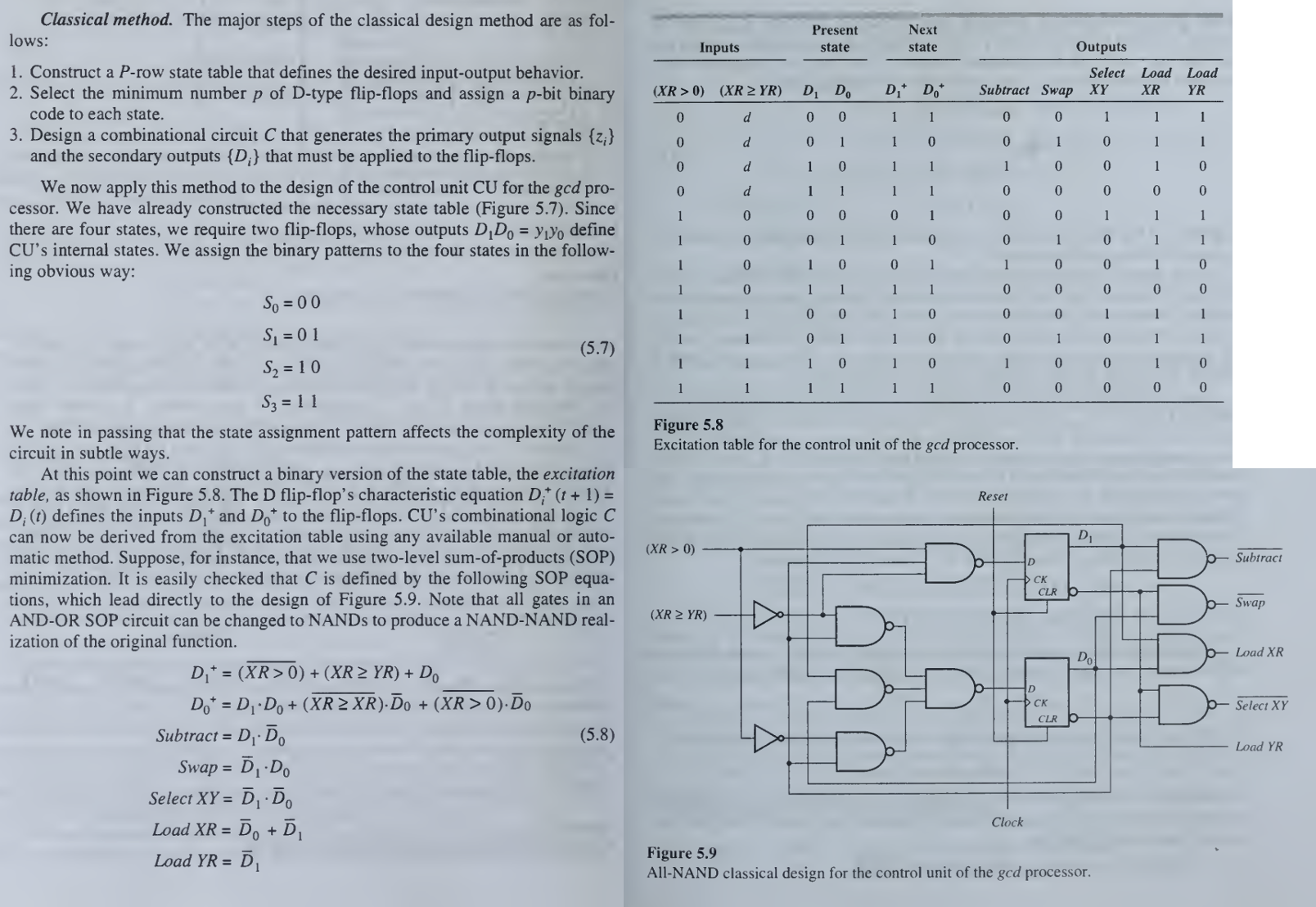
We now apply this method to the design of the control unit CU for the pro
cessor. We have already constructed the necessary state table Figure Since
there are four states, we require two flipflops, whose outputs define
CU's internal states. We assign the binary patterns to the four states in the follow
ing obvious way:
We note in passing that the state assignment pattern affects the complexity of the
circuit in subtle ways.
At this point we can construct a binary version of the state table, the excitation
table, as shown in Figure The D flipflop's characteristic equation
defines the inputs and to the flipflops. CU's combinational logic
can now be derived from the excitation table using any available manual or auto
matic method. Suppose, for instance, that we use twolevel sumofproducts SOP
minimization. It is easily checked that is defined by the following SOP equa
tions, which lead directly to the design of Figure Note that all gates in an
ANDOR SOP circuit can be changed to NANDs to produce a NANDNAND real
ization of the original function.
Subtract
Swap
Select
Load
Load
Figure
Excitation table for the control unit of the processor.
Subtract
Swap
Select
Load
Load
Step by Step Solution
There are 3 Steps involved in it
1 Expert Approved Answer
Step: 1 Unlock

Question Has Been Solved by an Expert!
Get step-by-step solutions from verified subject matter experts
Step: 2 Unlock
Step: 3 Unlock
 Study Help