







Question: hi i need help on this question. please no excel. Thank you! Innovation Company is thinking about marketing a new software product. Upfront costs to
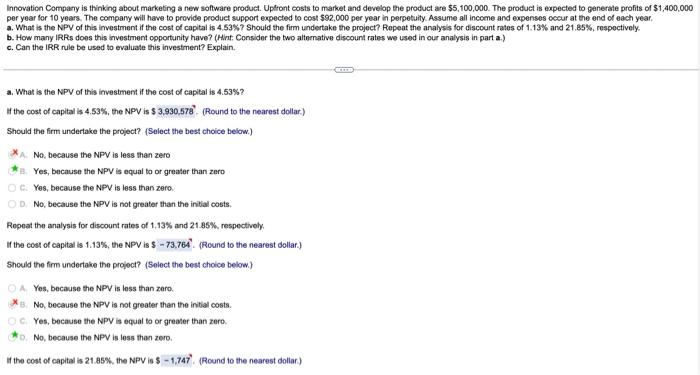
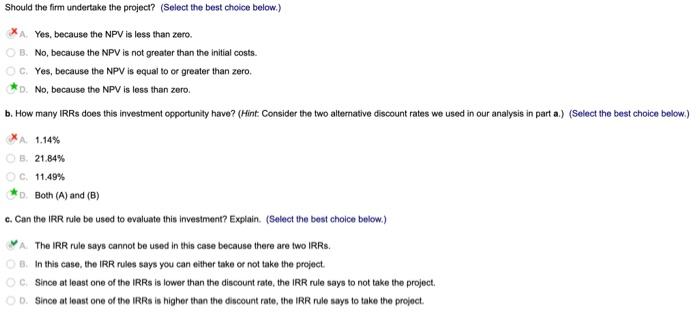
Innovation Company is thinking about marketing a new software product. Upfront costs to market and develop the product are $5,100,000. The product is expected to generale profits of $1,400,000 per year for 10 years. The company will have to provide product suppert expected to cost $92,000 per year in perpetuity. Assume all income and expenses cecur at the end of each year. a. What is the NPV of this imvestment if the cost of capital is 4.53% ? Should the firm undertake the project? Riepeat the analysis for discount rates of 1.13% and 21.85%, respectively. b. How many IRRs does this investment opportunity have? (Hint, Consider the two altemative discount rates we used in our analysis in part a.) c. Can the IRR rule be used to evaluate this investment? Explain. a. What is the NPV of this investment if the cost capital is 4.53% ? It the cost of capital is 4.53\%, the NPV is $3,930,578. (Round to the nearest dollar.) Should the firm undertake the project? (Select the best choice below.) A. No, because the NPV is less than zero B. Yes, because the NPV is equal to or greater than zero C. Yes, because the NPV is less than zero. D. No, because the NPV is not greater than the initial costs. Repeat the analysis for discount rates of 1,13% and 21.85%, respectively. If the cost of capital is 1.13%, the NPV is ? (Round to the nearest dollar.) Should the firm undertake the project? (Select the best choice below.) A. Yes, because the NPV is less than zero. B. No, because the NPV is not greater than the initial costs. C. Yes, because the NPV is equal to or greater than zero. D. No, because the NPV is less than zero. If the cost of capital is 21.85\%, the NPV is $1,747, (Round to the nearest dollar) Should the firm undertake the project? (Select the best choice below.) A. Yes, because the NPV is less than zero. B. No, because the NPV is not greater than the initial costs. C. Yes, because the NPV is equal to or greater than zero. D. No, because the NPV is less than zero. b. How many IRRs does this investment opportunity have? (Hint: Consider the two alternative discount rates we used in our analysis in part a.) (Select the best choice below.) A. 1.14% B. 21.84% C. 11.49% D. Both(A) and (B) c. Can the IRR rule be used to evaluate this investment? Explain. (Select the best choice below.) A. The IRR rule says cannot be used in this case because there are two IRRs. B. In this case, the IRR rules says you can either take or not take the project. C. Since at least one of the IRRs is lower than the discount rate, the IRR rule says to not take the project. D. Since at least one of the IRRs is higher than the discount rate, the IRR rule says to take the project
Step by Step Solution
There are 3 Steps involved in it

Get step-by-step solutions from verified subject matter experts
 Study Help