







Question: Hi, I need help, understanding how a Youtuber can create Creative Value like Todd Ziegler did with the Disney example and apple. How can someone
Hi,
I need help, understanding how a Youtuber can create Creative Value like Todd Ziegler did with the Disney example and apple.
How can someone on youtube, (influencer on youtube) created value beyond posting videos and merchandize, sponsorships or royalty... what other ways can a youtuber create value following the Theory of your Firm by Todd Ziegler. Can you please include references that I can use on my research?
I would also love a more simple explanation on the 3 sights
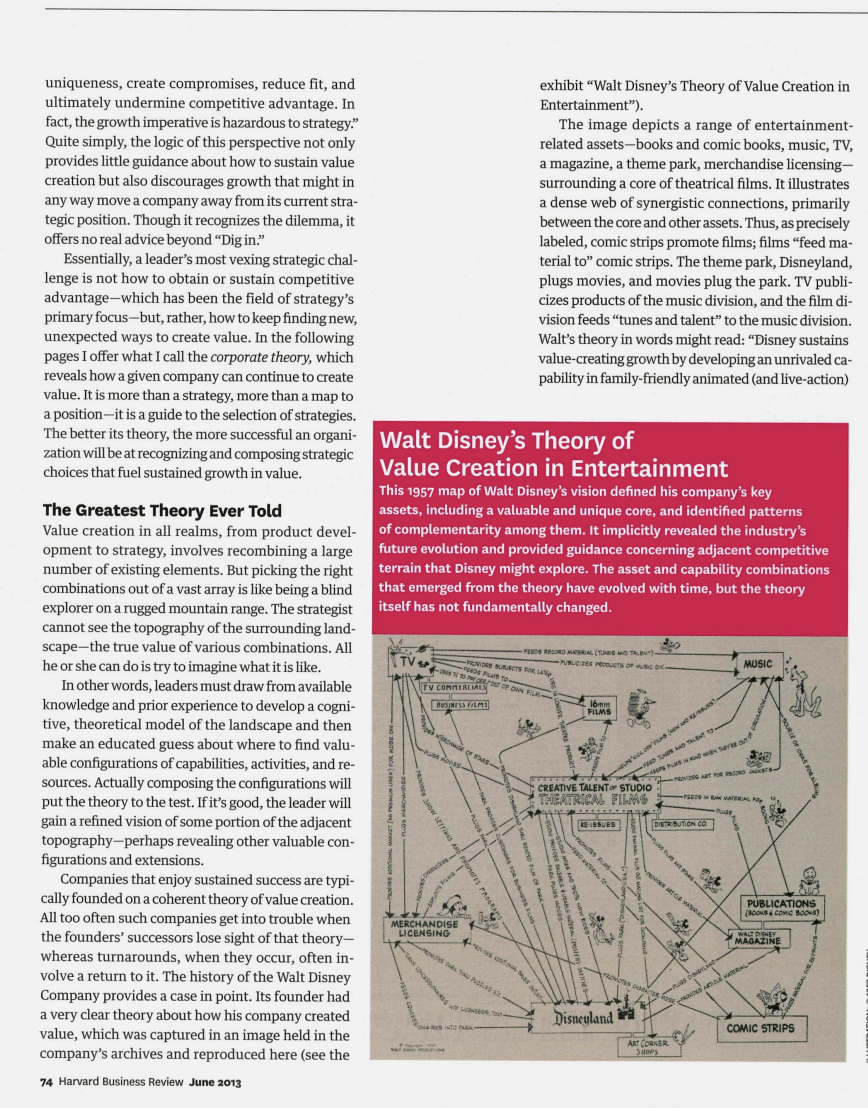
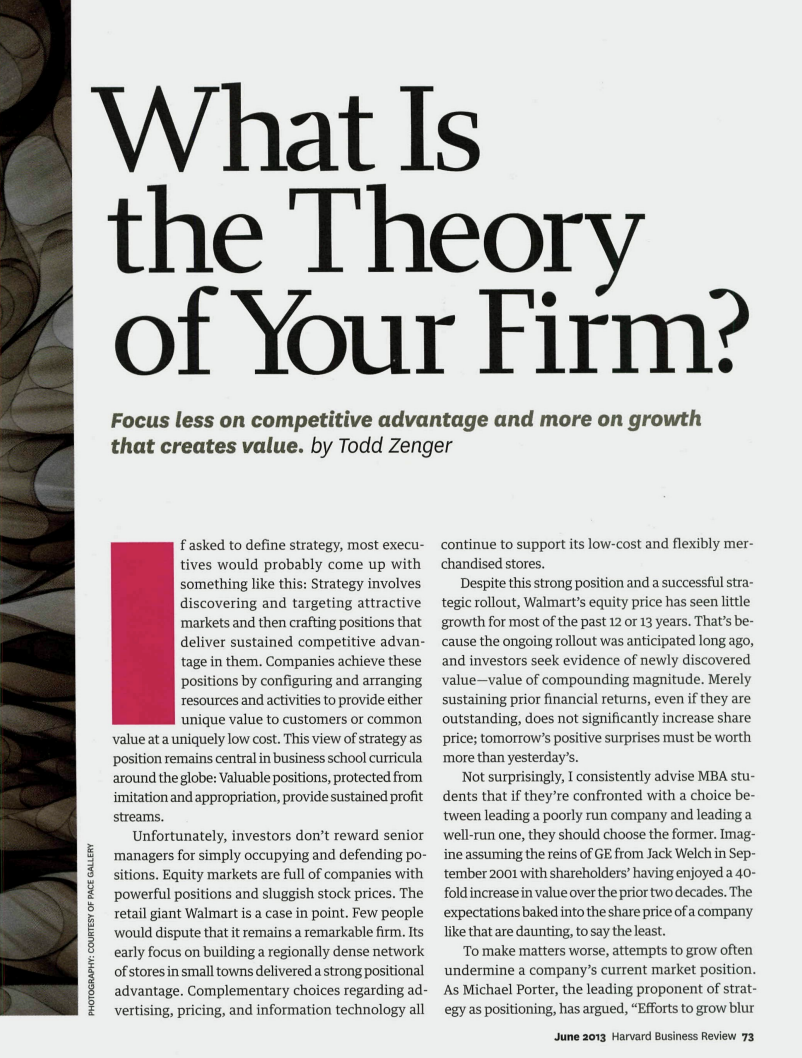
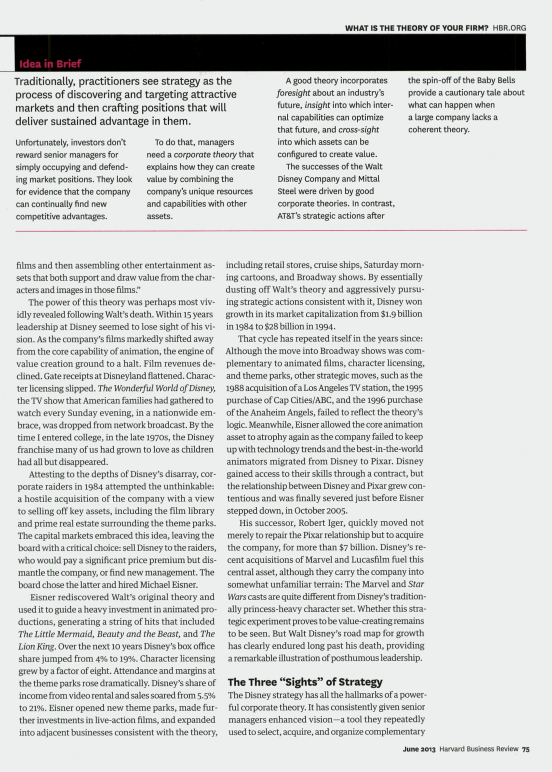
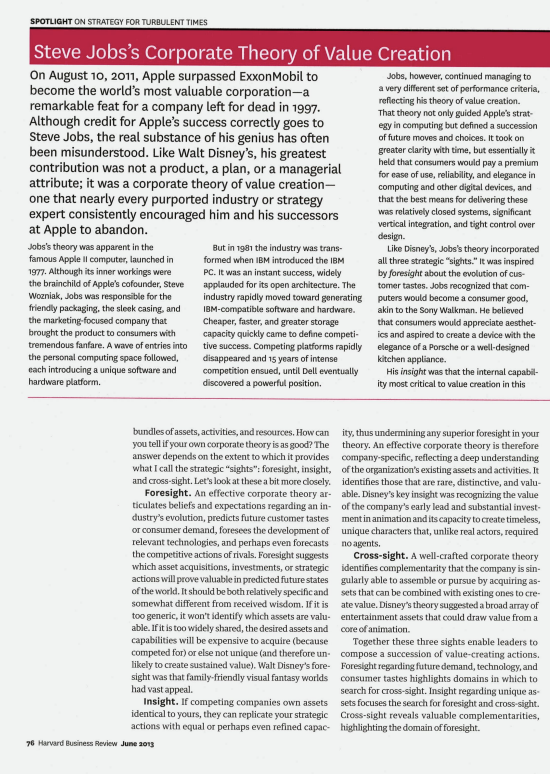
uniqueness, create compromises, reduce fit, and exhibit "Walt Disney's Theory of Value Creation in ultimately undermine competitive advantage. In Entertainment"). fact, the growth imperative is hazardous to strategy." The image depicts a range of entertainment- Quite simply, the logic of this perspective not only related assets-books and comic books, music, TV, provides little guidance about how to sustain value a magazine, a theme park, merchandise licensing- creation but also discourages growth that might in surrounding a core of theatrical films. It illustrates any way move a company away from its current stra- a dense web of synergistic connections, primarily tegic position. Though it recognizes the dilemma, it between the core and other assets. Thus, as precisely offers no real advice beyond "Dig in." labeled, comic strips promote films; films "feed ma- Essentially, a leader's most vexing strategic chal- terial to" comic strips. The theme park, Disneyland, lenge is not how to obtain or sustain competitive plugs movies, and movies plug the park. TV publi- advantage-which has been the field of strategy's cizes products of the music division, and the film di- primary focus-but, rather, how to keep finding new, vision feeds "tunes and talent" to the music division. unexpected ways to create value. In the following Walt's theory in words might read: "Disney sustains pages I offer what I call the corporate theory, which value-creating growth by developing an unrivaled ca- reveals how a given company can continue to create pability in family-friendly animated (and live-action) value. It is more than a strategy, more than a map to a position-it is a guide to the selection of strategies. The better its theory, the more successful an organi- zation will be at recognizing and composing strategic Walt Disney's Theory of choices that fuel sustained growth in value. Value Creation in Entertainment This 1957 map of Walt Disney's vision defined his company's key The Greatest Theory Ever Told assets, including a valuable and unique core, and identified patterns Value creation in all realms, from product devel of complementarity among them. It implicitly revealed the industry's opment to strategy, involves recombining a large future evolution and provided guidance concerning adjacent competitive number of existing elements. But picking the right terrain that Disney might explore. The asset and capability combinations combinations out of a vast array is like being a blind that emerged from the theory have evolved with time, but the theory explorer on a rugged mountain range. The strategist itself has not fundamentally changed. cannot see the topography of the surrounding land- scape-the true value of various combinations. All - FEEDS RECORD MATERIAL (TLINES AND TALENT) he or she can do is try to imagine what it is like. MOSS SUBJECTS FOR LAMP - PUBLICITES PRODUCTS OF PURE BY MUSIC In other words, leaders must draw from available TV COMMERCIALS DST OF OWN FILM knowledge and prior experience to develop a cogni- BUSINESS FILMS FILMS tive, theoretical model of the landscape and then make an educated guess about where to find valu- able configurations of capabilities, activities, and re- sources. Actually composing the configurations will CREATIVE TALENT OF STUDIO put the theory to the test. If it's good, the leader will THEATRICAL FILMS gain a refined vision of some portion of the adjacent BE 19 SUES DISTR BUTION CO. topography-perhaps revealing other valuable con- figurations and extensions. Companies that enjoy sustained success are typi- cally founded on a coherent theory of value creation. PUBLICATIONS All too often such companies get into trouble when MERCHANDISE the founders' successors lose sight of that theory- LICENSING MAGAZINE whereas turnarounds, when they occur, often in- volve a return to it. The history of the Walt Disney Company provides a case in point. Its founder had a very clear theory about how his company created Disneyland id COMIC STRIPS value, which was captured in an image held in the ART CORNER company's archives and reproduced here (see the 74 Harvard Business Review June 2013What Is the Theory of Your Firm? Focus less on competitive advantage and more on growth that creates value. by Todd Zenger f asked to define strategy, most execu- continue to support its low-cost and flexibly mer- tives would probably come up with chandised stores. something like this: Strategy involves Despite this strong position and a successful stra- discovering and targeting attractive tegic rollout, Walmart's equity price has seen little markets and then crafting positions that growth for most of the past 12 or 13 years. That's be- deliver sustained competitive advan- cause the ongoing rollout was anticipated long ago, tage in them. Companies achieve these and investors seek evidence of newly discovered positions by configuring and arranging value-value of compounding magnitude. Merely resources and activities to provide either sustaining prior financial returns, even if they are unique value to customers or common outstanding, does not significantly increase share value at a uniquely low cost. This view of strategy as price; tomorrow's positive surprises must be worth position remains central in business school curricula more than yesterday's. around the globe: Valuable positions, protected from Not surprisingly, I consistently advise MBA stu- imitation and appropriation, provide sustained profit dents that if they're confronted with a choice be- streams. tween leading a poorly run company and leading a Unfortunately, investors don't reward senior well-run one, they should choose the former. Imag- managers for simply occupying and defending po- ine assuming the reins of GE from Jack Welch in Sep- sitions. Equity markets are full of companies with tember 2001 with shareholders' having enjoyed a 40- powerful positions and sluggish stock prices. The fold increase in value over the prior two decades. The retail giant Walmart is a case in point. Few people expectations baked into the share price of a company PHOTOGRAPHY: COURTESY OF PACE GALLERY would dispute that it remains a remarkable firm. Its like that are daunting, to say the least. early focus on building a regionally dense network To make matters worse, attempts to grow often of stores in small towns delivered a strong positional undermine a company's current market position. advantage. Complementary choices regarding ad- As Michael Porter, the leading proponent of strat- vertising, pricing, and information technology all egy as positioning, has argued, "Efforts to grow blur June 2013 Harvard Business Review 73WHAT IS THE THEORY OF YOUR FIRM? HER.ORG Idea in Brief Traditionally, practitioners see strategy as the A good theory incorporates the spin-off of the Baby Bells process of discovering and targeting attractive foresight about an industry's provide a cautionary tale about markets and then crafting positions that will future, insight into which Inter- what can happen when deliver sustained advantage in them. nal capabilities can optimize a large company lacks a that future, and cross-sight coherent theory. Unfortunately, investors don't To do that, managers Into which assets can be reward senior managers for need a corporate theory that configured to create value. simply occupying and defend- explains how they can create The successes of the Walt ing market positions. They look value by combining the Disney Company and Mittal for evidence that the company company's unique resources Steel were driven by good can continually find new and capabilities with other corporate theories. In contrast, competitive advantages. assets. ATET's strategic actions after Films and then assembling other entertainment as- including retail stores, cruise ships, Saturday morn- sets that both support and draw value from the char- ing cartoons, and Broadway shows. By essentially acters and images in those films." dusting off Walt's theory and aggressively pursu- The power of this theory was perhaps most viv- ing strategic actions consistent with it, Disney won idly revealed following Walt's death. Within 15 years growth in its market capitalization from $1.9 billion leadership at Disney seemed to lose sight of his vi- in 1984 to $28 billion in 1994. sion. As the company's films markedly shifted away That cycle has repeated itself in the years since: from the core capability of animation, the engine of Although the move into Broadway shows was com- value creation ground to a halt. Film revenues de- plementary to animated films, character licensing, clined. Gate receipts at Disneyland flattened. Charac- and theme parks, other strategic moves, such as the ter licensing slipped. The Wonderful World of Disney, 1988 acquisition of a Los Angeles TV station, the 1995 the TV show that American families had gathered to purchase of Cap Cities/ABC, and the 1996 purchase watch every Sunday evening, in a nationwide em- of the Anaheim Angels, failed to reflect the theory's brace, was dropped from network broadcast. By the logic. Meanwhile, Eisner allowed the core animation time I entered college, in the late 1970s, the Disney asset to atrophy again as the company failed to keep franchise many of us had grown to love as children up with technology trends and the best-in-the-world had all but disappeared. animators migrated from Disney to Pixar. Disney Attesting to the depths of Disney's disarray, cor- gained access to their skills through a contract, but porate raiders in 1984 attempted the unthinkable: the relationship between Disney and Pixar grew con- a hostile acquisition of the company with a view tentious and was finally severed just before Eisner to selling off key assets, including the film library stepped down, in October 2005. and prime real estate surrounding the theme parks. His successor, Robert Iger, quickly moved not The capital markets embraced this idea, leaving the merely to repair the Pixar relationship but to acquire board with a critical choice: sell Disney to the raiders, the company, for more than $7 billion. Disney's re- who would pay a significant price premium but dis- cent acquisitions of Marvel and Lucasfilm fuel this mantle the company, or find new management. The central asset, although they carry the company into board chose the latter and hired Michael Eisner. somewhat unfamiliar terrain: The Marvel and Star Eisner rediscovered Walt's original theory and Wars casts are quite different from Disney's tradition- used it to guide a heavy investment in animated pro- ally princess-heavy character set. Whether this stra- ductions, generating a string of hits that included togic experiment proves to be value-creating remains The Little Mermaid, Beauty and the Beast, and The to be seen. But Walt Disney's road map for growth Lion King. Over the next 10 years Disney's box office has clearly endured long past his death, providing share jumped from 4% to 196. Character licensing a remarkable illustration of posthumous leadership. grew by a factor of eight. Attendance and margins at the theme parks rose dramatically. Disney's share of The Three "Sights" of Strategy income from video rental and sales soared from 5.5% The Disney strategy has all the hallmarks of a power- to 21%. Eisner opened new theme parks, made fur- ful corporate theory, It has consistently given senior ther investments in live-action films, and expanded managers enhanced vision-a tool they repeatedly into adjacent businesses consistent with the theory, used to select, acquire, and organize complementary June 3013 Harvard Business Review 75SPOTLIGHT ON STRATEGY FOR TURBULENT TIMES Steve Jobs's Corporate Theory of Value Creation On August 10, 2011, Apple surpassed ExxonMobil to Jobs, however, continued managing to become the world's most valuable corporation-a a very different set of performance criteria, remarkable feat for a company left for dead in 1997. reflecting his theory of value creation. That theory not only guided Apple's strat- Although credit for Apple's success correctly goes to egy in computing but defined a succession Steve Jobs, the real substance of his genius has often of future moves and choices. It took on been misunderstood. Like Walt Disney's, his greatest greater clarity with time, but essentially it contribution was not a product, a plan, or a managerial held that consumers would pay a premium for case of use, reliability, and elegance in attribute; it was a corporate theory of value creation- computing and other digital devices, and one that nearly every purported industry or strategy that the best means for delivering these expert consistently encouraged him and his successors was relatively closed systems, significant at Apple to abandon. vertical integration, and tight control over design. Jobs's theory was apparent in the But in 1981 the industry was trans- Like Disney's, Jobs's theory incorporated famous Apple Il computer, launched in formed when IBM introduced the IBM all three strategic "sights." It was inspired 1977. Although its inner workings were PC. It was an instant success, widely by foresight about the evolution of cus- the brainchild of Apple's cofounder, Steve applauded for its open architecture. The tomer tastes. Jobs recognized that com- Wozniak, Jobs was responsible for the industry rapidly moved toward generating puters would become a consumer good, friendly packaging, the sleek casing, and OM-compatible software and hardware. akin to the Sony Walkman. He believed the marketing-focused company that Cheaper, faster, and greater storage that consumers would appreciate aesthet brought the product to consumers with capacity quickly came to define competi- ics and aspired to create a device with the tremendous fanfare. A wave of entries into tive success. Competing platforms rapidly elegance of a Porsche or a well-designed the personal computing space followed, disappeared and 15 years of intense kitchen appliance. each introducing a unique software and competition ensued, until Dell eventually His insight was that the internal capabil hardware platform. discovered a powerful position. ity most critical to value creation in this bundles of assets, activities, and resources, How can ity, thus undermining any superior foresight in your you tell if your own corporate theory is as good? The theory. An effective corporate theory is therefore answer depends on the extent to which it provides company-specific, reflecting a deep understanding what I call the strategic "sights": foresight, insight, of the organization's existing assets and activities, It and cross-sight. Let's look at these a bit more closely. identifies those that are rare, distinctive, and valu- Foresight. An effective corporate theory ar- able. Disney's key insight was recognizing the value ticulates beliefs and expectations regarding an in- of the company's early lead and substantial invest- dustry's evolution, predicts future customer tastes ment in animation and its capacity to create timeless, or consumer demand, foresees the development of unique characters that, unlike real actors, required relevant technologies, and perhaps even forecasts noagents, the competitive actions of rivals. Foresight suggests Cross-sight. A well-crafted corporate theory which asset acquisitions, investments, or strategic identifies complementarity that the company is sin- actions will prove valuable in predicted future states gularly able to assemble or pursue by acquiring as- of the world. It should be both relatively specific and sets that can be combined with existing ones to cre- somewhat different from received wisdom. If it is ate value. Disney's theory suggested a broad array of too generic, it won't identify which assets are valu- entertainment assets that could draw value from a able. If it is too widely shared, the desired assets and core of animation. capabilities will be expensive to acquire (because Together these three sights enable leaders to competed for) or else not unique (and therefore un- compose a succession of value-creating actions. likely to create sustained value). Walt Disney's fore- Foresight regarding future demand, technology, and sight was that family-friendly visual fantasy worlds consumer tastes highlights domains in which to had vast appeal. search for cross-sight. Insight regarding unique as- Insight. If competing companies own assets sets focuses the search for foresight and cross-sight. identical to yours, they can replicate your strategic Cross-sight reveals valuable complementarities, actions with equal or perhaps even refined capac- highlighting the domain of foresight. 76 Harvard Business Review June 3013
Step by Step Solution
There are 3 Steps involved in it

Get step-by-step solutions from verified subject matter experts
 Study Help