Question: Hi, I need help with linear algebra question. Thanks. Problem 3. The Matrix Exponential: Algebraic Properties Recall that for a scalar a E R, we
Hi, I need help with linear algebra question. Thanks.
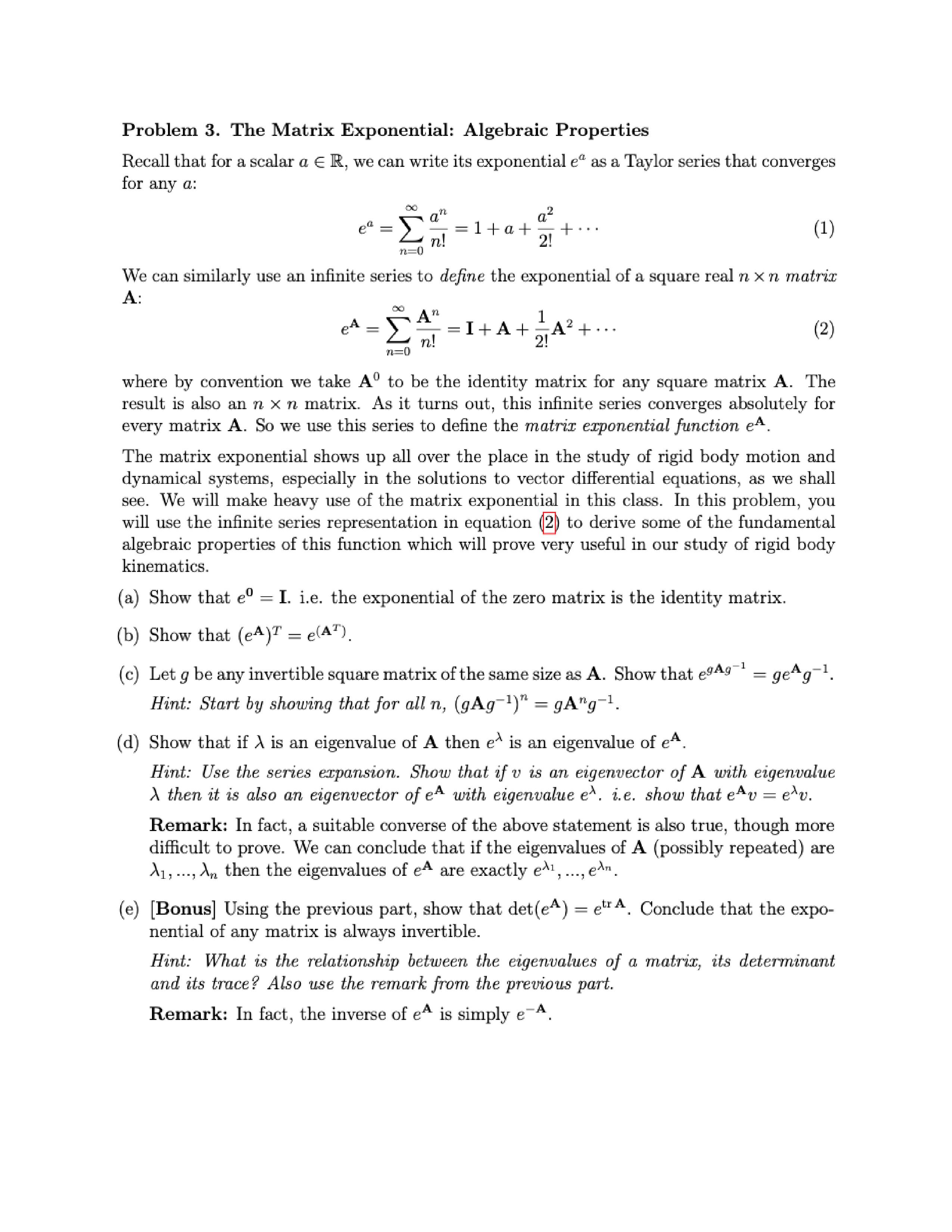
Problem 3. The Matrix Exponential: Algebraic Properties Recall that for a scalar a E R, we can write its exponential e" as a Taylor series that converges for any a: e Q = = 1+a+ 2! + ... (1) 1= 0 n! We can similarly use an infinite series to define the exponential of a square real n x n matrix A: eA : An n! T = ItA+ JA' + ... (2) where by convention we take A" to be the identity matrix for any square matrix A. The result is also an n x n matrix. As it turns out, this infinite series converges absolutely for every matrix A. So we use this series to define the matrix exponential function ed The matrix exponential shows up all over the place in the study of rigid body motion and dynamical systems, especially in the solutions to vector differential equations, as we shall see. We will make heavy use of the matrix exponential in this class. In this problem, you will use the infinite series representation in equation (2) to derive some of the fundamental algebraic properties of this function which will prove very useful in our study of rigid body kinematics. (a) Show that e = I. i.e. the exponential of the zero matrix is the identity matrix. (b) Show that (eA)T = e(AT). (c) Let g be any invertible square matrix of the same size as A. Show that egg = geg-1. Hint: Start by showing that for all n, (gAg-1)" = gAng-1 (d) Show that if A is an eigenvalue of A then ed is an eigenvalue of ed. Hint: Use the series expansion. Show that if v is an eigenvector of A with eigenvalue A then it is also an eigenvector of ed with eigenvalue ed. i.e. show that eau = exv. Remark: In fact, a suitable converse of the above statement is also true, though more difficult to prove. We can conclude that if the eigenvalues of A (possibly repeated) are 1, ..., An then the eigenvalues of ed are exactly edi, ..., ed. (e) [Bonus] Using the previous part, show that det(ed) = et A. Conclude that the expo- nential of any matrix is always invertible. Hint: What is the relationship between the eigenvalues of a matrix, its determinant and its trace? Also use the remark from the previous part. Remark: In fact, the inverse of ed is simply e-A
Step by Step Solution
There are 3 Steps involved in it
1 Expert Approved Answer
Step: 1 Unlock
Question Has Been Solved by an Expert!
Get step-by-step solutions from verified subject matter experts
Step: 2 Unlock
Step: 3 Unlock
Students Have Also Explored These Related Mathematics Questions!









 Study Help