Question: Hi, I only need question 2 a b and c 1. Suppose that a liquor distributor has an average known weekly demand of 10000 units
Hi, I only need question 2 a b and c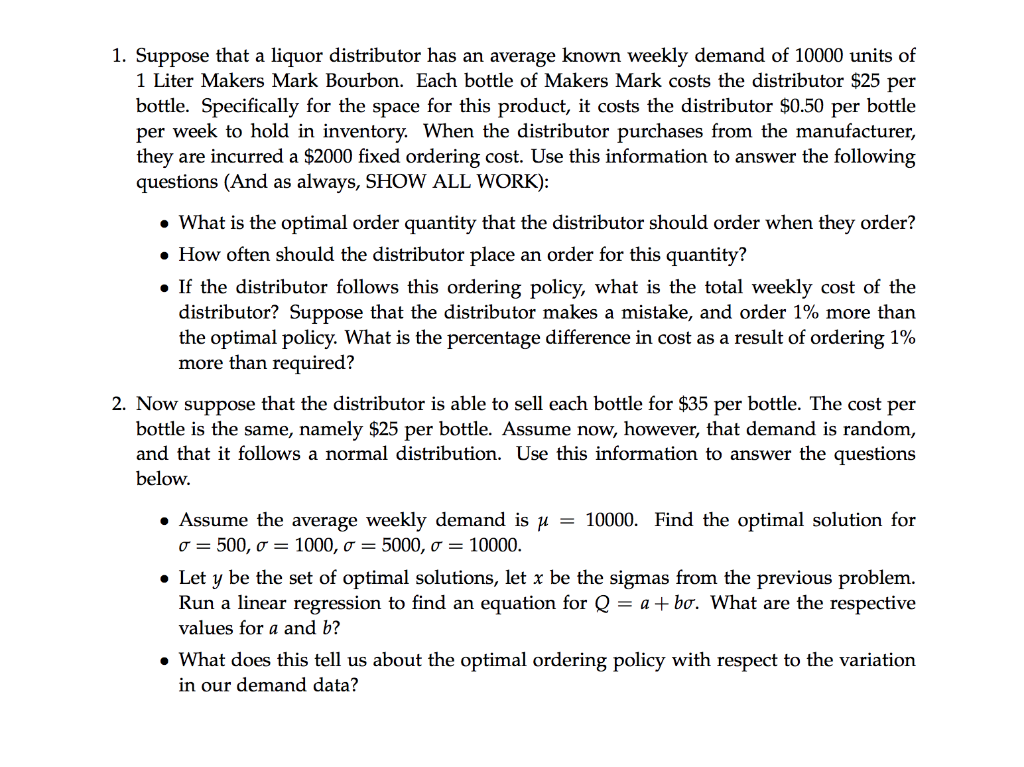
1. Suppose that a liquor distributor has an average known weekly demand of 10000 units of 1 Liter Makers Mark Bourbon. Each bottle of Makers Mark costs the distributor $25 per bottle. Specifically for the space for this product, it costs the distributor $0.50 per bottle per week to hold in inventory. When the distributor purchases from the manufacturer, they are incurred a $2000 fixed ordering cost. Use this information to answer the following questions (And as always, SHOW ALL WORK): What is the optimal order quantity that the distributor should order when they order? How often should the distributor place an order for this quantity? If the distributor follows this ordering policy, what is the total weekly cost of the distributor? Suppose that the distributor makes a mistake, and order 1% more than the optimal policy. What is the percentage difference in cost as a result of ordering 1% more than required? 2. Now suppose that the distributor is able to sell each bottle for $35 per bottle. The cost per bottle is the same, namely $25 per bottle. Assume now, however, that demand is random, and that it follows a normal distribution. Use this information to answer the questions below. Assume the average weekly demand is u = 10000. Find the optimal solution for 0 = 500,0 = 1000,0 = 5000,0 = 10000. Let y be the set of optimal solutions, let x be the sigmas from the previous problem. Run a linear regression to find an equation for Q = a +bo. What are the respective values for a and b? What does this tell us about the optimal ordering policy with respect to the variation in our demand data? 1. Suppose that a liquor distributor has an average known weekly demand of 10000 units of 1 Liter Makers Mark Bourbon. Each bottle of Makers Mark costs the distributor $25 per bottle. Specifically for the space for this product, it costs the distributor $0.50 per bottle per week to hold in inventory. When the distributor purchases from the manufacturer, they are incurred a $2000 fixed ordering cost. Use this information to answer the following questions (And as always, SHOW ALL WORK): What is the optimal order quantity that the distributor should order when they order? How often should the distributor place an order for this quantity? If the distributor follows this ordering policy, what is the total weekly cost of the distributor? Suppose that the distributor makes a mistake, and order 1% more than the optimal policy. What is the percentage difference in cost as a result of ordering 1% more than required? 2. Now suppose that the distributor is able to sell each bottle for $35 per bottle. The cost per bottle is the same, namely $25 per bottle. Assume now, however, that demand is random, and that it follows a normal distribution. Use this information to answer the questions below. Assume the average weekly demand is u = 10000. Find the optimal solution for 0 = 500,0 = 1000,0 = 5000,0 = 10000. Let y be the set of optimal solutions, let x be the sigmas from the previous problem. Run a linear regression to find an equation for Q = a +bo. What are the respective values for a and b? What does this tell us about the optimal ordering policy with respect to the variation in our demand data









 Study Help