



Question: Hi, I'm stuck at this question, please help me how to do it. Thank you 3. [18 points] We saw in class that applying Newton's
Hi, I'm stuck at this question, please help me how to do it. Thank you
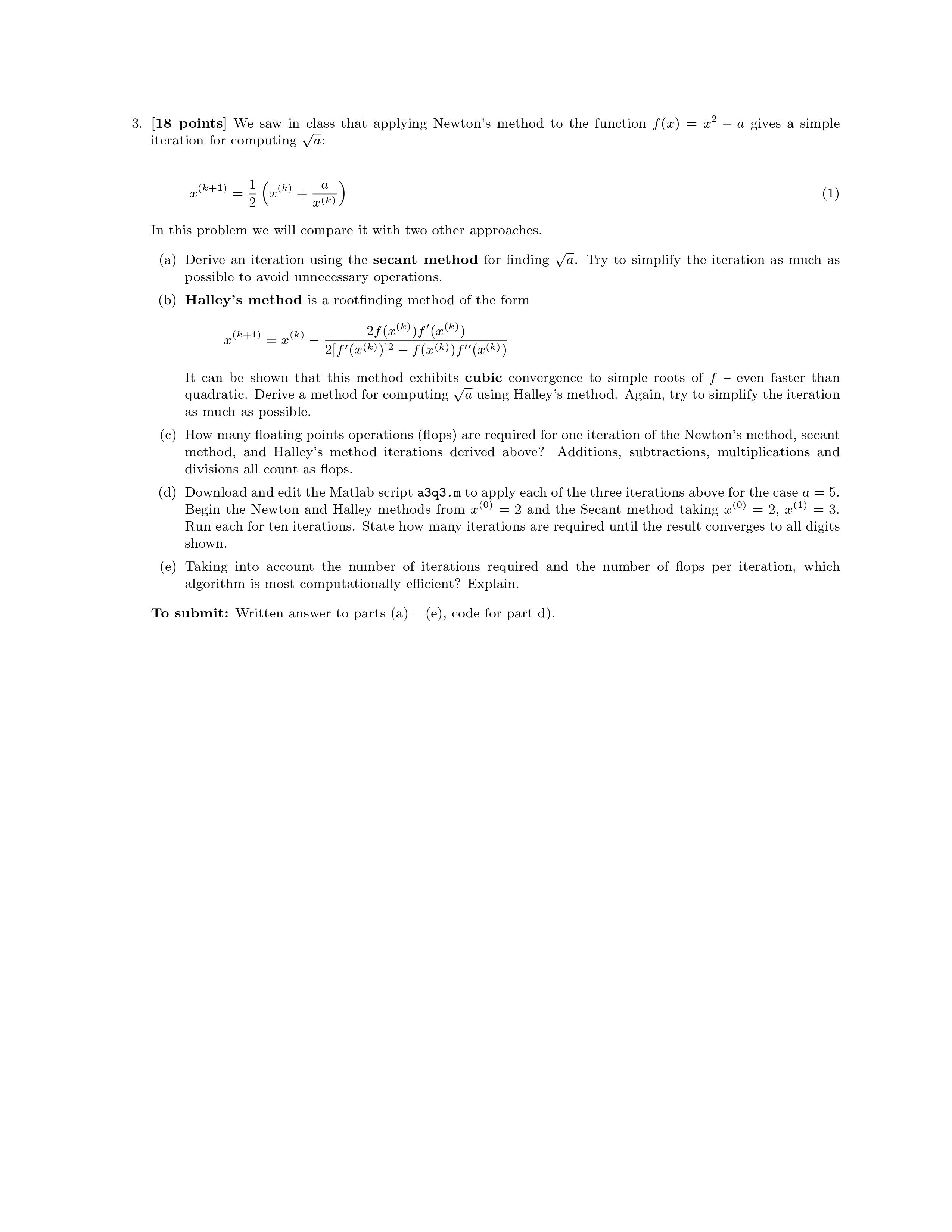
3. [18 points] We saw in class that applying Newton's method to the function f(x) = x2 - a gives a simple iteration for computing va: 20 ( k + 1 ) = ? ( 20 ( 10 ) + Choy ) (1) In this problem we will compare it with two other approaches. (a) Derive an iteration using the secant method for finding va. Try to simplify the iteration as much as possible to avoid unnecessary operations. (b) Halley's method is a rootfinding method of the form ac ( ki+1 ) = 20 ( k ) - 2f (a ()) f' ( 20 (k ) ) 2[f' ( 20 (10) ) 12 - f (20 ( k) ) f" ( 20 ( k ) ) It can be shown that this method exhibits cubic convergence to simple roots of f - even faster than quadratic. Derive a method for computing va using Halley's method. Again, try to simplify the iteration as much as possible. (c) How many floating points operations (flops) are required for one iteration of the Newton's method, secant method, and Halley's method iterations derived above? Additions, subtractions, multiplications and divisions all count as flops. (d) Download and edit the Matlab script a3q3.m to apply each of the three iterations above for the case a = 5. Begin the Newton and Halley methods from a = 2 and the Secant method taking a () = 2, x(1) = 3. Run each for ten iterations. State how many iterations are required until the result converges to all digits shown. (e) Taking into account the number of iterations required and the number of flops per iteration, which algorithm is most computationally efficient? Explain. To submit: Written answer to parts (a) - (e), code for part d)
Step by Step Solution
There are 3 Steps involved in it

Get step-by-step solutions from verified subject matter experts